Mastering the Waves: Real-World Sea Freight Tips from a Decade of Export Experience
Freight Experience
 27-Apr-2026
For global freight forwarders, navigating the complexities of sea freight export requires more than just industry knowledge—it demands proven Sea Freight Export Experience that translates to efficiency, cost savings, and client trust. Over a decade in the field, I’ve witnessed every challenge forwarders face, from volatile rates to compliance pitfalls, and refined strategies to turn obstacles into competitive advantages.
The global sea freight industry is a dynamic ecosystem, shaped by geopolitical shifts, supply chain disruptions, and evolving regulations. According to UNCTAD 2025 data, maritime transport carries over 82% of global trade by volume, a statistic that underscores the critical role of forwarders in keeping global commerce moving.
Yet, this responsibility brings immense pressure. Clients demand timely deliveries, transparent pricing, and efficient issue resolution, even amid unprecedented hurdles such as severe port congestion, surging fuel expenses, and frequent regulatory adjustments. This article consolidates ten years of practical sea freight export expertise into practical, implementable strategies, specially customized for international freight forwarding enterprises worldwide.
Whether you’re managing FCL (Full Container Load) or LCL (Less than Container Load) shipments, navigating hazardous goods regulations, or optimizing routes to cut costs, the insights here are designed to help you streamline operations, reduce risks, and deliver exceptional service to your clients. From pre-shipment preparation to post-delivery follow-up, every stage of the sea freight export process is covered, with real-world examples and data-backed strategies to ensure success.
What Makes Sea Freight Export Experience Indispensable for Global Forwarders?
Sea Freight Export Experience refers to the practical knowledge and hands-on expertise gained from managing end-to-end maritime export shipments, including navigating regulations, coordinating with carriers, and resolving unexpected disruptions. For forwarders, this experience is the difference between meeting client expectations and facing costly delays or penalties.
In an industry where even minor mistakes can lead to significant financial losses—such as a misdeclared cargo item resulting in a $30,000 fine (as seen in a 2024 Shanghai Maritime Court case)—experience is your most valuable asset. Forwarders with deep Sea Freight Export Experience can anticipate challenges before they arise, negotiate better rates with carriers, and provide clients with accurate timelines and cost estimates, all of which build long-term trust and loyalty.
According to Freightos Baltic Index (FBX) 2025 Q1 data, the average global sea freight rate fluctuated by 38% between January and December 2024, highlighting the need for forwarders to leverage experience to adapt to market volatility. Those without this experience often struggle to navigate rate changes, leading to lost profits or dissatisfied clients.
Conversely, forwarders with a decade of experience can identify rate trends, lock in favorable contracts, and pass savings on to their clients—creating a competitive edge in a crowded market.
How to Master Pre-Shipment Preparation: Avoid Costly Mistakes
Pre-shipment preparation is the foundation of a successful sea freight export, as it sets the stage for every subsequent step in the process. This phase involves verifying cargo details, preparing documentation, and ensuring compliance with both origin and destination country regulations.
A common mistake is rushing through pre-shipment checks, which often leads to errors in documentation or cargo misdeclaration. For example, a freight forwarder in 2024 mistakenly declared a UN number 1760 (hazardous goods) as 1780, resulting in the cargo being denied boarding and a $30,000 fine from the carrier (Shanghai Maritime Court, 2024). This mistake could have been avoided with thorough pre-shipment verification—a cornerstone of seasoned Sea Freight Export Experience.
What Documentation Do Forwarders Need to Prepare?
Proper documentation is non-negotiable in sea freight export, as it ensures compliance with customs regulations and facilitates smooth cargo movement. The exact documents required vary by country and cargo type, but there are core documents every forwarder must prepare.
• Commercial Invoice: A detailed document that includes cargo description, quantity, value, and terms of sale. Forwarders should note that this document must match the information on the bill of lading and packing list to avoid customs delays.
• Bill of Lading (B/L): The most critical document in sea freight, serving as a receipt for the cargo, a contract of carriage, and a document of title. The recommended approach is to verify all details on the B/L—including consignee information, port of discharge, and cargo description—before submitting it to the carrier, as errors can cost $500 or more per correction (China Water Transport Network, 2024).
• Packing List: A document that details the contents of each package, including weight, volume, and packaging type. This helps customs officials inspect cargo efficiently and ensures the cargo matches the description on the invoice and B/L.
• Certificate of Origin (CO): A document that certifies the country where the cargo was manufactured, which may be required for tariff exemptions or compliance with trade agreements. Forwarders should confirm whether the destination country requires a CO and which type (e.g., Form A, Form B) is needed.
• VGM (Verified Gross Mass): A mandatory document that declares the total weight of the container, including cargo, packaging, and the container itself. According to SOLAS (International Convention for the Safety of Life at Sea) regulations, “NO VGM, NO LOAD” policies are enforced by all major ports, meaning cargo without a valid VGM will not be loaded onto the vessel (International Maritime Organization, 2024).
How to Verify Cargo Details to Prevent Disruptions?
Verifying cargo details is a critical step in pre-shipment preparation, as discrepancies can lead to customs holds, carrier penalties, or even cargo rejection. Forwarders must cross-check every detail to ensure accuracy and compliance.
• Confirm Cargo Description: Ensure the cargo description is accurate and specific, avoiding vague terms like “general merchandise.” A common mistake is using overly broad descriptions, which can trigger customs inspections and delays. For example, describing a shipment as “electronics” instead of “100 units of wireless headphones (Model XYZ)” increases the risk of inspection.
• Verify Weight and Volume: Use calibrated scales to confirm the cargo’s weight and calculate volume accurately. According to VGM regulations, the declared weight must be within ±5% or 1 ton (whichever is smaller) of the actual weight. A shipment with a declared weight of 34.5 tons and an actual weight of 36 tons is acceptable (4.17% deviation), but a shipment with a declared weight of 12.2 tons and an actual weight of 13 tons is also acceptable (0.8-ton deviation, under 1 ton) (International Maritime Organization, 2024).
• Check for Hazardous Goods: If the cargo is hazardous, ensure it is classified correctly per the IMDG Code (International Maritime Dangerous Goods Code), and all required documentation (e.g., MSDS, dangerous goods declaration) is prepared. Forwarders should note that misclassifying hazardous goods can result in fines of up to $100,000 and criminal liability in some countries.
• Confirm Destination Regulations: Research the destination country’s customs regulations, including prohibited items, import duties, and documentation requirements. For example, some countries require additional permits for food, pharmaceuticals, or electronics, and failing to obtain these permits can lead to cargo seizure.
How to Navigate Carrier Relationships for Better Rates and Service?
Carrier relationships are a key component of successful Sea Freight Export Experience, as they directly impact pricing, capacity, and service quality. Forwarders who build strong relationships with carriers can secure better rates, priority capacity, and faster resolution of issues.
The global carrier market is dominated by a few major players, including Maersk, MSC, CMA CGM, and Hapag-Lloyd, which control over 65% of global container capacity (UNCTAD, 2025). For forwarders, navigating these relationships requires a combination of negotiation skills, market knowledge, and consistent communication.
What Factors Should Forwarders Consider When Choosing a Carrier?
Choosing the right carrier is critical to ensuring on-time deliveries and cost-effective shipments. Forwarders must evaluate multiple factors to select a carrier that aligns with their clients’ needs and their own business goals.
• Route Coverage: Ensure the carrier offers service to the destination port and has a reliable schedule. For example, if your client needs cargo delivered to St. Petersburg, Russia, confirm the carrier serves the Russian port (not the U.S. port of the same name) to avoid costly misdeliveries (China Water Transport Network, 2024).
• Rate Competitiveness: Compare rates from multiple carriers, but avoid choosing the cheapest option without considering service quality. According to Drewry 2025 Q1 data, carriers are increasing rates on key routes—Asia to Northern Europe rates have risen to $5,200 per 40ft container (Hapag-Lloyd, 2025)—so forwarders must balance cost with reliability.
• Capacity and Availability: During peak seasons (e.g., holiday periods, Chinese New Year), capacity can be limited. Forwarders with strong carrier relationships can secure priority booking, while those without may struggle to find space. According to the Shanghai Shipping Exchange 2025 Q1 data, China’s export container freight index rose by 5.8% in a single week in March 2025, driven by increased demand and limited capacity.
• Service Quality: Evaluate the carrier’s on-time performance, customer service, and ability to resolve issues. According to UNCTAD 2024 data, the average on-time performance of global carriers was 70% in 2024, so choosing a carrier with a higher on-time rate (e.g., 80% or above) can reduce delays for your clients.
• Additional Services: Consider whether the carrier offers value-added services, such as door-to-door delivery, warehousing, or customs clearance. These services can help forwarders streamline operations and offer more comprehensive solutions to their clients.
How to Negotiate Better Rates with Carriers?
Negotiating better rates with carriers is a skill that comes with Sea Freight Export Experience, as it requires understanding market trends, leveraging volume, and building trust. Forwarders who negotiate effectively can reduce costs and pass savings on to their clients, improving client retention.
• Leverage Volume: Carriers are more likely to offer discounted rates to forwarders who provide consistent volume. The recommended approach is to consolidate shipments from multiple clients to increase your total volume, which gives you more bargaining power. For example, a forwarder who ships 500 TEUs (Twenty-Foot Equivalent Units) per month is more likely to secure a 10–15% discount than one who ships 50 TEUs per month.
• Sign Long-Term Contracts: Long-term contracts (e.g., 1–2 years) provide carriers with predictable volume, which they reward with lower rates. Forwarders should note that these contracts often include minimum volume commitments, so ensure you can meet these commitments before signing.
• Negotiate Value-Added Incentives: In addition to lower rates, negotiate value-added incentives such as free storage, priority booking, or waived fees (e.g., demurrage, detention). These incentives can reduce overall costs and improve service quality for your clients.
• Stay Informed About Market Trends: Monitor freight rate trends using sources like the FBX and Shanghai Shipping Exchange to understand when rates are likely to rise or fall. Negotiating rates during periods of low demand (e.g., Q1, excluding Chinese New Year) can result in better terms.
• Build Personal Relationships: Develop relationships with carrier account managers, as personal connections can lead to better rates and faster resolution of issues. Regular communication, including face-to-face meetings when possible, helps build trust and ensures your needs are prioritized.
How to Manage Port Congestion and Avoid Delays?
Port congestion is a persistent challenge in sea freight export, causing delays, increased costs, and client dissatisfaction. According to UNCTAD 2025 Q1 data, the average waiting time for vessels at major ports worldwide was 2.9 days in 2024, with some ports (e.g., Los Angeles, Shanghai) experiencing waiting times of up to 6.5 days during peak periods.
Forwarders with Sea Freight Export Experience know how to anticipate congestion, adjust plans accordingly, and minimize its impact on their clients’ shipments. By understanding the root causes of congestion and implementing proactive strategies, you can keep your shipments on track.
What Are the Main Causes of Port Congestion?
Port congestion is caused by a combination of factors, including increased cargo volume, labor shortages, infrastructure limitations, and supply chain disruptions. Understanding these causes helps forwarders anticipate congestion and take preventive action.
• Increased Cargo Volume: Global trade recovery has led to a surge in cargo volume, overwhelming port infrastructure. According to WTO 2025 data, global merchandise trade volume increased by 4.1% in 2024, putting pressure on ports worldwide.
• Labor Shortages: Many ports face labor shortages due to retirements, pandemic-related absences, and difficulty recruiting new workers. For example, the Port of Los Angeles experienced a labor strike in 2024, leading to a 38% reduction in throughput and significant congestion.
• Infrastructure Limitations: Older ports often lack the infrastructure to handle large container ships (e.g., post-Panamax vessels), leading to delays in loading and unloading. According to Ningbo-Zhoushan Port 2024 annual report, the port handled over 1.4 billion tonnes of cargo in 2024, ranking first globally, but still faces infrastructure challenges during peak periods.
• Supply Chain Disruptions: Events like the Red Sea crisis (2023–2025) have forced carriers to reroute vessels, increasing transit times and putting additional pressure on alternative ports. This rerouting has led to congestion at ports like Cape Town and Durban, as vessels divert from the Red Sea route.
How to Minimize the Impact of Port Congestion?
Minimizing the impact of port congestion requires proactive planning, flexibility, and leveraging Sea Freight Export Experience to adjust strategies as needed. Forwarders can implement the following tips to keep shipments on track:
• Choose Alternative Ports: If the primary port is congested, consider using an alternative port and arranging inland transportation to the final destination. For example, if the Port of Shanghai is congested, use the Port of Ningbo-Zhoushan and transport cargo by truck to Shanghai.
• Book Early: During peak seasons, book shipments well in advance (e.g., 4–6 weeks) to secure space and avoid last-minute delays. The recommended approach is to work with clients to plan shipments ahead of time, especially for time-sensitive cargo.
• Monitor Port Status: Use port tracking tools to monitor congestion levels, waiting times, and berthing schedules. Many ports (e.g., Los Angeles, Singapore) provide real-time data on their websites, allowing forwarders to adjust plans accordingly.
• Optimize Loading and Unloading Times: Coordinate with carriers and port authorities to schedule loading and unloading during off-peak hours (e.g., nights, weekends) to reduce waiting times. Forwarders should note that this may require additional planning but can significantly reduce delays.
• Communicate Proactively with Clients: Keep clients informed about port congestion and any potential delays, providing regular updates on shipment status. Transparent communication helps manage client expectations and builds trust, even when delays occur.
How to Handle Compliance and Regulatory Challenges?
Compliance with international regulations is a critical aspect of Sea Freight Export Experience, as non-compliance can result in fines, cargo seizure, or even legal liability. Forwarders must stay up-to-date with evolving regulations, including customs rules, trade sanctions, and environmental requirements.
The regulatory landscape is constantly changing, with new rules being introduced regularly. For example, the International Maritime Organization (IMO) implemented enhanced environmental regulations in 2025, requiring vessels to reduce sulfur emissions to 0.5% (down from 3.5% previously) and adopt more stringent carbon intensity targets. This has impacted carrier costs and, in turn, sea freight rates (UNCTAD, 2025).
What Key Regulations Do Forwarders Need to Understand?
Forwarders must comply with a range of regulations, including customs rules, trade sanctions, environmental requirements, and hazardous goods regulations. Understanding these regulations is essential to avoiding costly mistakes and ensuring smooth cargo movement.
• Customs Regulations: Each country has its own customs rules, including import duties, prohibited items, and documentation requirements. A common mistake is failing to research destination country customs rules, which can lead to cargo holds and fines. For example, some countries require a certificate of inspection for certain goods (e.g., food, electronics), and failing to obtain this certificate can result in cargo seizure.
• Trade Sanctions: Forwarders must ensure that shipments do not violate international trade sanctions, which target specific countries, entities, or individuals. For example, the U.S. Office of Foreign Assets Control (OFAC) maintains a list of sanctioned entities, and shipping to or from these entities can result in severe fines. Forwarders should use sanctions screening tools to verify that all parties involved in the shipment are not sanctioned.
• Environmental Regulations: The IMO’s environmental regulations, including sulfur emission limits and carbon intensity requirements, impact carriers and forwarders. Forwarders should note that carriers may pass on the cost of compliance (e.g., using low-sulfur fuel, installing scrubbers) to forwarders, which can increase rates. Additionally, some ports require emissions permits for vessels, and failing to comply can result in delays.
• Hazardous Goods Regulations: Hazardous goods must be classified, packaged, and documented in accordance with the IMDG Code (International Maritime Dangerous Goods Code). Misclassifying hazardous goods or failing to prepare the required documentation can result in fines, cargo rejection, or even accidents. For example, a freight forwarder in 2024 was fined $30,000 for misdeclaring a hazardous cargo’s UN number (Shanghai Maritime Court, 2024).
How to Stay Up-to-Date with Regulatory Changes?
Staying up-to-date with regulatory changes is a continuous process that requires proactive research and engagement with industry organizations. Forwarders with Sea Freight Export Experience know how to stay informed and adapt their operations to comply with new rules.
• Join Industry Organizations: Organizations like the International Federation of Freight Forwarders Associations (FIATA) and local freight forwarder associations provide updates on regulatory changes, training, and resources. Membership in these organizations also allows forwarders to network with peers and share best practices.
• Subscribe to Regulatory Updates: Subscribe to newsletters and alerts from regulatory bodies (e.g., IMO, OFAC, customs authorities) to receive timely updates on new rules and changes to existing regulations. Many of these organizations offer free email alerts, making it easy to stay informed.
• Invest in Training: Provide training for your team to ensure they understand new regulations and how to comply with them. The recommended approach is to conduct regular training sessions, including online courses and in-person workshops, to keep your team’s skills up-to-date.
• Work with Compliance Experts: If you’re unsure about a regulation or need help with compliance, work with a compliance expert or legal advisor who specializes in sea freight export. This can help you avoid mistakes and ensure your operations are fully compliant.
How to Optimize Costs and Maximize Profitability?
Cost optimization is a key goal for all forwarders, as it directly impacts profitability. With sea freight rates fluctuating and costs rising (e.g., fuel, labor, compliance), forwarders must leverage Sea Freight Export Experience to identify cost-saving opportunities and maximize profits.
According to FBX 2025 Q1 data, global sea freight rates increased by an average of 16% in 2024, driven by rising fuel costs and limited capacity. For forwarders, this means finding ways to reduce costs without compromising service quality is more important than ever.
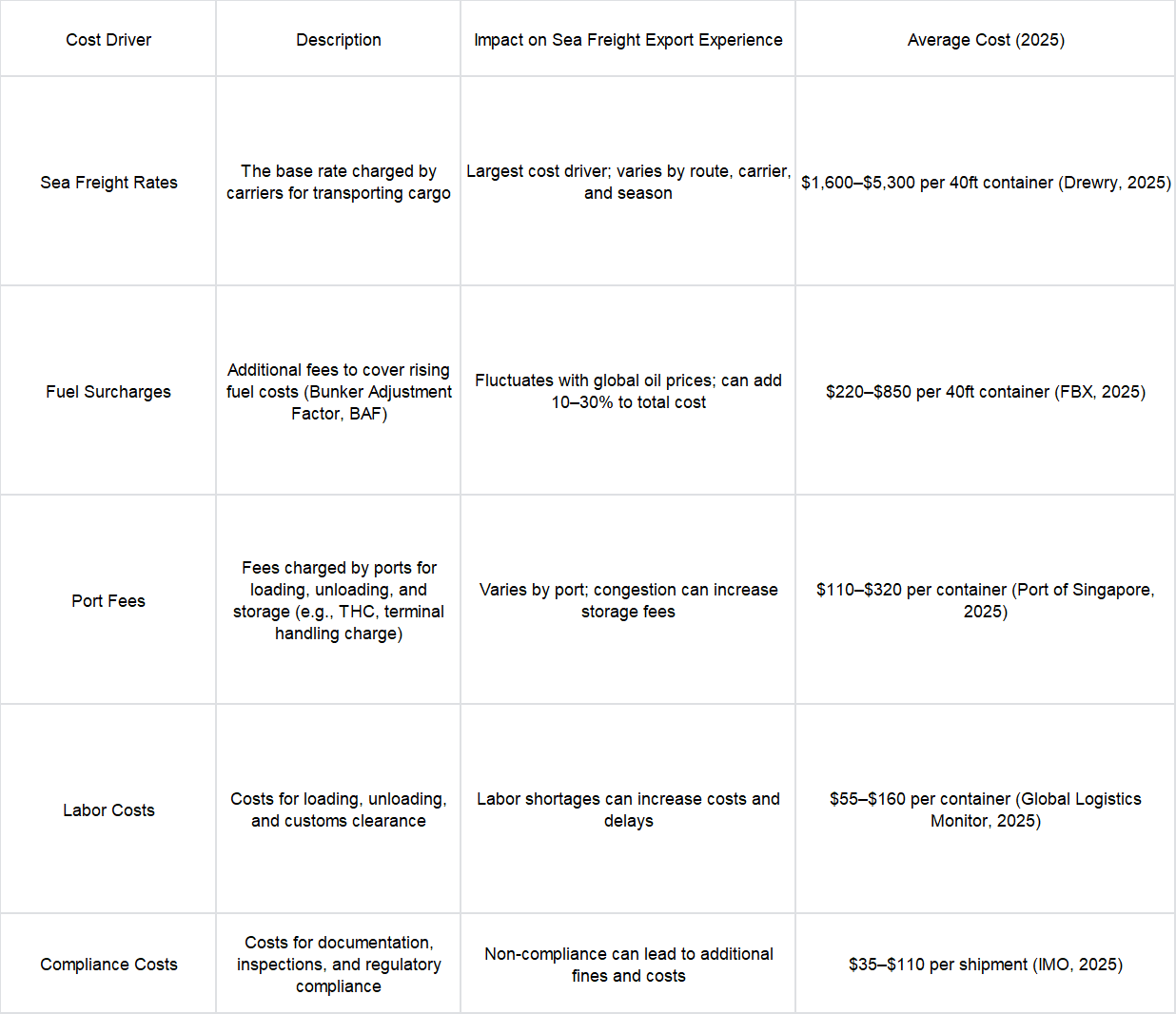
What Are the Key Cost Drivers in Sea Freight Export?
Understanding the key cost drivers in sea freight export helps forwarders identify areas where they can cut costs and improve profitability. The main cost drivers include sea freight rates, fuel surcharges, port fees, and labor costs.
How to Reduce Costs Without Compromising Service Quality?
Reducing costs requires a strategic approach that leverages Sea Freight Export Experience to identify inefficiencies and implement cost-saving measures. Forwarders can use the following tips to cut costs while maintaining high service quality:
• Consolidate Shipments: Consolidate LCL shipments from multiple clients to reduce per-unit costs. By combining small shipments into a single container, forwarders can negotiate better rates with carriers and pass savings on to clients.
• Optimize Routes: Choose the most cost-effective route for each shipment, considering factors like transit time, rates, and port fees. For example, a shipment to Europe may be cheaper via the Suez Canal than the Cape of Good Hope, even with transit time differences.
• Negotiate Surcharges: Negotiate with carriers to reduce or waive fuel surcharges (BAF) and other additional fees (e.g., demurrage, detention). Forwarders with strong carrier relationships are more likely to secure favorable terms on surcharges.
• Streamline Documentation Processes: Use digital documentation tools to reduce paper costs and improve efficiency. Digital tools can also reduce errors in documentation, which can lead to costly delays and fines.
• Outsource Non-Core Functions: Outsource non-core functions like warehousing, packaging, and customs clearance to specialized providers. This can reduce labor costs and allow your team to focus on core activities like client management and carrier relationships.
How to Resolve Common Sea Freight Export Disputes?
Even with the best planning, disputes can arise in sea freight export, including delays, cargo damage, and billing issues. Forwarders with Sea Freight Export Experience know how to resolve these disputes efficiently, minimizing financial losses and preserving client relationships.
According to the Shanghai Maritime Court 2024 data, over 32% of sea freight disputes involve delays or cargo damage, with the average dispute costing forwarders $16,000 in fines, damages, or legal fees. Resolving these disputes quickly and effectively is critical to maintaining profitability and client trust.
What Are the Most Common Disputes in Sea Freight Export?
The most common disputes in sea freight export involve delays, cargo damage, misdelivery, and billing issues. Understanding these disputes and their causes helps forwarders take preventive action and resolve them efficiently when they occur.
• Delay Disputes: Delays can occur due to port congestion, carrier issues, or documentation errors. Clients may seek compensation for losses caused by delays, so forwarders must have a clear plan to resolve these disputes.
• Cargo Damage Disputes: Cargo damage can occur during loading, unloading, or transit. According to the Chinese Maritime Law (2024), carriers are liable for cargo damage caused by their negligence, but forwarders may be held liable if they failed to properly package or declare the cargo.
• Misdelivery Disputes: Misdelivery occurs when cargo is delivered to the wrong consignee or port. A common example is shipping to St. Petersburg, Florida, instead of St. Petersburg, Russia, which can result in costly re-shipment fees (China Water Transport Network, 2024).
• Billing Disputes: Billing disputes involve discrepancies between the quoted price and the final invoice, often due to additional fees (e.g., demurrage, detention) or rate changes. Forwarders should provide clear, detailed quotes to avoid these disputes.
How to Resolve Disputes Efficiently?
Resolving disputes efficiently requires clear communication, documentation, and a willingness to collaborate with all parties involved. Forwarders can use the following steps to resolve common sea freight export disputes:
• Gather Documentation: Collect all relevant documentation, including the bill of lading, commercial invoice, packing list, and any communication with the carrier or client. This documentation will help you prove your case and resolve the dispute quickly.
• Communicate with All Parties: Maintain open communication with the client, carrier, and any other involved parties. Listen to their concerns and work together to find a mutually beneficial solution. The recommended approach is to schedule a meeting or call to discuss the dispute and agree on a resolution.
• Refer to Contracts and Regulations: Review the contract with the client and carrier to understand your rights and obligations. Refer to relevant regulations (e.g., Chinese Maritime Law, IMO rules) to determine liability and compensation.
• Offer a Fair Resolution: Propose a fair resolution, such as a partial refund, discount on future services, or compensation for damages. Forwarders should note that offering a fair resolution can help preserve client relationships and avoid costly legal action.
• Learn from the Dispute: After resolving the dispute, analyze the root cause and implement changes to prevent similar disputes in the future. For example, if a misdelivery occurred due to a documentation error, implement stricter pre-shipment checks.
How to Leverage Technology to Enhance Sea Freight Export Operations?
Technology is transforming the sea freight industry, and forwarders who leverage it effectively can streamline operations, improve efficiency, and deliver better service to their clients. From digital documentation to real-time tracking, technology is a powerful tool that complements Sea Freight Export Experience.
According to UNCTAD 2025 data, forwarders who use digital tools report a 27% reduction in operational costs and a 32% improvement in on-time deliveries. For global freight forwarding firms, investing in digital technology is no longer optional—it has become an absolute necessity to sustain market competitiveness.
What Digital Tools Should Forwarders Use?
There are a variety of digital tools available to forwarders, each designed to address specific challenges in sea freight export. The most useful tools include real-time tracking platforms, digital documentation software, and rate comparison tools.
• Real-Time Tracking Platforms: These tools allow forwarders and clients to track shipments in real time, providing updates on location, transit time, and any delays. Platforms like Maersk Track & Trace and MSC MyTracking integrate with carrier systems to provide accurate, up-to-date information.
• Digital Documentation Software: Digital documentation software streamlines the preparation and submission of documents, reducing errors and improving efficiency. Tools like CargoSmart and Descartes allow forwarders to create, edit, and share documents (e.g., B/L, commercial invoice) electronically, eliminating the need for paper.
• Rate Comparison Tools: These tools allow forwarders to compare rates from multiple carriers quickly, helping them find the most cost-effective option for their clients. Tools like Freightos and Xeneta provide real-time rate data, allowing forwarders to negotiate better rates and stay competitive.
• Customer Relationship Management (CRM) Software: CRM software helps forwarders manage client relationships, track interactions, and provide personalized service. Tools like Salesforce and HubSpot allow forwarders to store client information, track shipments, and send automated updates, improving client satisfaction.
How to Implement Technology Effectively?
Implementing technology effectively requires a strategic approach, including training, integration with existing systems, and ongoing optimization. Forwarders with Sea Freight Export Experience know how to integrate technology into their operations to maximize efficiency and minimize disruption.
• Train Your Team: Provide comprehensive training for your team to ensure they understand how to use the new tools. The recommended approach is to conduct hands-on training sessions and provide ongoing support to address any questions or issues.
• Integrate with Existing Systems: Ensure the new technology integrates with your existing systems (e.g., accounting, CRM) to avoid duplication of work. Integration helps streamline operations and improve data accuracy.
• Start Small: Implement one tool at a time to avoid overwhelming your team. Start with the tool that addresses your biggest pain point (e.g., digital documentation to reduce errors) and expand gradually.
• Monitor and Optimize: Monitor the performance of the new technology and gather feedback from your team and clients. Use this feedback to optimize the tool and ensure it meets your needs. For example, if a tracking platform is not providing accurate updates, work with the provider to resolve the issue.
Conclusion: Turning Sea Freight Export Experience into Competitive Advantage
Over a decade of sea freight export experience has taught me that success in the global freight forwarding industry requires a combination of practical expertise, proactive planning, and a commitment to continuous improvement. For global forwarders, the tips and strategies outlined in this article are designed to help you navigate the complexities of sea freight export, mitigate risks, optimize costs, and deliver exceptional service to your clients.
From pre-shipment preparation to post-delivery follow-up, every stage of the sea freight export process requires attention to detail and a deep understanding of the industry. By leveraging your Sea Freight Export Experience, building strong carrier relationships, staying compliant with regulations, and embracing technology, you can turn challenges into opportunities and establish your company as a trusted partner in the global supply chain.
Remember, Sea Freight Export Experience is not just about avoiding mistakes—it’s about anticipating them, adapting to change, and finding innovative solutions to meet your clients’ needs. As the global sea freight industry continues to evolve, forwarders who invest in their experience and embrace new strategies will thrive, while those who rely on outdated methods will struggle to compete. By mastering the waves of sea freight export, you can build a successful, sustainable business that stands the test of time.
Last
The Global Agent's Manual: Sharing Essential Sea Freight Knowledge and On-the-Ground Export Experience
For global freight forwarders navigating the complexities of international trade, Sea Freight Export Experienceis the cornerstone
Next
Avoiding Port Bottlenecks: Lessons Learned from Years of Practical Sea Freight and Export Experience
Port bottlenecks are a persistent threat to global freight forwarders, causing costly delays, lost revenue, and damaged client rel
