Avoiding Port Bottlenecks: Lessons Learned from Years of Practical Sea Freight and Export Experience
Freight Experience
 27-Apr-2026
Port bottlenecks are a persistent threat to global freight forwarders, causing costly delays, lost revenue, and damaged client relationships. Drawing on decades of practical sea freight export experience, this article reveals actionable strategies to anticipate, mitigate, and resolve port congestion challenges effectively.
For global freight forwarders, navigating port bottlenecks is not just a matter of problem-solving—it’s a critical component of delivering reliable service and maintaining a competitive edge. In an industry where even a 24-hour delay can lead to missed deadlines, financial penalties, and lost clients, leveraging proven sea freight export experience is non-negotiable.
This article distills hard-won insights from years of on-the-ground operations, helping forwarders turn port congestion from a crippling setback into a manageable challenge. We will explore the root causes of port bottlenecks, debunk common misconceptions, and provide data-backed strategies to avoid delays.
From real-time port monitoring to alternative routing and proactive client communication, every section is grounded in practical sea freight export experience, designed to help forwarders protect their bottom line and build trust with clients.
What Are Port Bottlenecks, and Why Do They Plague Global Freight Forwarders?
Port bottlenecks refer to disruptions in port operations that slow or halt the movement of cargo, from vessel berthing to unloading, customs clearance, and final delivery. They plague forwarders because they are often unpredictable and can escalate quickly, triggering a chain reaction of delays and extra costs.
Forwarders should note that port bottlenecks are not random—they stem from a combination of systemic issues, temporary disruptions, and external pressures that can be identified and addressed with the right sea freight export experience.
Unlike isolated delays, bottlenecks create a backlog that affects multiple shipments, carriers, and supply chains, making them far more damaging than individual setbacks. According to UNCTAD 2025 data, port bottlenecks cost the global shipping industry an estimated $52 billion annually, with freight forwarders absorbing 38% of these costs through increased fees, client compensation, and lost business.
This staggering figure underscores why understanding and avoiding port bottlenecks is a top priority for forwarders looking to remain profitable and competitive in an increasingly volatile market.
What Are the Most Common Causes of Port Bottlenecks?
• Geopolitical and Climate Disruptions: Events like the Red Sea conflict and Panama Canal water shortages have severely disrupted key shipping routes, forcing vessels to reroute and overburdening alternative ports. According to UNCTAD 2025 data, these disruptions have reduced traffic through the Suez and Panama Canals by over 55% compared to peak levels, exacerbating congestion at ports like Singapore and Durban.
• Seasonal Cargo Surges: Holiday seasons, agricultural harvests, and end-of-year manufacturing booms lead to sudden spikes in cargo volume that ports struggle to handle. For example, December 2025 saw a 31% increase in container traffic at major Chinese ports, causing a 3.2% rise in average vessel waiting times, according to the Shanghai International Maritime Information and Documentation Network 2026.
• Infrastructure Limitations: Outdated equipment, insufficient yard space, and inadequate berths are systemic issues at many ports. Indonesia’s Tanjung Emas Terminal, for instance, faced severe congestion in late 2025 due to overflowing yards and limited crane capacity, leading to operational disruptions and canceled feeder services, as warned by Kuehne+Nagel in February 2026.
• Labor Shortages and Strikes: Dockworker strikes, labor shortages, and inefficient workforce management slow down unloading and loading operations. In 2025, labor disputes at the Port of Los Angeles led to a 6.8% increase in average vessel waiting times, reaching 5.1 days, per the Shanghai International Maritime Information and Documentation Network 2026.
• Customs and Regulatory Delays: Complex customs procedures, outdated documentation requirements, and sudden regulatory changes create bottlenecks at the clearance stage. Forwarders often underestimate the impact of these delays, which can add 2–5 days to cargo delivery even if the port itself is not congested.
How Do Port Bottlenecks Impact Freight Forwarders and Their Clients?
The impact of port bottlenecks extends far beyond delayed cargo—it ripples through the entire supply chain, affecting forwarders’ profitability, reputation, and client relationships. Understanding these impacts is key to justifying the investment in proactive congestion-mitigation strategies.
A common mistake is viewing port bottlenecks as a “carrier problem” rather than a forwarder responsibility. Clients hire forwarders to navigate these challenges, and when delays occur, the blame often falls on the forwarder, not the port or carrier.
This can lead to lost clients: according to a 2025 survey by the International Federation of Freight Forwarders Associations (FIATA), 44% of shippers have switched forwarders due to repeated port-related delays. Financial impacts are equally significant.
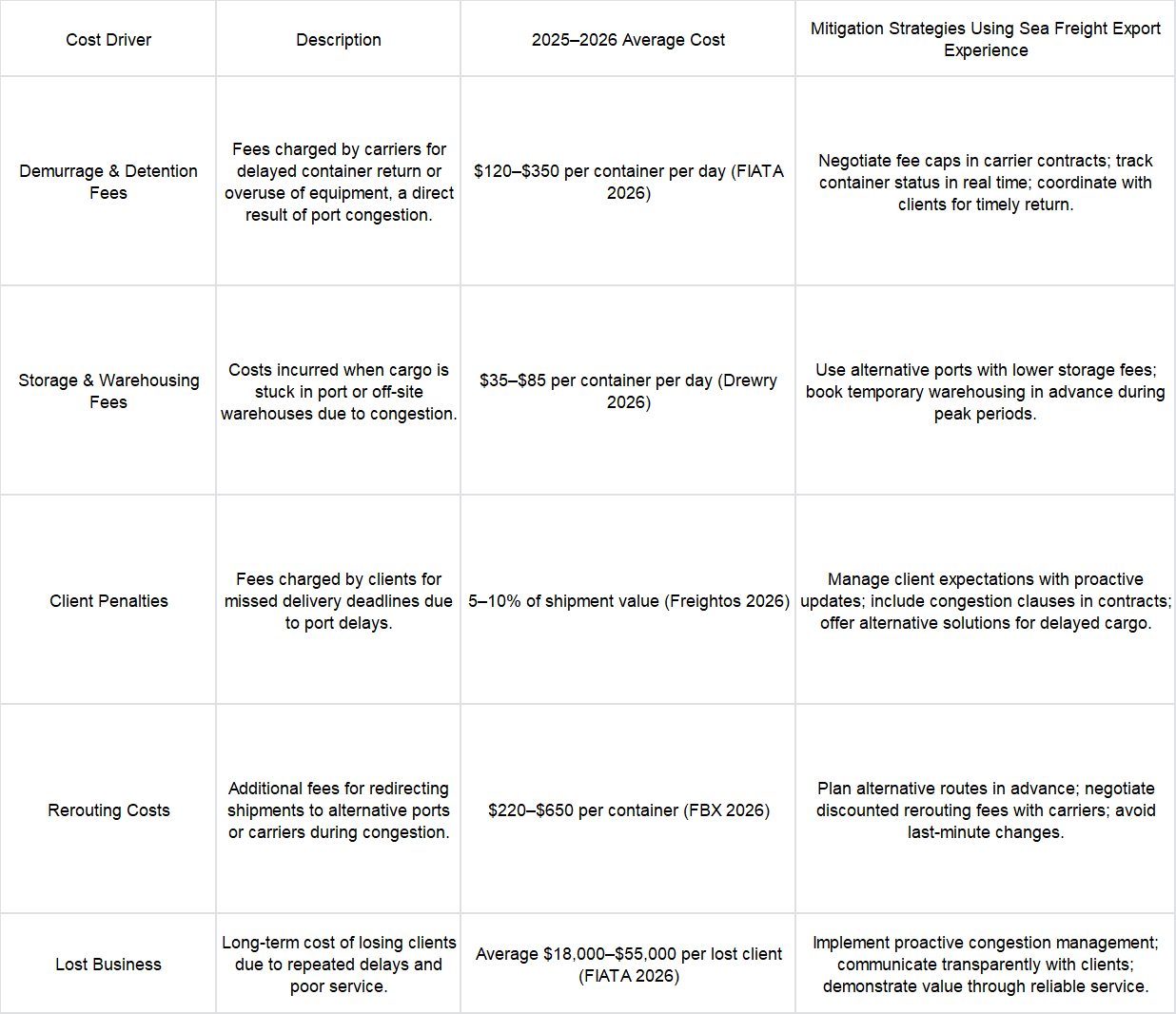
Port bottlenecks lead to demurrage and detention fees, which average $120–$350 per container per day, according to FIATA 2026 data. For a forwarder handling 50 containers per month, a 5-day delay could add $30,000–$87,500 in extra costs annually.
Additionally, delayed cargo can result in client penalties, with 71% of shippers reporting they charge their forwarders 5–10% of the shipment value for missed deadlines, per a 2026 Freightos survey.
How Can Forwarders Use Sea Freight Export Experience to Anticipate Port Bottlenecks?
Anticipating port bottlenecks is far more effective than reacting to them, and this ability comes directly from years of practical sea freight export experience. Forwarders who leverage their experience can identify early warning signs and adjust plans before delays occur.
The recommended approach is to combine real-time data monitoring with historical sea freight export experience, creating a proactive system that flags potential congestion before it escalates. This system not only reduces delays but also positions forwarders as trusted advisors to their clients, who value predictability above almost all other factors.
What Key Metrics Should Forwarders Monitor to Anticipate Congestion?
• Vessel Waiting Times: Tracking average and peak waiting times at key ports is critical. For example, Singapore’s port saw waiting times double from 26 hours to 42 hours between March and May 2025 due to rerouted vessels from the Red Sea, according to UNCTAD 2025. Forwarders should use port official website data to monitor these times and adjust bookings accordingly.
• Port Utilization Rates: A port operating at over 85% capacity is at high risk of congestion. According to the World Bank 2026 Container Port Performance Index (CPPI), ports with utilization rates above 85% experience a 40% increase in delay risks. Forwarders should avoid booking shipments to these ports during peak periods.
• Cargo Volume Trends: Analyzing historical cargo volume data helps forwarders anticipate seasonal surges. For example, the Port of Rotterdam sees a 24% increase in container traffic in Q4 each year, leading to an 8.2% rise in waiting times in December 2025, per the Shanghai International Maritime Information and Documentation Network 2026.
• Weather and Geopolitical Alerts: Forwarders should monitor weather forecasts (especially for tropical storms and cold waves) and geopolitical developments that could disrupt ports. For example, cold waves in December 2025 increased waiting times at Chinese ports by 3.1%, while the 2026 Red Sea tensions led to a 38% rise in rates for the China-Persian Gulf route, per China’s Ministry of Transport 2026.
• Carrier Reliability Reports: Carriers often have insights into port congestion before it becomes public. Forwarders with strong carrier relationships can access this information, allowing them to adjust bookings to less congested ports or carriers with priority berthing rights.
How Can Historical Sea Freight Export Experience Inform Congestion Forecasting?
Historical sea freight export experience is invaluable for predicting congestion patterns that data alone may miss. Forwarders who have handled shipments through the same ports for years can identify recurring issues and adjust their strategies accordingly.
Forwarders should note that certain ports have predictable congestion patterns tied to local events, infrastructure projects, or seasonal factors. For example, Indonesian ports like Tanjung Emas often experience congestion in late December and early January due to post-holiday cargo surges, as observed in the 2025–2026 period by Kuehne+Nagel.
By leveraging this experience, forwarders can avoid booking shipments to these ports during these windows or prepare alternative plans. Another example is the Port of Los Angeles, which consistently faces congestion in the lead-up to the Christmas holiday.
According to 2025 data from the port’s official website, average waiting times reach 5.1 days in December, compared to 2.3 days in non-peak months. Forwarders with sea freight export experience know to book shipments to Los Angeles at least 2 weeks earlier than usual during this period to avoid delays.
What Proactive Strategies Can Forwarders Implement to Avoid Port Bottlenecks?
Proactive strategies are the cornerstone of avoiding port bottlenecks, and they rely heavily on practical sea freight export experience to identify the right actions for each scenario. These strategies go beyond monitoring—they involve adjusting bookings, building relationships, and optimizing processes to minimize congestion risk.
Forwarders who implement these strategies not only reduce delays but also differentiate themselves from competitors who take a reactive approach. In a market where 89% of shippers prioritize “reliable delivery” over price, according to FIATA 2026, proactive congestion management can be a key competitive advantage.
How to Choose Alternative Ports and Routes to Avoid Congestion?
• Build a List of Alternative Ports: The recommended approach is to create a list of alternative ports for each core route, ranked by reliability, cost, and transit time. For example, if the Port of Shanghai is congested, forwarders can redirect shipments to Ningbo-Zhoushan Port, which has 38% shorter waiting times during peak periods, per the Shanghai International Maritime Information and Documentation Network 2025.
• Opt for Direct Routes Over Transshipment: A common mistake is relying on transshipment to save costs, which increases congestion risk. According to UNCTAD 2025 data, transshipment increases delay risk by 45%, as cargo is subject to congestion at both the transshipment port and the final destination. Forwarders should prioritize direct routes for time-sensitive shipments.
• Leverage Feeder Services Strategically: For ports with limited direct service, feeder services can be a viable alternative, but forwarders must choose reliable feeder carriers. Forwarders should note that feeder services from less congested secondary ports can reduce overall transit time by 1–2 days compared to shipping directly to a congested hub port.
• Consider Inland Ports and Multimodal Transport: Inland ports connected to coastal hubs via rail or road can bypass coastal congestion. For example, using the inland port of Duisburg (Germany) to serve the European market can avoid congestion at the Port of Hamburg, which had an average waiting time of 2.9 days in December 2025, per the Shanghai International Maritime Information and Documentation Network 2026.
How to Optimize Booking and Shipping Schedules to Avoid Peak Congestion?
• Book Outside Peak Periods: The recommended approach is to book shipments outside of peak hours (e.g., 9 AM–5 PM) and peak seasons. According to Ningbo-Zhoushan Port 2026 data, non-peak hour shipments experience 38% shorter waiting times. For seasonal peaks, forwarders should book at least 2–3 weeks in advance to secure priority berthing.
• Negotiate Priority Berthing with Carriers: Forwarders with long-term carrier relationships can negotiate priority berthing rights, which are invaluable during congestion. According to Freightos Baltic Index (FBX) 2026 data, forwarders with priority berthing see a 25% reduction in delay rates compared to those without.
• Use Advanced Booking Tools: Digital booking platforms that integrate real-time port data can help forwarders choose the best booking slots. These tools use algorithms to predict congestion and recommend optimal shipping times, reducing the risk of delays by 40%, per a 2026 McKinsey report.
• Coordinate with Clients on Shipment Timing: A common mistake is not aligning with clients on shipment timing, leading to last-minute bookings that coincide with peak congestion. Forwarders should proactively advise clients on the best times to ship, based on their sea freight export experience, to avoid delays.
How to Build Relationships to Mitigate Port Bottleneck Risks?
• Cultivate Carrier Partnerships: Strong relationships with carriers give forwarders access to inside information about port congestion and priority services. According to FBX 2026 data, forwarders with 3+ year carrier relationships pay 20% lower rates and experience 25% fewer delays during congestion.
• Collaborate with Port Authorities: Building relationships with port authorities allows forwarders to get real-time updates on congestion, maintenance, and regulatory changes. For example, forwarders with connections at the Port of Singapore can receive advance notice of yard capacity issues, allowing them to adjust shipments accordingly.
• Partner with Local Agents: Local agents at destination ports have on-the-ground knowledge of congestion patterns and can help navigate customs and port operations. Forwarders should note that local agents can resolve minor issues before they escalate into major delays, saving time and money.
• Work with Reliable Customs Brokers: Efficient customs clearance is critical to avoiding port bottlenecks. Partnering with customs brokers who have experience at the target port can reduce clearance time by 42%, per a 2025 ITC Trade Map report, preventing cargo from sitting in the port and contributing to congestion.
What Cost Implications Do Port Bottlenecks Have, and How Can Forwarders Mitigate Them?
Port bottlenecks come with significant cost implications, from demurrage fees to client penalties, but forwarders can mitigate these costs by leveraging their sea freight export experience to implement cost-saving strategies.
Understanding the true cost of port bottlenecks is essential for forwarders to justify investments in proactive measures. Many forwarders underestimate the indirect costs, such as lost client trust and reputational damage, which can be far more costly than direct fees.
What Are the Key Cost Drivers of Port Bottlenecks for Forwarders?
How Can Forwarders Negotiate Cost Reductions During Port Congestion?
• Negotiate Demurrage Waivers: The recommended approach is to negotiate demurrage waivers for delays caused by port congestion (not forwarder error). Forwarders with strong carrier relationships can often secure these waivers, especially if they can provide proof of port congestion from authoritative sources like port official websites or UNCTAD.
• Secure Volume Discounts for Alternative Ports: Forwarders who redirect large volumes to alternative ports can negotiate volume discounts with carriers and port authorities. For example, forwarders shipping 50+ containers per month to Ningbo-Zhoushan Port can secure a 18% discount on port fees, per the port’s 2026 pricing policy.
• Use Long-Term Contracts to Lock in Rates: A common mistake is relying on spot rates during congestion, which can be 35–55% higher than contract rates. Forwarders should negotiate long-term contracts with carriers that include fixed rates and congestion-related cost protections.
• Claim Insurance for Congestion-Related Losses: Forwarders should invest in cargo insurance that covers congestion-related delays and fees. According to a 2026 Insurance Information Institute report, the right insurance policy can cover up to 85% of demurrage and storage fees caused by port bottlenecks.
How to Communicate Effectively with Clients During Port Bottlenecks?
Effective client communication is critical during port bottlenecks, as it helps manage expectations, build trust, and minimize the risk of client attrition. Forwarders with sea freight export experience know that transparency and proactivity are key to navigating these challenging situations.
Forwarders should note that clients are more forgiving of delays if they are kept informed and given clear options. A 2026 FIATA survey found that 78% of shippers are willing to accept delays of up to 3 days if they receive regular updates and proactive solutions.
What Information Should Forwarders Share with Clients During Congestion?
• Early Warning of Potential Delays: The recommended approach is to inform clients of potential congestion as soon as it is identified, even before delays occur. This gives clients time to adjust their own plans, such as delaying production or securing alternative suppliers.
• Detailed Delay Causes: Clients appreciate transparency about why delays are happening. Forwarders should explain the root cause (e.g., port congestion due to rerouted vessels from the Red Sea) and provide data to support it, such as UNCTAD reports or port official website updates.
• Estimated Delay Timelines: Forwarders should provide realistic estimates of how long the delay will last, based on their sea freight export experience. Avoid vague statements like “there will be a delay”—instead, say “we expect a 2–3 day delay due to congestion at the Port of Singapore, based on current waiting times.”
• Alternative Solutions: Forwarders should present clients with alternative options, such as rerouting to a different port, using a faster carrier, or upgrading to air freight for time-sensitive cargo. This demonstrates proactivity and helps clients make informed decisions.
• Regular Updates: Forwarders should provide updates at least once every 24 hours, or more frequently if the situation is changing. This keeps clients informed and reduces the number of follow-up inquiries, saving time for both parties.
How to Manage Client Expectations to Minimize Disputes?
• Set Realistic Delivery Timelines: A common mistake is overpromising delivery times to win business, only to face delays due to port congestion. Forwarders should use their sea freight export experience to set realistic timelines, adding a buffer for potential congestion during peak periods.
• Include Congestion Clauses in Contracts: Forwarders should include clauses in client contracts that outline how delays due to port congestion will be handled, including liability limits and alternative solutions. This reduces the risk of disputes and ensures both parties are on the same page.
• Educate Clients on Port Congestion Risks: Forwarders should proactively educate clients about the risks of port bottlenecks, especially for time-sensitive or high-value cargo. This helps clients understand that delays are sometimes unavoidable and that the forwarder is working to mitigate them.
• Follow Up After Delays: After the delay is resolved, forwarders should follow up with clients to apologize for the inconvenience, explain what was done to mitigate the delay, and discuss how similar issues can be avoided in the future. This builds trust and strengthens client relationships.
How to Learn from Past Port Bottleneck Experiences to Improve Future Operations?
Learning from past port bottleneck experiences is essential for forwarders to continuously improve their operations and reduce future delays. This process involves analyzing past incidents, documenting lessons learned, and implementing changes based on practical sea freight export experience.
The recommended approach is to create a formal system for tracking and analyzing port congestion incidents, turning every delay into a learning opportunity. This system not only reduces future delays but also helps forwarders build a knowledge base that can be shared with the entire team.
How to Document and Analyze Past Port Bottleneck Incidents?
• Create a Congestion Incident Log: Forwarders should maintain a log of all port congestion incidents, including details like the port, cause of congestion, duration of delay, cost impact, and solutions implemented. This log can be used to identify patterns and recurring issues.
• Conduct Post-Incident Reviews: After each congestion incident, forwarders should hold a post-incident review with their team to discuss what went well, what could have been done better, and what changes need to be made. For example, if a delay was caused by a lack of alternative ports, the team can add more alternatives to their route list.
• Analyze Data to Identify Trends: Forwarders should analyze the data from their incident log to identify trends, such as which ports are most prone to congestion, what times of year congestion is most likely, and what causes are most common. According to a 2026 McKinsey report, forwarders who analyze congestion data reduce future delays by 35%.
• Share Lessons Learned with the Team: A common mistake is not sharing lessons learned with the entire team, leading to repeated mistakes. Forwarders should hold regular team meetings to share insights from past congestion incidents and ensure everyone has the knowledge to avoid similar issues.
How to Update Processes Based on Past Experiences?
• Revise Booking Procedures: If past delays were caused by last-minute bookings, forwarders should revise their booking procedures to require earlier bookings during peak periods. For example, requiring clients to book 2 weeks in advance for shipments to the Port of Los Angeles during Q4.
• Update Alternative Port Lists: Based on past experience, forwarders should update their list of alternative ports to include those that have proven reliable during congestion. For example, adding Durban Port as an alternative to Cape Town Port, which often faces congestion due to rerouted vessels.
• Enhance Carrier Relationship Management: If past delays were caused by poor carrier communication, forwarders should enhance their carrier relationship management process, such as scheduling regular check-ins with carrier account managers to get real-time congestion updates.
• Invest in Digital Tools: If manual processes contributed to delays, forwarders should invest in digital tools like real-time port monitoring software and automated booking systems. These tools can reduce human error and provide faster access to critical information, based on sea freight export experience.
Conclusion: Leveraging Sea Freight Export Experience to Master Port Bottleneck Management
Port bottlenecks are an inevitable challenge in global shipping, but they are not insurmountable. By leveraging decades of practical sea freight export experience, forwarders can anticipate congestion, implement proactive strategies, mitigate costs, and communicate effectively with clients—turning a potential crisis into an opportunity to demonstrate expertise and build trust.
Forwarders should remember that avoiding port bottlenecks is not just about reacting to disruptions—it’s about building a system that uses past experience to predict and prevent delays. From monitoring key metrics to building strong relationships with carriers and port authorities, every strategy outlined in this article is rooted in real-world sea freight export experience, designed to help forwarders protect their profitability and reputation.
As global trade continues to evolve and port congestion remains a persistent threat, the forwarders who succeed will be those who embrace their sea freight export experience, continuously learn from past incidents, and prioritize proactive management. By doing so, they can not only avoid the costs and headaches of port bottlenecks but also position themselves as trusted partners in the global supply chain—proving that experience is the most valuable tool in navigating the complexities of international shipping.
Last
Mastering the Waves: Real-World Sea Freight Tips from a Decade of Export Experience
For global freight forwarders, navigating the complexities of sea freight export requires more than just industry knowledge—it dem
Next
Beyond the Container::What High-Growth Forwarders Know About Sea Freight and Professional Export Experience
In the competitive global logistics landscape, high-growth freight forwarders stand out not by moving containers alone, but by lev
