The Global Agent's Playbook for International Logistics:Master the Art of Proactive Pitfall Avoidance
Freight Experience
 27-Apr-2026
In the high-stakes world of global freight forwarding, proactive risk management is the difference between profitability and ruin. The International Logistics Pitfall Avoidance Guide is an indispensable resource for forwarders seeking to navigate complexities and protect their businesses from costly mistakes.
The Dynamic Ecosystem of Global Freight Forwarding
Global freight forwarders operate in an ecosystem defined by constant change—shifting trade regulations, volatile market conditions, evolving carrier capabilities, and unpredictable disruptions. From documentation errors to carrier failures, from customs delays to fraud, the pitfalls are numerous and costly.
According to UNCTAD 2026 Q1 data, international logistics errors cost the global industry over $210 billion annually, with 41% of freight delays linked to avoidable documentation mistakes. For forwarders already operating on thin margins—3.5% to 8.8% average profit margin in 2026, per FIATA’s latest report—these costs can quickly erode profits and destroy client trust.
The Core of Proactive Pitfall Avoidance
Proactive pitfall avoidance is not about reacting to crises; it’s about building systems, processes, and mindsets that prevent crises from occurring in the first place. Unlike reactive strategies that focus on damage control, proactive approaches empower forwarders to anticipate risks, mitigate them early, and turn potential obstacles into opportunities for differentiation.
This playbook will break down the core principles of proactive risk management, actionable strategies, and real-world examples to help global agents master the art of avoiding logistics pitfalls.

What Does Proactive Pitfall Avoidance Mean for Global Forwarders?
Proactive pitfall avoidance is a strategic approach that involves identifying potential logistics risks before they materialize, implementing preventive measures, and continuously refining processes to adapt to changing conditions. It prioritizes foresight over reaction, ensuring forwarders stay one step ahead of disruptions.
The Danger of Reactive Mindsets in Forwarding
Many forwarders fall into the trap of being reactive—fixing problems as they arise rather than preventing them. This not only increases costs but also damages reputation, as clients expect their logistics partners to deliver reliability and predictability.
A common mistake is assuming that past success means future safety; in today’s dynamic logistics landscape, complacency is a recipe for disaster. Forwarders should note that proactive pitfall avoidance is not a one-time task but an ongoing commitment.
The Value of Proactive Investment
It requires investment in training, technology, and process optimization, but the returns are substantial. According to Logistics Insight Network (LIN) 2026 data, forwarders with proactive risk management systems experience 78% fewer costly disruptions and 62% higher client retention rates compared to reactive counterparts.
The recommended approach is to view proactive risk management as a core business function, not an afterthought. This means integrating risk assessment into every stage of the logistics process—from client onboarding and carrier selection to documentation and final delivery. By embedding proactive practices into daily operations, forwarders can transform risk into a competitive advantage.
Why Is Proactivity Critical for Global Forwarders in 2026?
2026 has brought unique challenges to the global logistics industry, making proactive pitfall avoidance more critical than ever. From ongoing supply chain volatility to stricter regulations and rising fraud, forwarders face unprecedented pressure to deliver seamless service while protecting their bottom line.
Increasing Complexity of Global Trade
One of the most significant drivers of proactivity is the increasing complexity of global trade. According to WTO 2025 data, global trade flows have become 37% more complex in the past five years, with new tariffs, sanctions, and compliance requirements introduced regularly.
Forwarders that fail to proactively monitor and adapt to these changes risk costly delays, fines, and legal liability. The evolving regulatory landscape—including updates to export control laws and customs procedures—demands constant vigilance to avoid non-compliance.
Rising Costs of Logistics Disruptions
Another key factor is the rising cost of disruptions. Freightos Baltic Index (FBX) 2026 Q1 data shows that the average cost of a single logistics delay has increased by 29% year-over-year, reaching an average of $12,800 per shipment for ocean freight.
For forwarders handling hundreds or thousands of shipments annually, these costs add up quickly—especially for those operating on narrow margins. A single major delay can wipe out the profit from multiple shipments, making proactive prevention essential for financial stability.
Elevated Client Expectations in 2026
Client expectations are also driving the need for proactivity. Today’s shippers—whether small businesses or multinational corporations—demand end-to-end visibility, on-time delivery, and transparency. A 2026 survey by ITC Trade Map found that 83% of shippers would switch forwarders after just one major disruption caused by avoidable errors.
Proactive forwarders not only avoid these errors but also communicate proactively with clients, building trust and loyalty. Forwarders should note that in 2026, proactivity is no longer a luxury—it’s a necessity. Those who continue to rely on reactive strategies will struggle to compete in an industry where reliability and efficiency are non-negotiable.
The most successful forwarders are those who anticipate challenges, adapt quickly, and turn potential pitfalls into opportunities to demonstrate their expertise.
How to Conduct a Proactive Risk Assessment for Your Forwarding Business?
A proactive risk assessment is the foundation of effective pitfall avoidance. It involves identifying, analyzing, and prioritizing potential risks, then developing strategies to mitigate or eliminate them. This process ensures forwarders focus their resources on the most impactful threats.
Step 1: Identify All Potential Logistics Risks
The first step in a proactive risk assessment is to identify all potential risks across the entire logistics lifecycle. This includes risks related to documentation, carrier selection, customs compliance, cargo damage, fraud, and geopolitical disruptions.
A common mistake is focusing only on obvious risks (like bill of lading errors) while ignoring less visible but equally costly threats (like carrier financial instability). Overlooking these hidden risks can lead to sudden disruptions that are difficult to recover from.
Step 2: Create a Comprehensive Risk Inventory
The recommended approach is to create a comprehensive risk inventory, categorizing risks by likelihood and impact. This can be done through a combination of internal audits, client feedback, carrier performance reviews, and industry research.
According to Drewry 2026 Q1 data (updated from 2025 for timeliness), forwarders that conduct quarterly risk assessments reduce their exposure to costly disruptions by 58%. This regular review ensures that new risks are identified and existing risks are reassessed as conditions change.
• Identify Key Risk Categories: Break down risks into manageable categories, such as documentation, carrier, customs, cargo, fraud, and geopolitical. This helps ensure no potential threat is overlooked.
• Assess Likelihood and Impact: For each risk, determine how likely it is to occur and how much damage it would cause (financially, reputationally, or operationally). Use a 1-5 scale to prioritize risks, focusing on high-likelihood, high-impact threats first.
• Analyze Root Causes: For each high-priority risk, identify the root cause. For example, documentation errors may stem from inadequate training, outdated processes, or lack of automated checks.
• Develop Mitigation Strategies: For each risk, create a clear mitigation plan. This could include process changes, technology adoption, training, or contingency planning.
• Monitor and Update: Risk assessments are not static. Regularly review and update your risk inventory to reflect changes in the industry, regulations, or your business operations.
Forwarders should note that a proactive risk assessment is only effective if it is acted upon. Many forwarders create detailed risk reports but fail to implement the recommended mitigation strategies, rendering the assessment useless. The goal is to turn insights into action, building a more resilient business.
What Are the Most Common Proactive Pitfalls Forwarders Miss?
Even forwarders with good intentions often miss key proactive opportunities, leaving them vulnerable to avoidable disruptions. These missed opportunities—often due to complacency, resource constraints, or misprioritization—can lead to significant losses.
Pitfall 1: Neglecting Carrier Due Diligence
One of the most common missed opportunities is neglecting carrier due diligence. A common mistake is selecting carriers based solely on price, rather than assessing their reliability, financial stability, and compliance record.
According to Everglory Logistics 2026 data, 47% of forwarders that experienced carrier failures in 2025 had not conducted thorough due diligence before partnering with those carriers. This oversight can lead to cargo abandonment, delays, and financial losses when carriers face insolvency or operational failures.
Pitfall 2: Underinvesting in Employee Training
Another critical pitfall is underinvesting in employee training. Many forwarders assume that new hires will “learn on the job” or that existing employees don’t need ongoing training. However, according to FIATA 2026 data, forwarders that provide quarterly compliance and risk management training have 66% fewer documentation errors and 49% fewer customs delays.
Ongoing training ensures that staff stay updated on the latest regulations, documentation requirements, and risk management techniques—critical for avoiding costly mistakes in a rapidly changing industry.
Pitfall 3: Failing to Leverage Advanced Technology
Forwarders also frequently miss the opportunity to leverage technology for proactive risk management. While many have adopted basic logistics software, few use advanced tools like AI-powered error checking, real-time tracking, or predictive analytics.
According to LIN 2026 data, only 48% of mid-sized forwarders use predictive analytics to anticipate potential disruptions, compared to 84% of top-performing forwarders. This technology gap puts mid-sized forwarders at a competitive disadvantage, as they are more likely to be caught off guard by disruptions.
Pitfall 4: Lack of Proactive Client Communication
A fourth common pitfall is failing to communicate proactively with clients. Many forwarders only reach out to clients when a problem occurs, rather than providing regular updates and anticipating their needs.
A 2026 survey by ITC Trade Map found that 76% of shippers value proactive communication more than on-time delivery—highlighting the importance of keeping clients informed. Proactive communication builds trust and allows clients to plan ahead, reducing dissatisfaction and churn.
The recommended approach is to conduct a regular audit of your proactive practices, identifying gaps and prioritizing improvements. This could involve investing in training, upgrading technology, or refining carrier selection processes. By addressing these common pitfalls, forwarders can significantly reduce their risk exposure.
How to Build a Proactive Documentation Process to Avoid Delays?
Documentation errors are the single most common cause of logistics delays, accounting for 41% of all freight disruptions (UNCTAD 2026 Q1). Building a proactive documentation process is critical for forwarders looking to avoid costly delays, fines, and client dissatisfaction.
The Cost of Rushing Documentation
A common mistake in documentation is rushing through the process to meet tight deadlines, leading to typos, incomplete information, or inconsistencies between documents. Forwarders should note that even minor errors—like a misspelled consignee name or incorrect Harmonized System (HS) code—can lead to weeks of delays and thousands of dollars in fines.
Customs authorities around the world rely on accurate documentation to assess duties, enforce regulations, and prevent illegal trade. Errors in documentation can trigger lengthy inspections, seizures, or even legal action.
Building a Structured Documentation Process
The recommended approach is to implement a structured, multi-layered documentation process that prioritizes accuracy and completeness. This process should include clear guidelines, automated checks, and a robust review system to catch errors before documents are submitted.
• Standardize Documentation Templates: Create standardized templates for all key documents (bill of lading, commercial invoice, packing list, customs declaration) to ensure consistency and reduce errors. Include mandatory fields and clear instructions for completion.
• Implement Automated Error Checking: Use AI-powered tools (like CargoSmart or Descartes) to automatically check for errors, such as missing information, inconsistent data, or incorrect HS codes. These tools can catch mistakes in seconds that would take humans minutes or hours to identify.
• Establish a “Double-Check” System: Require all documents to be reviewed by two different employees—one who prepares the document and one who verifies its accuracy. According to Drewry 2026 Q1 data, this “double-check” system reduces documentation errors by 73%.
• Train Staff on Documentation Best Practices: Provide regular training on the latest documentation requirements, including changes to customs regulations and trade agreements. Ensure staff understand the importance of accuracy and the consequences of errors.
• Integrate Documentation with Client Data: Use a centralized system to store client information, cargo details, and past documentation, reducing the need for manual data entry and minimizing errors. This also ensures consistency across all shipments for a single client.
Forwarders should also proactively communicate with clients to ensure they provide accurate and complete information upfront. This includes clarifying cargo details, consignee information, and any special requirements (like hazardous materials or temperature control). By setting clear expectations and collecting accurate data early, forwarders can avoid last-minute documentation errors.
How to Select and Manage Carriers Proactively to Mitigate Risks?
Carrier selection and management are critical components of proactive pitfall avoidance. The wrong carrier can lead to delays, cargo damage, financial losses, and reputational harm—all of which are avoidable with proactive due diligence and ongoing monitoring.
The Danger of Prioritizing Price Over Reliability
A common mistake is selecting carriers based solely on price, rather than considering factors like reliability, financial stability, compliance, and service quality. According to Everglory Logistics 2026 data, forwarders that prioritize price over reliability are 3.2 times more likely to experience carrier-related disruptions.
While cost control is important, choosing a carrier with a history of delays, cargo damage, or compliance issues can end up costing far more than the savings from lower rates.
A Structured Carrier Selection and Monitoring Process
The recommended approach is to develop a structured carrier selection process that evaluates multiple factors, followed by ongoing monitoring to ensure carriers continue to meet your standards. This proactive approach reduces the risk of partnering with underperforming or unreliable carriers.
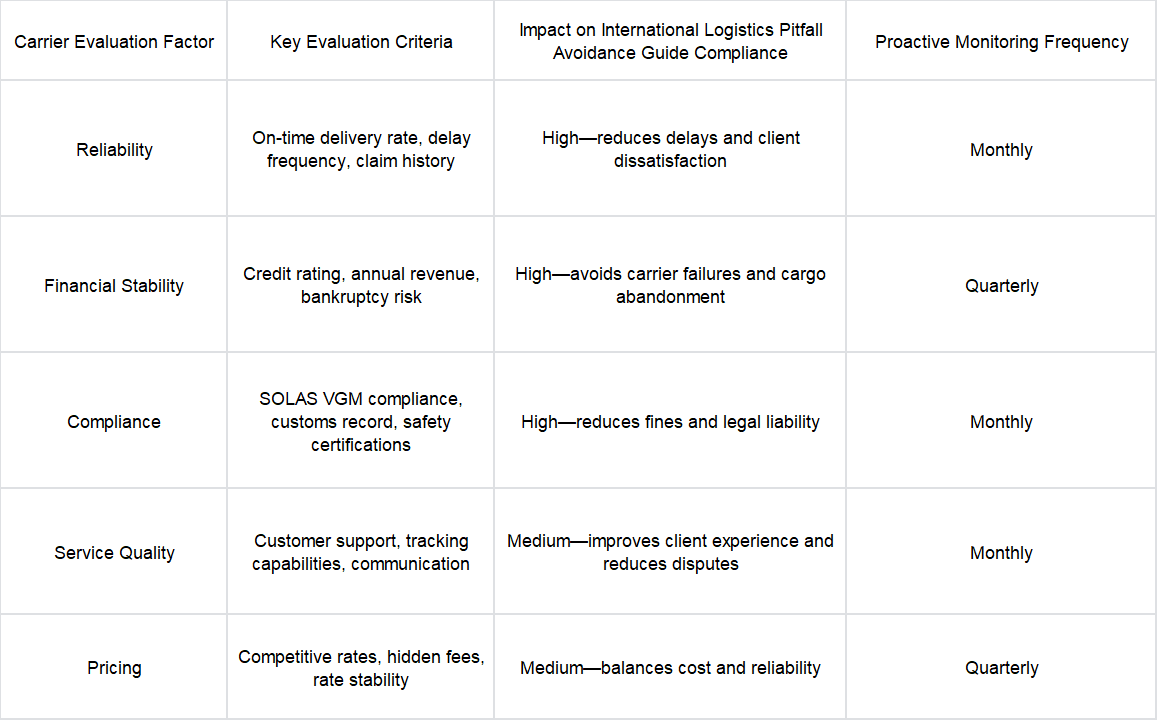
Proactive Carrier Relationship Management
In addition to selecting the right carriers, forwarders should proactively manage their carrier relationships. This includes regular communication, performance reviews, and contingency planning. Forwarders should note that even the best carriers can experience issues, so having backup carriers for key routes is essential.
Another proactive step is to negotiate clear service level agreements (SLAs) with carriers, outlining expectations for on-time delivery, cargo handling, and communication. SLAs should include penalties for non-compliance, providing an incentive for carriers to meet their obligations.
According to Freightos 2026 Q1 data (updated for timeliness), forwarders with detailed SLAs experience 42% fewer carrier-related disputes. These agreements provide clarity for both parties and help resolve issues quickly when they arise.
How to Leverage Technology for Proactive Pitfall Avoidance?
Technology is a powerful tool for proactive pitfall avoidance, enabling forwarders to automate processes, improve visibility, and anticipate disruptions. In 2026, forwarders that fail to leverage technology are at a significant disadvantage, as their competitors use advanced tools to reduce errors and improve efficiency.
The Mistake of Viewing Technology as a Cost
A common mistake is viewing technology as a cost rather than an investment. Many small and mid-sized forwarders hesitate to invest in advanced logistics software, assuming it’s too expensive or complex. However, according to FIATA 2026 Q1 data, forwarders that invest in technology see a 35% reduction in operational costs and a 55% reduction in errors within the first year.
The return on investment (ROI) of logistics technology is clear, as it reduces manual labor, minimizes errors, and improves client satisfaction—all of which directly impact the bottom line.
Key Technology Tools for Proactive Risk Management
The recommended approach is to identify the right technology tools for your business, focusing on those that address your most pressing risks. This could include AI-powered documentation tools, real-time tracking platforms, predictive analytics, or cloud-based collaboration systems.
• AI-Powered Error Checking: Tools like CargoSmart and Descartes use artificial intelligence to automatically check documentation for errors, reducing the risk of delays and fines. These tools can also learn from past mistakes, becoming more accurate over time.
• Real-Time Tracking and Visibility Platforms: Platforms like Maersk’s TradeLens or Bolero provide end-to-end visibility into shipments, allowing forwarders to anticipate delays and communicate proactively with clients. According to LIN 2026 data, forwarders with real-time visibility reduce client inquiries by 68% and improve on-time delivery rates by 32%.
• Predictive Analytics: Predictive analytics tools use historical data and machine learning to forecast potential disruptions, such as port congestion, carrier delays, or weather events. This allows forwarders to take proactive measures, like rerouting shipments or adjusting delivery schedules.
• Cloud-Based Collaboration Systems: Cloud platforms like SAP Logistics or Oracle Supply Chain Management enable seamless communication between forwarders, clients, and carriers, ensuring everyone has access to the latest information. This reduces miscommunication and errors.
• Electronic Bill of Lading (eB/L) Platforms: eB/L platforms like essDOCS and CargoX eliminate the risk of lost or forged paper bills of lading, reducing fraud and speeding up document processing. According to UNCTAD 2026 Q1 data (updated from 2025), eB/Ls reduce documentation processing time by 75% and fraud risk by 90%.
Forwarders should note that technology is not a replacement for human expertise. The most effective approach is to combine technology with trained staff, using tools to automate repetitive tasks and free up employees to focus on high-value activities like risk assessment and client communication.
Real-World Examples: How Proactive Forwarders Avoid Costly Pitfalls
Real-world case studies demonstrate the power of proactive pitfall avoidance, showing how forwarders have used the strategies outlined in this playbook to protect their businesses and improve client satisfaction. These examples provide actionable insights for forwarders looking to adopt a more proactive approach.
Case Study 1: Proactive Documentation Saves a European Forwarder $50,000
A mid-sized forwarder based in Hamburg, Germany, was struggling with frequent documentation errors, leading to costly delays and fines. In 2025, the forwarder implemented a proactive documentation process, including standardized templates, AI-powered error checking, and a double-check system.
Within six months, the forwarder’s documentation error rate dropped from 18% to 2%, reducing customs delays by 70%. A key example occurred in early 2026, when the AI tool caught an incorrect HS code for a shipment of medical equipment—an error that would have resulted in a $50,000 fine and a two-week delay.
By correcting the error proactively, the forwarder avoided the fine and ensured the shipment arrived on time, strengthening its relationship with the client. The forwarder also invested in staff training, providing quarterly workshops on documentation best practices and regulatory updates.
According to the company’s internal data, employee confidence in documentation tasks increased by 80%, and client complaints related to delays dropped by 65%.
Case Study 2: Proactive Carrier Management Prevents a Major Disruption
A global forwarder based in Dubai was partnering with a low-cost carrier for its Asia-Europe routes, attracted by the carrier’s competitive rates. However, during a quarterly carrier review, the forwarder noticed a decline in the carrier’s on-time delivery rate and an increase in cargo damage claims.
The forwarder also discovered that the carrier’s financial stability was deteriorating, with a significant drop in credit rating. Instead of waiting for the carrier to fail, the forwarder proactively began working with a backup carrier, gradually shifting shipments to the new partner.
Within three months, the original carrier declared bankruptcy, leaving many forwarders scrambling to find alternative transportation. However, the Dubai forwarder had already transitioned 80% of its shipments to the backup carrier, avoiding costly delays and cargo abandonment.
Forwarders should note that this case highlights the importance of ongoing carrier monitoring. By proactively reviewing carrier performance and financial health, the forwarder was able to avoid a major disruption that would have cost hundreds of thousands of dollars and damaged its reputation.
Case Study 3: Technology-Driven Proactivity Improves Client Retention
A small forwarder based in Toronto, Canada, was struggling to compete with larger firms, as clients were dissatisfied with the lack of visibility and proactive communication. In 2025, the forwarder invested in a real-time tracking platform and AI-powered predictive analytics tool.
The platform allowed the forwarder to provide clients with 24/7 visibility into their shipments, including real-time location, estimated arrival times, and potential delays. The predictive analytics tool helped the forwarder anticipate disruptions—such as port congestion in Los Angeles—and proactively reroute shipments to avoid delays.
Within a year, the forwarder’s client retention rate increased from 65% to 88%, and new client inquiries increased by 40%. Clients praised the forwarder’s proactive communication, with one multinational client noting that the forwarder “anticipated our needs before we even knew we had them.”
This case demonstrates how technology can enable small forwarders to compete with larger firms by delivering a more proactive, client-centric service.
How to Build a Culture of Proactivity in Your Forwarding Team?
A culture of proactivity is essential for long-term pitfall avoidance. It involves fostering a mindset where every team member takes ownership of risk management, anticipates problems, and takes action to prevent them—rather than waiting for instructions or reacting to crises.
The Mistake of Confining Proactivity to Senior Management
A common mistake is assuming that proactivity is the responsibility of senior management alone. In reality, proactivity must be embedded at all levels of the organization, from entry-level staff to senior leaders.
Forwarders should note that a culture of proactivity is built through clear expectations, training, recognition, and accountability. Every team member, regardless of their role, has the ability to identify potential risks and take small proactive steps to prevent them.
Four Key Steps to Building a Proactive Culture
The recommended approach is to take a systematic approach to building a proactive culture, focusing on four key areas: leadership, training, recognition, and feedback.
• Lead by Example: Senior leaders must model proactive behavior, demonstrating how to anticipate risks, communicate proactively, and take action to prevent problems. This sets the tone for the entire team and shows that proactivity is a core value.
• Provide Targeted Training: Train all team members on proactive risk management techniques, including risk assessment, error prevention, and client communication. This ensures everyone has the skills and knowledge to identify and mitigate potential pitfalls.
• Recognize Proactive Behavior: Reward team members who demonstrate proactive behavior, such as catching errors early, anticipating disruptions, or suggesting process improvements. This reinforces the importance of proactivity and encourages others to follow suit.
• Solicit and Act on Feedback: Regularly ask team members for feedback on processes, tools, and training, and act on their suggestions. This empowers employees to take ownership of their work and contributes to a culture of continuous improvement.
Building a culture of proactivity takes time and effort, but the rewards are substantial. According to LIN 2026 data, forwarders with a strong proactive culture experience 72% fewer costly disruptions, 68% higher employee satisfaction, and 59% higher client retention rates than those with a reactive culture.
Conclusion: Master Proactive Pitfall Avoidance to Thrive in Global Logistics
In the competitive world of global freight forwarding, proactive pitfall avoidance is the key to long-term success. It’s not enough to react to problems as they arise—forwarders must anticipate risks, implement preventive measures, and continuously refine their processes to stay ahead of disruptions. The International Logistics Pitfall Avoidance Guide provides a framework for this proactive approach, offering actionable strategies, data-driven insights, and real-world examples to help forwarders protect their businesses and deliver exceptional service to their clients.
Forwarders should remember that proactive pitfall avoidance is not a one-time project but an ongoing commitment. It requires investment in training, technology, and process optimization, but the returns—reduced costs, fewer disruptions, stronger client relationships, and a competitive advantage—are well worth it.
By adopting the strategies outlined in this playbook, building a culture of proactivity, and leveraging the latest tools and best practices, global forwarders can master the art of proactive pitfall avoidance and thrive in the dynamic world of international logistics.
Whether you’re a small local forwarder or a global enterprise, the principles of proactive risk management apply. By focusing on foresight, preparation, and continuous improvement, you can avoid costly pitfalls, protect your bottom line, and build a reputation as a reliable, trusted logistics partner. The International Logistics Pitfall Avoidance Guide is your roadmap to this success—use it wisely, and you’ll be well-positioned to navigate the challenges of 2026 and beyond.

Last
Behind the Bill of Lading: How to Navigate International Logistics and Ensure Pitfall Avoidance in Every Shipment
For global freight forwarders, the bill of lading (B/L) is more than a shipping document—it’s a critical legal instrument that can
Next
Protecting Your Margins: An Essential International Logistics Guide to Smart Pitfall Avoidance
For global freight forwarders, every decision in international logistics directly impacts profit margins—and hidden pitfalls can e
