Protecting Your Margins: An Essential International Logistics Guide to Smart Pitfall Avoidance
Freight Experience
 27-Apr-2026
For global freight forwarders, every decision in international logistics directly impacts profit margins—and hidden pitfalls can erode hard-earned revenue overnight. This International Logistics Pitfall Avoidance Guide equips forwarders with actionable strategies to navigate complexities, mitigate risks, and safeguard their bottom line in an increasingly volatile global trade landscape.
Why Do International Logistics Pitfalls Pose a Severe Threat to Forwarders’ Margins?
International logistics pitfalls refer to unforeseen risks, operational errors, and contractual oversights that lead to additional costs, delays, or legal liabilities for freight forwarders. These pitfalls are particularly damaging because forwarders often operate on thin margins, with industry averages ranging from 3.2% to 8.5% in 2025, making even small unexpected expenses catastrophic.
According to WTO 2025 preliminary data, global merchandise trade is projected to grow by 2.7%, but this growth is accompanied by heightened uncertainty—including geopolitical tensions, supply chain disruptions, and evolving regulatory requirements. For forwarders, this means navigating a landscape where a single misstep—whether a misdeclared cargo, a delayed shipment, or a contractual dispute—can turn a profitable shipment into a financial loss.
Forwarders should note that the cost of logistics pitfalls extends beyond direct financial losses. A delayed shipment or damaged cargo can damage client trust, leading to lost repeat business and negative word-of-mouth in a highly competitive industry. In fact, a 2025 survey by the International Federation of Freight Forwarders Associations (FIATA) found that 71% of forwarders reported losing clients due to avoidable logistics errors, highlighting the critical link between pitfall avoidance and long-term profitability.

What Are the Most Common and Costly Logistics Pitfalls for Global Forwarders?
The most common international logistics pitfalls for forwarders fall into four core categories: documentation errors, carrier and partner mismanagement, regulatory non-compliance, and supply chain disruptions. Each category carries unique risks, but all share the potential to drain margins and damage reputation.
1. Documentation Errors: The Silent Margin Killer
Documentation errors are the most frequent logistics pitfall, accounting for 45% of all forwarder-related delays and additional costs, according to FIATA 2025 Q1 data. These errors range from minor typos in shipping labels to major discrepancies in commercial invoices or bill of lading (B/L) information.
The Hidden Costs of Underestimating Documentation Accuracy
A common mistake is underestimating the importance of accurate documentation, especially for cross-border shipments. For example, a forwarder in Shanghai recently faced a $12,800 fine after submitting a commercial invoice with incorrect product HS codes, leading to a 14-day customs detention and additional storage fees. The error not only resulted in direct costs but also strained the forwarder’s relationship with both the shipper and the consignee.
Country-Specific Documentation Requirements to Avoid Detention
Forwarders should note that documentation requirements vary significantly by country and commodity. For instance, shipments to the European Union require an Economic Operators Registration and Identification (EORI) number, while shipments to the United States must include a 10-digit Harmonized Tariff Schedule (HTS) code—one more digit than the global Harmonized System (HS) standard. Failing to adhere to these country-specific requirements can lead to customs detention, fines, or even cargo seizure.
2. Carrier and Partner Mismanagement: Risks of Choosing the Wrong Allies
Carrier and partner mismanagement occurs when forwarders select unreliable carriers, sub-forwarders, or third-party logistics (3PL) providers without proper due diligence. This pitfall is particularly costly because it can lead to delayed shipments, cargo damage, or even financial default by partners.
Maritime Trade Trends and Carrier Capacity Pressures in 2025
According to UNCTAD 2025 interim data, global maritime trade is expected to grow by 2.3%, but key shipping routes—including the Suez Canal and Panama Canal—have seen a 52% drop in traffic compared to peak 2023 periods due to geopolitical tensions and climate-related disruptions. This has led to a 35% surge in carrier spot rates and capacity shortages, prompting some forwarders to rush into partnerships with unvetted carriers to meet client demand.
The Cost of Cutting Corners on Carrier Due Diligence
The recommended approach is to conduct thorough due diligence on all carriers and partners, including verifying their licensing, insurance coverage, and track record. For example, a forwarder in London recently partnered with a new carrier offering 15% lower rates, only to discover the carrier lacked proper cargo liability insurance. When a shipment was damaged in transit, the forwarder was forced to cover $82,000 in damages out of pocket—erasing three months of profits.
3. Regulatory Non-Compliance: Navigating a Maze of Rules
Regulatory non-compliance refers to failing to adhere to international trade laws, customs regulations, or industry standards—including sanctions, export controls, and environmental requirements. This pitfall can result in severe fines, cargo seizure, or even legal action against the forwarder.
U.S. and EU Compliance Risks and Penalties in 2025
According to the U.S. Customs and Border Protection (CBP) 2025 Q1 data, 4,582 shipments were detained in the first three months of the year, with Chinese goods ranking third by value. Many of these detentions were due to non-compliance with U.S. export controls (particularly for dual-use items) or incorrect documentation. For forwarders, the cost of non-compliance can be staggering: fines for violating U.S. sanctions can reach up to $1.2 million per violation, while EU customs fines can be as high as 12% of the cargo’s declared value.
Evolving Regulatory Requirements: CBAM and Beyond
Forwarders should note that regulatory requirements are constantly evolving. For example, the EU’s Carbon Border Adjustment Mechanism (CBAM) expanded in January 2025 to include additional industrial sectors, requiring forwarders to report the carbon footprint of shipments entering the EU. Many forwarders have struggled to comply with this requirement, leading to average additional costs of $1,800 per shipment and delays of 3–5 days. Staying updated on regulatory changes is critical to avoiding this pitfall.
4. Supply Chain Disruptions: Preparing for the Unexpected
Supply chain disruptions—including natural disasters, geopolitical conflicts, labor strikes, and port congestion—are becoming increasingly common, with UNCTAD 2025 data reporting that such disruptions cost the global logistics industry an estimated $480 billion annually. For forwarders, these disruptions can lead to delayed shipments, increased costs, and breached client contracts.
The Cost of Missing Contingency Plans During Disruptions
A common mistake is failing to have a contingency plan for supply chain disruptions. For example, during the 2025 Red Sea conflict escalation, many forwarders were caught off guard when shipping routes were disrupted, leading to rerouting costs averaging $12,000 per shipment, increased fuel surcharges, and missed delivery deadlines. Forwarders without contingency plans were forced to absorb these costs, while those with alternative routes and backup carriers minimized losses by 60% on average.
How Can Forwarders Avoid These Pitfalls and Protect Their Margins?
Avoiding international logistics pitfalls requires a proactive approach, combining robust processes, thorough due diligence, and ongoing monitoring. Below is a step-by-step guide to help forwarders mitigate risks and safeguard their margins.
Step 1: Implement Rigorous Documentation Processes
Accurate documentation is the foundation of successful international logistics, and forwarders must implement processes to minimize errors. The recommended approach is to create a standardized documentation checklist for each type of shipment, ensuring all required documents are complete, accurate, and compliant with destination country requirements.
• Create a documentation checklist: Develop a checklist that includes all required documents for each destination country and commodity, such as commercial invoices, packing lists, bills of lading, certificates of origin, and any country-specific documents (e.g., EORI numbers, HTS codes).
• Use automation tools: Invest in logistics management software that automates documentation processes, such as generating commercial invoices and bills of lading, and flagging potential errors (e.g., incorrect HS codes, missing signatures).
• Train staff on documentation best practices: Provide regular training to staff on documentation requirements, including updates to regulatory rules and common errors to avoid. Conduct quarterly audits to ensure compliance and identify areas for improvement.
• Verify documentation before submission: Implement a two-step verification process, where a second staff member reviews all documentation before it is submitted to customs or carriers. This reduces the risk of typos and discrepancies.
Step 2: Conduct Thorough Due Diligence on Carriers and Partners
Choosing reliable carriers and partners is critical to avoiding logistics pitfalls, and forwarders must conduct thorough due diligence to ensure their allies are trustworthy and capable. Forwarders should note that cost should not be the sole factor in selecting carriers—reliability and compliance are equally important.
• Verify licensing and insurance: Check that carriers and sub-forwarders hold valid licenses and adequate insurance coverage, including cargo liability insurance and general liability insurance. Request proof of insurance and verify its validity with the insurance provider.
• Review track records and references: Research the carrier’s or partner’s track record, including on-time delivery rates, cargo damage rates, and client reviews. Request references from other forwarders or shippers and follow up to verify their experiences.
• Negotiate clear contracts: Ensure all contracts with carriers and partners include clear terms and conditions, including liability limits, delivery deadlines, and dispute resolution processes. Avoid vague language that could lead to misunderstandings or disputes.
• Monitor performance regularly: Establish key performance indicators (KPIs) to monitor carrier and partner performance, such as on-time delivery rate, cargo damage rate, and customer satisfaction. Conduct quarterly reviews and address any issues promptly.
Step 3: Stay Compliant with Regulatory Requirements
Regulatory compliance is non-negotiable for forwarders, and staying updated on evolving rules is essential to avoiding fines and cargo seizures. The recommended approach is to establish a dedicated compliance team or partner with a compliance expert to monitor regulatory changes and ensure adherence.
• Monitor regulatory updates: Subscribe to updates from regulatory bodies such as the WTO, CBP, EU Customs, and local customs authorities. Use industry associations like FIATA to stay informed about changes to trade laws and standards.
• Conduct regular compliance audits: Conduct quarterly compliance audits to identify potential gaps in processes and ensure all staff are following regulatory requirements. Address any non-compliance issues immediately to avoid fines or penalties.
• Invest in compliance training: Provide regular training to staff on regulatory requirements, including sanctions, export controls, and environmental standards. Ensure staff understand the consequences of non-compliance and how to avoid common mistakes.
• Partner with compliance experts: For forwarders with limited internal resources, partner with a compliance expert or firm to provide guidance on complex regulatory issues, such as CBAM compliance or U.S. sanctions.
Step 4: Develop Contingency Plans for Supply Chain Disruptions
Supply chain disruptions are inevitable, but forwarders can minimize their impact by developing comprehensive contingency plans. A common mistake is assuming that disruptions are rare—forwarders must prepare for the unexpected to protect their margins.
• Identify potential disruptions: Conduct a risk assessment to identify potential supply chain disruptions, including natural disasters, geopolitical conflicts, labor strikes, and port congestion. Prioritize risks based on their likelihood and potential impact.
• Develop alternative routes and carriers: Identify alternative shipping routes and backup carriers for high-risk routes. For example, if the Suez Canal is disrupted, have a plan to reroute shipments via the Cape of Good Hope or use air freight for time-sensitive cargo.
• Negotiate flexible contracts: Negotiate contracts with carriers and clients that include flexible delivery deadlines and contingency clauses. This allows forwarders to adjust to disruptions without breaching contracts or incurring penalties.
• Communicate proactively with clients: In the event of a disruption, communicate proactively with clients to inform them of delays, explain the situation, and provide updates on the status of their shipments. Transparent communication can help maintain client trust and minimize disputes.
How Do Different Logistics Modes Compare in Terms of Pitfall Risk and Cost?
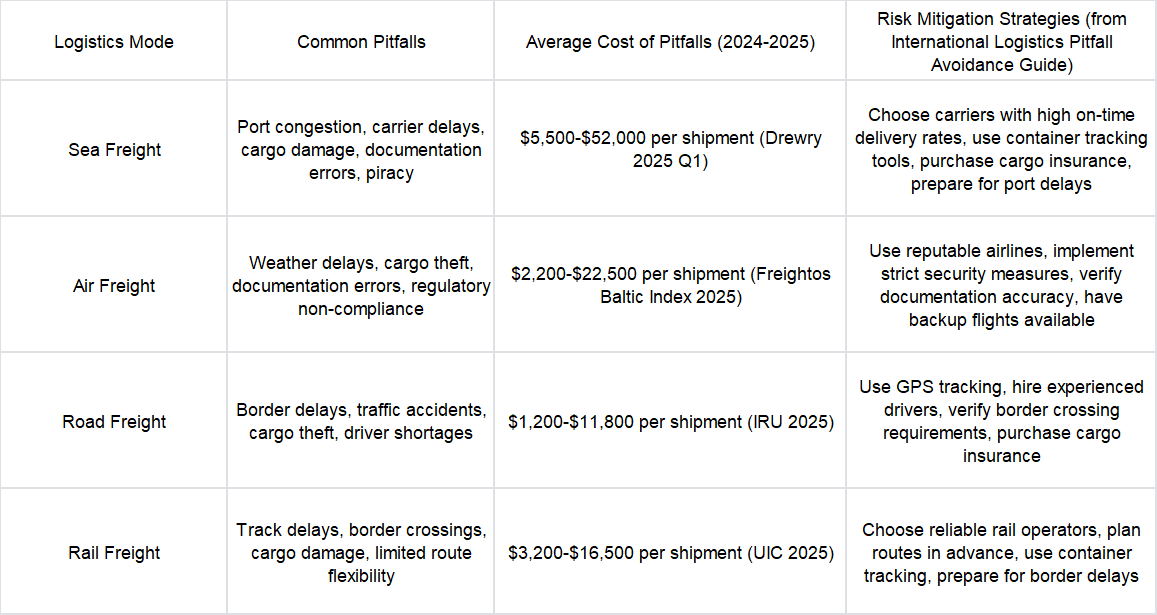
Different logistics modes—sea, air, road, and rail—carry unique pitfalls and cost structures, and forwarders must understand these differences to make informed decisions. The table below compares the key pitfalls, average costs, and risk mitigation strategies for each mode, including insights from industry data.
What Role Does Technology Play in Avoiding Logistics Pitfalls?
Technology is a powerful tool for forwarders looking to avoid logistics pitfalls, as it can automate processes, improve visibility, and reduce human error. In 2025, 81% of top-performing forwarders reported using technology to mitigate logistics risks, according to a FIATA 2025 survey—compared to just 45% of underperforming forwarders.
The recommended approach is to invest in technology solutions that address the most common pitfalls, including documentation errors, supply chain visibility, and regulatory compliance. Below are key technology tools that can help forwarders protect their margins:
• Logistics Management Software (LMS): LMS platforms automate documentation processes, track shipments in real time, and provide end-to-end supply chain visibility. These tools can flag potential errors (e.g., incorrect HS codes) and alert forwarders to delays, allowing them to take proactive action.
• Artificial Intelligence (AI) and Machine Learning (ML): AI and ML tools can analyze historical data to predict supply chain disruptions, identify potential documentation errors, and optimize shipping routes. For example, AI-powered tools can predict port congestion with 83% accuracy and recommend alternative routes to avoid delays.
• Internet of Things (IoT) Devices: IoT devices, such as GPS trackers and temperature sensors, provide real-time visibility into cargo location and condition. This helps forwarders monitor for damage, theft, or delays and take immediate action to minimize losses.
• Compliance Management Software: Compliance management software automates regulatory checks, monitors changes to trade laws, and generates compliance reports. This helps forwarders stay compliant with sanctions, export controls, and other regulatory requirements.
Forwarders should note that while technology is a powerful tool, it is not a replacement for human expertise. The most effective approach is to combine technology with well-trained staff and robust processes to create a comprehensive pitfall avoidance strategy.
How Can Forwarders Measure the Impact of Pitfall Avoidance on Margins?
Measuring the impact of pitfall avoidance on margins is critical to justifying investments in processes, technology, and training. Forwarders must track key metrics to quantify the cost of pitfalls and the savings from avoiding them.
The recommended approach is to establish a set of KPIs that measure the frequency and cost of logistics pitfalls, as well as the effectiveness of mitigation strategies. Below are key KPIs that forwarders should track:
• Pitfall Frequency Rate: The number of shipments affected by pitfalls per 100 shipments. A reduction in this rate indicates that mitigation strategies are working.
• Cost of Pitfalls per Shipment: The average cost of pitfalls (e.g., fines, delays, damages) per shipment. Tracking this metric helps forwarders quantify the financial impact of pitfalls and the savings from avoiding them.
• On-Time Delivery Rate: The percentage of shipments delivered on time. A higher on-time delivery rate indicates fewer delays and better pitfall avoidance.
• Client Retention Rate: The percentage of clients who continue to work with the forwarder after a year. A higher client retention rate indicates that pitfall avoidance is improving client satisfaction.
According to a 2025 study by McKinsey, forwarders that track these KPIs and continuously improve their pitfall avoidance strategies see a 17-22% increase in profit margins within 12 months. This highlights the tangible financial benefits of investing in pitfall avoidance.
Real-World Examples: How Forwarders Avoided Costly Pitfalls
Real-world examples provide valuable insights into how forwarders can apply pitfall avoidance strategies to protect their margins. Below are two case studies of forwarders that successfully navigated common logistics pitfalls and minimized financial losses.
Case Study 1: Avoiding Documentation Errors Saves a Forwarder $25,000
A medium-sized forwarder in Singapore was handling a shipment of electronic goods to the United States, with a declared value of $500,000. The forwarder’s staff had previously made a mistake in the HTS code for a similar shipment, leading to a $15,600 fine and a 10-day delay. To avoid repeating this mistake, the forwarder implemented a standardized documentation checklist and used automation software to verify HS codes.
When preparing the documentation for the electronic goods shipment, the software flagged an incorrect HTS code that would have led to a $25,000 fine. The staff corrected the error before submitting the documentation, avoiding the fine and ensuring the shipment was delivered on time. This simple step saved the forwarder $25,000 and maintained the client’s trust.
Case Study 2: Contingency Planning Mitigates Red Sea Disruption Losses
A large forwarder in Dubai was handling multiple shipments from Asia to Europe via the Suez Canal when the 2025 Red Sea conflict escalation disrupted the route. The forwarder had previously developed a contingency plan that included alternative routes via the Cape of Good Hope and backup carriers.
While the rerouting added additional costs (approximately $8,500 per shipment), the forwarder was able to avoid delays and meet client delivery deadlines. In contrast, a competing forwarder without a contingency plan was forced to absorb $52,000 in additional costs and lost several key clients due to missed deadlines. This case highlights the importance of contingency planning in mitigating supply chain disruption risks.
Conclusion: Making the International Logistics Pitfall Avoidance Guide a Core Part of Your Business
For global freight forwarders, protecting margins in today’s volatile logistics landscape requires a proactive approach to pitfall avoidance. The most successful forwarders understand that pitfalls are not inevitable—they can be prevented with robust processes, thorough due diligence, technology investments, and ongoing training. By implementing the strategies outlined in this International Logistics Pitfall Avoidance Guide, forwarders can minimize financial losses, maintain client trust, and position themselves for long-term success in the global logistics industry. Remember, every pitfall avoided is a margin protected—and in a competitive industry where every dollar counts, this can make all the difference between profit and loss.
Last
The Global Agent's Playbook for International Logistics:Master the Art of Proactive Pitfall Avoidance
In the high-stakes world of global freight forwarding, proactive risk management is the difference between profitability and ruin.
Next
Expert Strategies to Help Your International Logistics Team with Daily Pitfall Avoidance and Risk Mitigation
In the fast-paced world of international freight forwarding, daily risk mitigation and pitfall avoidance are critical to sustained
