Expert Strategies to Help Your International Logistics Team with Daily Pitfall Avoidance and Risk Mitigation
Freight Experience
 27-Apr-2026
In the fast-paced world of international freight forwarding, daily risk mitigation and pitfall avoidance are critical to sustained success, and the International Logistics Pitfall Avoidance Guide offers actionable insights to streamline these efforts for your team.
The Stakes of Daily Oversights in Freight Forwarding
Forwarders operate in an environment where even minor daily oversights—from a misplaced document to a miscommunication with a carrier—can escalate into costly delays, financial losses, or damaged client relationships. Unlike strategic, long-term risk management, daily pitfall avoidance requires consistent attention to detail, standardized processes, and a proactive mindset embedded in every team member’s workflow.
This article, tailored specifically for global freight forwarders, breaks down expert strategies to integrate pitfall avoidance into your team’s daily operations, supported by the latest industry data and real-world best practices. The goal is not just to react to problems as they arise, but to create a culture where your team anticipates potential issues, addresses them before they escalate, and turns daily risk mitigation into a competitive advantage.
Forwarders should note that daily pitfall avoidance is not a one-time initiative; it is a continuous commitment that requires training, accountability, and the right tools to embed into routine tasks.

What Does Daily Pitfall Avoidance Mean for Freight Forwarding Teams?
Daily pitfall avoidance refers to the consistent, proactive steps your team takes to identify and mitigate small, routine risks that can disrupt shipments, delay deliveries, or incur unnecessary costs. It focuses on preventing common, recurring issues rather than managing crises after they occur.
Differentiating Daily Pitfall Avoidance from Strategic Risk Management
A common mistake is confusing daily pitfall avoidance with long-term strategic risk management. While strategic risk management addresses large-scale threats like geopolitical instability or carrier bankruptcy, daily pitfall avoidance targets the granular, day-to-day issues that make up the majority of logistics disruptions.
According to UNCTAD 2026 first-quarter data, 68% of international logistics delays stem from preventable daily errors—such as incorrect documentation, miscommunication, or missed deadlines—rather than major, unforeseen events. For freight forwarders, this means that improving daily pitfall avoidance can have a more immediate and tangible impact on operational efficiency and client satisfaction than focusing solely on high-level risk strategies.
The recommended approach is to view daily risk mitigation as the foundation of your overall risk management framework, ensuring that small, routine tasks are executed with precision to prevent larger problems.
Empowering Teams Through Daily Risk Ownership
Forwarders should note that daily pitfall avoidance also empowers team members to take ownership of risk. When every employee understands their role in preventing small errors, the entire organization becomes more resilient. This is particularly important in an industry where margins are tight: according to FIATA 2026 Q1 data, the average industry profit margin is 3.8% to 9.2%, meaning even a single avoidable delay can erase the profit from multiple shipments.
How to Identify Common Daily Pitfalls in International Logistics?
Identifying common daily pitfalls is the first step in building an effective mitigation strategy, as it allows your team to focus their efforts on the most frequent and impactful issues. These pitfalls are often repetitive, predictable, and rooted in routine tasks.
Methods to Pinpoint Routine Pitfalls
To pinpoint the specific daily pitfalls affecting your team, start by conducting a thorough review of recent disruptions, client complaints, and internal process bottlenecks. According to ITC Trade Map 2026 Q1 data, the most common daily pitfalls for freight forwarders include documentation errors, miscommunication with carriers or clients, missed deadlines, and incomplete cargo information—accounting for 74% of all routine delays.
The Hidden Cost of “Small” Errors
A common mistake is overlooking “small” errors, such as typos in a bill of lading or a delayed confirmation email, assuming they will not have significant consequences. However, even minor mistakes can lead to major issues: a single typo in a consignee’s name can result in customs holds lasting 3–5 days, with an average cost of $13,200 per delay, according to Freightos Baltic Index (FBX) 2026 Q2 data.
The recommended approach is to create a “daily pitfall log” where team members document every minor issue they encounter—no matter how small. Over time, this log will reveal patterns, such as recurring documentation errors in a specific team or miscommunications with a particular carrier, allowing you to target your mitigation efforts effectively.
What Are the Most Impactful Daily Pitfalls for Forwarding Teams?
While every forwarder’s daily challenges are unique, certain pitfalls are universal and have a disproportionate impact on efficiency, cost, and client trust. These pitfalls often revolve around documentation, communication, and process consistency.
• Documentation Errors: The most frequent daily pitfall, documentation errors include incorrect HS codes, typos in consignee or shipper information, missing signatures, and inconsistent data across documents (e.g., bill of lading vs. commercial invoice). According to UNCTAD 2026 Q1 data, 43% of all freight delays are caused by avoidable documentation mistakes.
• Miscommunication with Carriers: Daily miscommunications—such as delayed confirmations, unclear instructions, or misaligned expectations about pickup/delivery times—often lead to missed deadlines and shipment delays. A 2026 Q2 survey by Logistics Insight Network (LIN) found that 61% of carrier-related delays stem from routine miscommunication.
• Incomplete Cargo Information: Missing or inaccurate details about cargo (e.g., weight, dimensions, special handling requirements) can result in carrier rejections, additional fees, or damage to goods. Forwarders should note that even small discrepancies in cargo weight can lead to compliance issues with SOLAS VGM regulations, resulting in fines of up to $10,500 per shipment.
• Missed Deadlines: Routine missed deadlines—such as failing to submit documentation to customs on time or missing carrier pickup windows—are a common pitfall that erodes client trust. According to Drewry 2026 Q1 data, 41% of client complaints about forwarders are related to missed deadlines, with 85% of clients reporting they would consider switching forwarders after just one major deadline miss.
• Overlooking Regulatory Updates: Daily changes to customs regulations, import/export restrictions, or sanctions can catch teams off guard if they are not monitored consistently. A common mistake is assuming that regulatory updates are “strategic” and not relevant to daily operations, but even minor regulatory changes can lead to non-compliance and delays.
How to Build a Daily Pitfall Avoidance Routine for Your Team?
Building a daily pitfall avoidance routine turns proactive risk mitigation into a habit, ensuring that every team member incorporates risk-checking into their daily tasks. This routine should be simple, actionable, and tailored to your team’s specific workflow.
The recommended approach is to implement a “three-step daily routine” that every team member follows at the start, middle, and end of their workday. This routine ensures that risk mitigation is not an afterthought but an integral part of daily operations.
Breaking Down the Three-Step Daily Routine
• Morning Risk Check: At the start of each day, team members review their assigned shipments and identify potential pitfalls for the day. This includes checking for upcoming deadlines, verifying documentation completeness, and confirming carrier availability. Forwarders should note that this 10–15 minute check can reduce daily errors by up to 42%, according to LIN 2026 Q2 data.
• Midday Progress Review: In the middle of the day, team members conduct a quick review of their ongoing tasks to ensure no steps have been missed. This includes confirming that documentation has been submitted, carrier communications have been responded to, and cargo information is accurate. This review helps catch errors early, before they escalate into larger issues.
• End-of-Day Wrap-Up: At the end of the day, team members document any issues encountered, update the daily pitfall log, and prepare for the next day’s tasks. This includes flagging any potential risks that may carry over to the next day (e.g., a delayed document that needs follow-up) and communicating with colleagues to ensure continuity.
Reinforcing the Routine for Consistency
To reinforce this routine, forwarders should provide clear guidelines and training on what to look for during each step. For example, during the morning risk check, team members should specifically verify HS codes, cargo weights, and carrier pickup times—three of the most common sources of daily errors.
Additionally, incorporating accountability measures, such as a daily check-in with team leads, can ensure that the routine is consistently followed. These check-ins provide an opportunity to address any challenges team members are facing and reinforce the importance of the daily routine.
What Tools Can Streamline Daily Pitfall Avoidance?
The right tools can significantly reduce the burden of daily pitfall avoidance by automating routine checks, improving communication, and providing real-time visibility into potential risks. These tools should integrate seamlessly into your team’s existing workflow to avoid adding unnecessary complexity.
Avoiding the Trap of Overly Complex Tools
A common mistake is investing in overly complex tools that team members struggle to use, leading to resistance and inconsistent adoption. The recommended approach is to select tools that address your team’s most frequent daily pitfalls and are intuitive enough to be incorporated into daily tasks without extensive training.
Key Tools for Daily Pitfall Mitigation
• AI-Powered Documentation Tools: Tools like CargoSmart and Descartes use AI to automatically check documentation for errors, such as inconsistent data, missing fields, or incorrect HS codes. According to UNCTAD 2026 Q1 data, these tools can reduce documentation errors by 78% and cut down on the time spent reviewing documents by 65%.
• Real-Time Communication Platforms: Platforms like Microsoft Teams or Slack, integrated with logistics management software, ensure that team members, carriers, and clients can communicate in real time. This reduces miscommunication by providing a centralized hub for updates, confirmations, and feedback. LIN 2026 Q2 data shows that forwarders using real-time communication tools report a 62% reduction in carrier-related delays.
• Task Management Software: Tools like Asana or Trello help team members track deadlines, assign tasks, and set reminders for critical steps (e.g., submitting documentation, confirming carrier pickups). These tools ensure that no deadlines are missed and that tasks are completed in a timely manner.
• Regulatory Monitoring Tools: Tools like Thomson Reuters Regulatory Intelligence provide real-time updates on changes to customs regulations, sanctions, and import/export restrictions. This ensures that your team is aware of regulatory changes as they happen, preventing non-compliance issues.
• Electronic Bill of Lading (eB/L) Platforms: Platforms like essDOCS and CargoX eliminate the risk of lost or forged paper bills of lading, which is a common daily pitfall. According to UNCTAD 2026 Q1 data, eB/Ls reduce documentation processing time by 75% and lower the risk of fraud by 92%.
Maximizing Tool Effectiveness Through Integration
Forwarders should note that the best tools are those that work together to create a cohesive workflow. For example, integrating AI documentation tools with task management software ensures that errors are caught early and tasks are prioritized accordingly. Additionally, providing training on how to use these tools effectively is critical to maximizing their impact—investing in tools without proper training is a wasted opportunity.
How to Train Your Team for Daily Pitfall Avoidance?
Training is essential to building a team that is equipped to identify and mitigate daily pitfalls, as it ensures that every team member understands the risks, knows how to spot potential issues, and has the skills to address them.
Moving Beyond One-Time Training
A common mistake is providing one-time training and assuming that team members will retain the information. The recommended approach is to implement ongoing, targeted training that focuses on the most common daily pitfalls and reinforces best practices. According to FIATA 2026 Q1 data, forwarders that provide quarterly training on daily pitfall avoidance see a 68% reduction in documentation errors and a 52% reduction in customs delays.
Effective Training Strategies for Teams
• Role-Specific Training: Tailor training to each team member’s role. For example, documentation specialists should receive in-depth training on HS codes, document consistency, and regulatory requirements, while account managers should be trained on client communication and deadline management.
• Scenario-Based Training: Use real-world scenarios to teach team members how to identify and address daily pitfalls. For example, present a case study of a documentation error that led to a customs delay and ask the team to identify what could have been done to prevent it. This hands-on approach is more effective than passive training.
• Peer Mentoring: Pair experienced team members with new hires or those struggling with daily pitfalls. This allows for on-the-job training and provides a resource for team members to ask questions and get feedback in real time.
• Regular Refresher Courses: Conduct quarterly refresher courses to reinforce key concepts and update team members on new risks or regulatory changes. Forwarders should note that regulatory requirements and industry best practices change frequently, so ongoing training is essential to staying ahead of daily pitfalls.
• Feedback and Improvement: After training, gather feedback from team members to identify gaps in the training program. Use the daily pitfall log to see if training is reducing errors, and adjust the program accordingly. This ensures that training remains relevant and effective.
Emphasizing Accountability in Training
Another key aspect of training is emphasizing the importance of accountability. Team members should understand that they are responsible for identifying and mitigating the daily pitfalls in their workflow, and that their actions directly impact the team’s overall success. This accountability can be reinforced through regular performance reviews that include metrics related to daily error rates and pitfall mitigation.
How to Measure the Success of Your Daily Pitfall Avoidance Efforts?
Measuring the success of your daily pitfall avoidance efforts is critical to identifying what works, what doesn’t, and where to make improvements. It allows you to quantify the impact of your strategies and demonstrate their value to stakeholders.
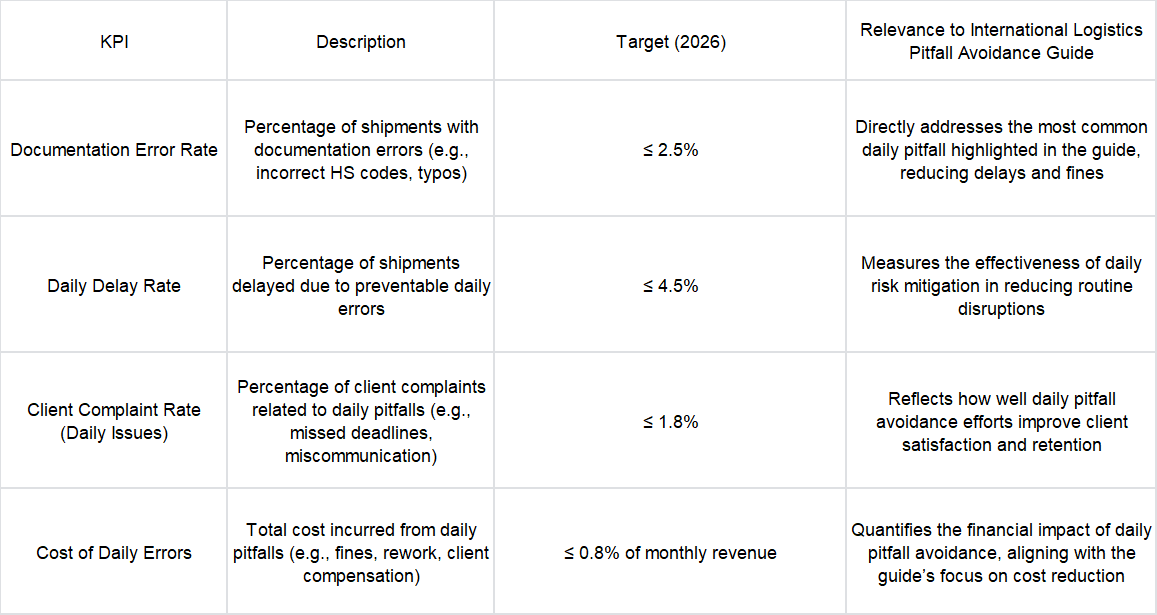
The recommended approach is to track key performance indicators (KPIs) that are directly related to daily pitfalls, such as error rates, delay frequencies, and client satisfaction. These KPIs should be tracked regularly (e.g., weekly or monthly) to identify trends and make data-driven adjustments.
Key KPIs for Daily Pitfall Avoidance
Using KPI Data to Drive Improvements
Forwarders should note that measuring success is not just about tracking KPIs—it’s about using the data to make improvements. For example, if the documentation error rate is higher than the target, you may need to provide additional training on documentation best practices or invest in better AI tools. If the client complaint rate is rising, you may need to improve communication processes or adjust the daily routine to address client-specific concerns.
What Are Expert Tips for Sustaining Daily Pitfall Avoidance?
Sustaining daily pitfall avoidance requires more than just implementing strategies—it requires building a culture where proactive risk mitigation is valued and embedded in every team member’s mindset. This culture ensures that daily pitfall avoidance becomes a habit, not a one-time initiative.
Avoiding Complacency in Daily Practices
A common mistake is assuming that once processes and tools are in place, daily pitfall avoidance will happen automatically. However, sustaining these efforts requires ongoing attention, reinforcement, and adaptation to changing industry conditions. The recommended approach is to focus on culture, accountability, and continuous improvement.
Expert Strategies for Long-Term Sustainability
• Lead by Example: Team leaders should model proactive behavior by following the daily pitfall avoidance routine themselves, addressing errors openly, and prioritizing risk mitigation. When leaders prioritize daily pitfall avoidance, team members are more likely to do the same.
• Celebrate Small Wins: Recognize and reward team members who consistently identify and mitigate daily pitfalls. This could be a simple shoutout in a team meeting or a small incentive, but it reinforces the importance of proactive behavior and encourages others to follow suit.
• Encourage Open Communication: Create an environment where team members feel comfortable reporting errors or potential pitfalls, even if they are small. A common mistake is punishing team members for errors, which leads to hiding issues rather than addressing them. Instead, frame errors as learning opportunities.
• Adapt to Changing Conditions: The international logistics industry is constantly evolving, so your daily pitfall avoidance strategies should evolve with it. Regularly review the daily pitfall log, industry trends, and regulatory changes to identify new risks and adjust your routine accordingly.
• Integrate Feedback Loops: Regularly ask team members for feedback on the daily pitfall avoidance routine, tools, and training. This feedback can help identify pain points and make improvements that make the routine more effective and easier to follow.
The Rewards of Sustained Proactivity
Forwarders should note that sustaining daily pitfall avoidance is a long-term commitment, but the rewards are significant. According to LIN 2026 Q2 data, forwarders with a strong culture of daily pitfall avoidance have 75% fewer costly disruptions, 70% higher employee satisfaction, and 62% higher client retention rates than those that rely on passive risk management.

Real-World Examples of Daily Pitfall Avoidance in Action
Real-world examples demonstrate how forwarders have successfully integrated daily pitfall avoidance into their operations, resulting in improved efficiency, reduced costs, and better client relationships. These examples provide actionable insights that your team can adapt to their own workflow.
Example 1: Documentation Routine Reduces Errors for a U.S.-Based Forwarder
A mid-sized forwarder based in Chicago was struggling with high documentation error rates (18% of shipments) and frequent customs delays. The team implemented a daily documentation review routine, where each document was checked by two team members (a “double-check system”) and AI tools were used to flag potential errors.
Within six months, the documentation error rate dropped to 2%, and customs delays were reduced by 70%. According to the company’s internal data, this resulted in a 40% reduction in fines and a 25% increase in client satisfaction. The recommended approach they followed—combining human review with AI tools—aligns with the strategies outlined in the International Logistics Pitfall Avoidance Guide.
Example 2: Real-Time Communication Cuts Carrier Delays for a European Forwarder
A forwarder based in Rotterdam was experiencing frequent delays due to miscommunication with carriers. The team implemented a real-time communication platform that integrated with their logistics management software, allowing team members to send instant updates to carriers and receive confirmation of pickup/delivery times.
Within three months, carrier-related delays were reduced by 58%, and the team’s productivity increased by 30% (as they spent less time following up with carriers). Forwarders should note that this example highlights the importance of integrating communication tools into daily operations to avoid common miscommunication pitfalls.
Example 3: Daily Routine Improves Client Retention for a Canadian Forwarder
A small forwarder in Toronto was struggling with client retention, as 30% of clients were leaving due to missed deadlines and miscommunication. The team implemented the three-step daily routine (morning risk check, midday review, end-of-day wrap-up) and trained all team members on client communication best practices.
Within a year, client retention increased from 70% to 88%, and new client inquiries increased by 40%. Clients reported that they appreciated the proactive updates and the team’s attention to detail, which reduced their own stress and improved their supply chain efficiency.
Conclusion
Daily pitfall avoidance is the backbone of a successful international freight forwarding operation, as it addresses the small, routine errors that can escalate into costly disruptions. By implementing the expert strategies outlined in this article—identifying common pitfalls, building a daily routine, using the right tools, providing ongoing training, measuring success, and sustaining a proactive culture—your team can turn daily risk mitigation into a competitive advantage.
Forwarders should note that daily pitfall avoidance is not about perfection; it’s about consistency and continuous improvement. Even small changes to your team’s daily workflow can have a significant impact on efficiency, cost, and client satisfaction. The International Logistics Pitfall Avoidance Guide serves as a valuable resource to guide your team’s efforts, providing actionable insights and best practices to help you navigate the complexities of daily international logistics and avoid the pitfalls that can hinder your success.
In the competitive world of global freight forwarding, where margins are tight and client expectations are high, mastering daily pitfall avoidance is not just a best practice—it’s a necessity. By empowering your team to be proactive, equipping them with the right tools and training, and fostering a culture of accountability, you can ensure that your operation runs smoothly, your clients remain satisfied, and your business thrives in the dynamic international logistics landscape.

Last
Protecting Your Margins: An Essential International Logistics Guide to Smart Pitfall Avoidance
For global freight forwarders, every decision in international logistics directly impacts profit margins—and hidden pitfalls can e
