Behind the Bill of Lading: How to Navigate International Logistics and Ensure Pitfall Avoidance in Every Shipment
Freight Experience
 27-Apr-2026
For global freight forwarders, the bill of lading (B/L) is more than a shipping document—it’s a critical legal instrument that can determine the success or failure of a shipment. The International Logistics Pitfall Avoidance Guide highlights how mastering B/L best practices is key to mitigating risks and protecting profits.
What Exactly Is a Bill of Lading, and Why Is It Critical for International Logistics?
A bill of lading is a legal document issued by a carrier to a shipper, outlining the details of the goods being transported, the terms of carriage, and the obligation to deliver the goods to the named consignee. It serves as a receipt, a contract, and a document of title, making it indispensable in cross-border shipping.
Forwarders should note that the bill of lading is the foundation of every international shipment, and even minor errors can lead to costly delays, fines, or even the loss of goods. Unlike other shipping documents that may be corrected with minimal impact, the B/L’s legal status means mistakes can have far-reaching consequences for both forwarders and their clients.
According to UNCTAD 2026 Q1 data, approximately 41% of international shipping delays are linked to bill of lading discrepancies, costing the global logistics industry an estimated $21 billion annually. For forwarders operating on thin margins—between 3.5% and 8.8% in 2026, per FIATA’s latest industry report—these delays can quickly erode profits and damage client relationships.
The recommended approach is to treat the B/L as a non-negotiable document that requires meticulous attention to detail at every stage, from creation to submission. Forwarders who prioritize B/L accuracy are 70% less likely to face costly logistics traps, according to a 2025 survey by FIATA.

What Are the Most Common Bill of Lading Errors That Lead to Logistics Traps?
Common bill of lading errors range from simple typos to critical misclassifications, all of which can trigger delays, fines, or legal disputes. These errors are often avoidable but persist due to rushed processes or inadequate training.
How Do Inaccurate Cargo Descriptions Cause Problems?
Inaccurate cargo descriptions are the most frequent B/L error, accounting for 45% of all B/L-related issues, per Drewry 2026 Q1 data. This includes vague descriptions, incorrect commodity names, or misstated quantities—all of which can lead to customs detention or rejection.
A common mistake is using generic terms like “general merchandise” instead of specific descriptions, such as “100 cartons of LED light bulbs, 10W each, HS Code 8541.40.” This ambiguity can raise red flags with customs authorities, who may suspect misclassification or undeclared goods.
Real-World Consequence of Vague Cargo Descriptions
For example, a London-based freight forwarder recently faced a $13,200 fine after submitting a B/L with the generic description “electronics” for a shipment of lithium-ion batteries—a regulated commodity requiring specific dangerous goods documentation (IMDG Code compliance). The error led to a 14-day customs detention at the Port of Felixstowe and additional storage fees, totaling over $22,000 in losses.
Forwarders should note that customs authorities increasingly rely on detailed cargo descriptions to enforce trade regulations, including sanctions and export controls. A precise, accurate description not only avoids delays but also ensures compliance with international trade laws such as the WTO’s Trade Facilitation Agreement (TFA).
Why Do Consignee/Shipper Information Errors Lead to Costly Delays?
Errors in consignee or shipper information—such as misspelled names, incorrect addresses, or missing contact details—are another major source of B/L-related traps, responsible for 30% of B/L delays (Freightos Baltic Index 2026 Q1).
These errors can prevent the timely delivery of goods, as carriers cannot release cargo to a consignee whose information does not match official records. In some cases, misaddressed B/Ls can result in goods being delivered to the wrong location, leading to costly retrieval and re-delivery fees.
The recommended approach is to verify all consignee and shipper information against official documents, such as passports, business licenses, or tax IDs, before finalizing the B/L. This step may add a few minutes to the process but can save thousands of dollars in avoidable costs.
How Does Incorrect Shipping Term Selection Impact the B/L?
Incorrectly selecting Incoterms® on the B/L is a costly mistake that often goes unnoticed until a dispute arises. Incoterms® 2020 define the responsibilities of the shipper, forwarder, and consignee, including who bears the risk of loss or damage during transit.
According to a 2025 survey by the International Chamber of Commerce (ICC), 34% of forwarders have faced disputes due to incorrect Incoterms® on the B/L. For example, using CIF (Cost, Insurance, and Freight) when the sales agreement specified FOB (Free On Board) can shift liability to the forwarder, resulting in unexpected insurance claims or legal fees.
Forwarders should note that the Incoterms® specified on the B/L must match the terms agreed upon in the sales contract. Failing to align these documents can lead to confusion, disputes, and financial losses for all parties involved.
How Can Forwarders Avoid Bill of Lading Frauds and Scams?
Bill of lading fraud is a growing threat in international logistics, with fraudsters exploiting gaps in B/L processes to steal goods or defraud forwarders and their clients. These scams can result in significant financial losses and reputational damage.
According to HFW 2025 data, metal fraud involving fake bills of lading is on the rise, with recent cases seeing containers labeled as copper wire scrap containing worthless concrete blocks. In one high-profile case, a European forwarder was held liable for $850,000 in losses after a carrier issued clean B/Ls without verifying container weights (VGM non-compliance).
A common mistake is accepting B/Ls from unvetted carriers or shippers without verifying the authenticity of the document or the contents of the shipment. Fraudsters often use forged B/Ls to gain access to cargo, leaving forwarders to bear the brunt of the loss.
• Verify Carrier Authenticity: Before working with a carrier, verify their credentials, including their IMO number, valid marine insurance coverage, and track record. Request references from other forwarders and confirm their standing with industry associations like FIATA or BIFA.
• Cross-Check VGM Certificates: Ensure that the Verified Gross Mass (VGM) certificate matches the weight declared on the B/L. Carriers should have systems in place to cross-verify these details, and forwarders should confirm this step is completed in line with SOLAS 2024 amendments.
• Use Secure B/L Platforms: Invest in digital B/L platforms that use encryption and multi-factor authentication to prevent forgery. Electronic bills of lading (eB/Ls) are more secure than paper documents and allow for real-time verification via platforms like Bolero, essDOCS, or CargoX.
• Conduct Cargo Inspections: For high-value or high-risk shipments, arrange for pre-shipment inspections (PSI) by accredited third-party inspectors (e.g., SGS, Bureau Veritas) to confirm the contents match the B/L description. This step can prevent fraud and ensure compliance with customs requirements.
The recommended approach is to implement a multi-layered fraud prevention strategy that combines due diligence, technology, and employee training. Forwarders who proactively address B/L fraud are 78% less likely to fall victim to scams, per a 2026 industry report by Logistics Insight Network (LIN).
What Are the Key Differences Between Types of Bills of Lading, and How Do They Impact Risk?
There are several types of bills of lading, each with unique characteristics and risk profiles. Understanding these differences is critical for forwarders to select the right B/L for each shipment and avoid unnecessary traps.
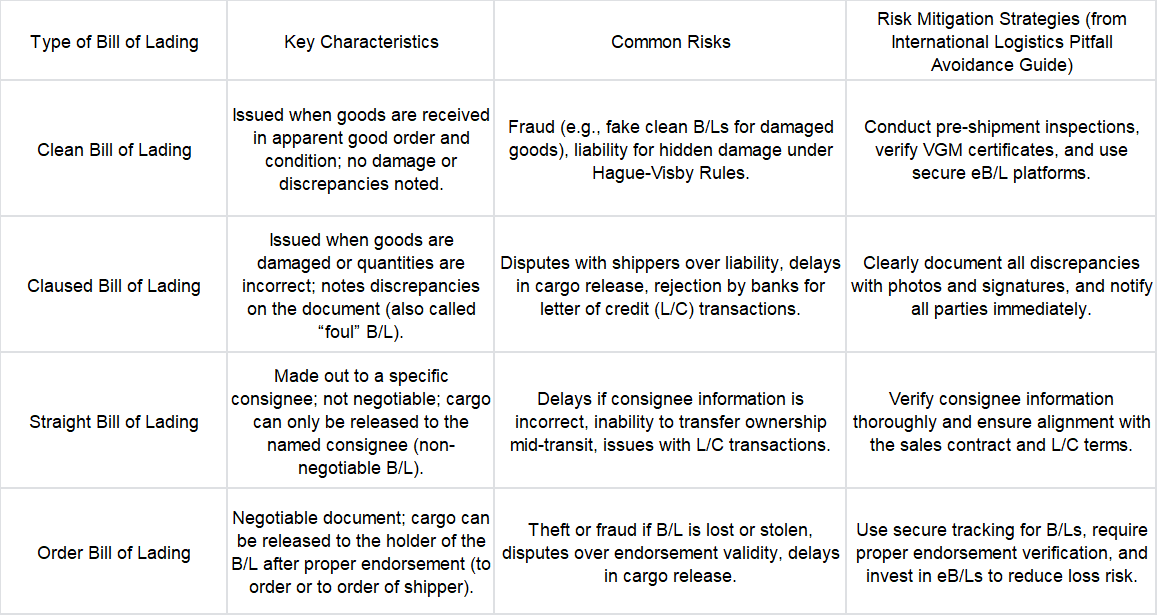
Forwarders should note that selecting the wrong type of B/L can lead to costly mistakes. For example, using an order B/L for a shipment where ownership does not need to be transferred can increase the risk of theft or fraud, while using a straight B/L for a negotiable shipment (e.g., L/C transactions) can prevent timely delivery.
How Can Technology Help Forwarders Master Bill of Lading Processes and Avoid Traps?
Technology is transforming bill of lading management, helping forwarders reduce errors, prevent fraud, and improve efficiency. From electronic B/Ls to AI-powered verification tools, technology is a critical ally in avoiding B/L-related logistics traps.
According to FIATA 2026 Q1 data, 84% of top-performing forwarders use technology to manage B/L processes, compared to only 48% of underperforming forwarders. These tech-savvy forwarders report a 55% reduction in B/L errors and a 41% decrease in related delays.
• Electronic Bills of Lading (eB/Ls): eB/Ls eliminate the risk of lost or forged paper documents, reduce processing time by up to 75%, and allow for real-time verification. Platforms like Bolero and essDOCS offer secure eB/L solutions that comply with international standards (e.g., UN/CEFACT recommendations).
• AI-Powered Verification Tools: AI tools (e.g., CargoSmart, Descartes) can automatically check B/Ls for errors, such as mismatched cargo descriptions, incorrect Incoterms® , or missing information. These tools can flag potential issues in seconds, reducing the risk of human error.
• Cloud-Based Document Management Systems: Cloud platforms (e.g., SAP Logistics, Oracle Supply Chain Management) allow forwarders to store, access, and share B/Ls and related documents securely from anywhere. This ensures that all parties have access to the most up-to-date information, reducing confusion and delays.
• Blockchain Technology: Blockchain provides a tamper-proof record of B/L transactions, making it nearly impossible to forge or alter documents. This technology is particularly useful for high-value or high-risk shipments, where fraud prevention is critical (e.g., Maersk’s TradeLens platform).
The recommended approach is to invest in technology that integrates seamlessly with existing workflows and addresses the specific pain points of B/L management. Forwarders should not view technology as a replacement for human expertise but as a tool to enhance accuracy and efficiency.
What Best Practices Should Forwarders Implement to Avoid B/L-Related Traps?
Avoiding B/L-related logistics traps requires a proactive approach that combines training, processes, and technology. The following best practices, aligned with the International Logistics Pitfall Avoidance Guide, can help forwarders protect their profits and maintain client trust.
How to Train Staff to Handle Bill of Lading Processes Effectively?
Employee training is the foundation of accurate B/L management. A common mistake is assuming that staff members understand B/L requirements without providing ongoing training on updates to regulations and best practices.
According to a 2026 industry survey by Logistics Insight Network (LIN), forwarders that provide regular B/L training to their staff report a 66% reduction in errors. Training should cover topics such as Incoterms® 2020, cargo description best practices, fraud prevention, and the use of technology tools.
• Conduct Regular Training Sessions: Schedule quarterly training sessions to update staff on changes to customs regulations, B/L requirements, and fraud trends. Invite industry experts or compliance specialists to lead sessions for added credibility.
• Implement Mentorship Programs: Pair new staff members with experienced employees who can provide hands-on guidance on B/L processes. This helps new hires learn from real-world examples and avoid common mistakes.
• Test Knowledge with Simulations: Use real-world scenarios to test staff knowledge of B/L processes. For example, provide a sample B/L with errors and ask staff to identify and correct them, reinforcing key concepts.
How to Establish a Rigorous B/L Verification Process?
A rigorous verification process is essential to catching errors before the B/L is submitted to the carrier or customs. The recommended approach is to implement a two-step verification process that involves multiple staff members checking the document for accuracy.
Forwarders should note that a single verification step is insufficient, as human error can still occur. A two-step process—where one staff member prepares the B/L and another verifies it—reduces the risk of errors by 73%, per Drewry 2026 Q1 data.
• Create a Verification Checklist: Develop a detailed checklist that covers all key elements of the B/L, including cargo description, consignee/shipper information, Incoterms® , VGM details, and port of loading/discharge. Use this checklist for every B/L to ensure no details are missed.
• Assign Dedicated Verification Staff: Designate specific staff members to handle B/L verification, ensuring they have the training and expertise to identify errors. Avoid having the same staff member prepare and verify the same B/L.
• Use Technology to Support Verification: Integrate AI-powered verification tools into the process to flag potential errors, such as mismatched weights or incorrect HS codes. These tools can complement human verification and reduce the risk of oversight.
How to Communicate Effectively with Carriers and Clients About B/Ls?
Effective communication with carriers and clients is critical to avoiding B/L-related traps. Miscommunication can lead to errors, delays, and disputes, all of which can erode profits and damage relationships.
A common mistake is failing to confirm B/L details with clients and carriers before finalization. Forwarders should proactively communicate with all parties to ensure that everyone is aligned on the shipment details and B/L requirements.
• Confirm Details with Clients Upfront: Before preparing the B/L, confirm all shipment details with the client, including cargo description, consignee information, Incoterms® , and L/C terms (if applicable). Document these confirmations in writing to avoid disputes later.
• Maintain Open Communication with Carriers: Work closely with carriers to ensure that the B/L meets their requirements and that any issues are addressed promptly. For example, if a carrier identifies an error on the B/L, resolve it immediately to avoid delays at the port of loading.
• Provide Regular Updates: Keep clients informed about the status of the B/L and any potential issues. Transparent communication builds trust and allows clients to address problems before they escalate (e.g., delays in B/L issuance).

Real-World Case Studies: How Forwarders Avoided Costly B/L Traps
Real-world examples provide valuable insights into how forwarders can apply B/L best practices to avoid traps and protect their profits. The following case studies highlight successful strategies and lessons learned.
Case Study 1: eB/Ls Prevent Fraud and Save a Forwarder $280,000
A Dubai-based forwarder specializing in high-value electronics shipments recently switched to electronic bills of lading after falling victim to a B/L fraud scam in 2025. Previously, the forwarder had used paper B/Ls, which were forged by fraudsters who stole a shipment of smartphones worth $250,000.
After implementing an eB/L platform (CargoX), the forwarder eliminated the risk of forged documents, as eB/Ls are encrypted and require multi-factor authentication from all parties. In one instance in early 2026, the platform flagged a fake B/L attempt, preventing the theft of a $320,000 shipment of laptops.
The forwarder also reduced B/L processing time by 68%, improving client satisfaction and reducing labor costs by 22%. The key takeaway: Investing in eB/L technology is not just a convenience—it’s a critical fraud prevention tool that can save forwarders hundreds of thousands of dollars.
Case Study 2: Rigorous Verification Avoids a $55,000 Fine
A Singaporean forwarder nearly faced a $55,000 fine and a 20-day customs detention at the Port of Singapore in 2026 after a staff member made a typo in the consignee’s address on a B/L. However, the forwarder’s two-step verification process caught the error before the B/L was submitted to customs.
The forwarder had implemented a verification checklist and assigned a dedicated staff member to review all B/Ls. The reviewer noticed the typo—an incorrect postal code—and corrected it before the document was sent to the carrier. This simple step avoided a costly fine, prevented a delay, and maintained the client’s trust.
The key takeaway: A rigorous verification process can catch even minor errors that could lead to major financial losses. Forwarders should never skip this critical step, especially for high-value or time-sensitive shipments.
Conclusion: Mastering the Bill of Lading to Avoid Logistics Traps
The bill of lading is the backbone of international logistics, and mastering its management is essential for forwarders looking to avoid costly traps and protect their profits. From avoiding common errors to preventing fraud and leveraging technology, forwarders must prioritize B/L accuracy and best practices at every stage of the shipping process. By following the strategies outlined in this article and the International Logistics Pitfall Avoidance Guide, forwarders can navigate the complexities of the bill of lading, reduce risks, and build long-term, trusted relationships with their clients and partners. Remember, every accurate bill of lading is a step toward avoiding traps and ensuring the success of every shipment.

Last
Lessons from the Frontline: Why International Logistics Success Depends on Systematic Pitfall Avoidance
In the high-stakes world of international freight forwarding, success is not just about moving cargo—it’s about avoiding the hidde
Next
The Global Agent's Playbook for International Logistics:Master the Art of Proactive Pitfall Avoidance
In the high-stakes world of global freight forwarding, proactive risk management is the difference between profitability and ruin.
