Maersk Overtakes COSCO to Top Intra-Asia Capacity Rankings
Logistics News
 21-Sep-2026
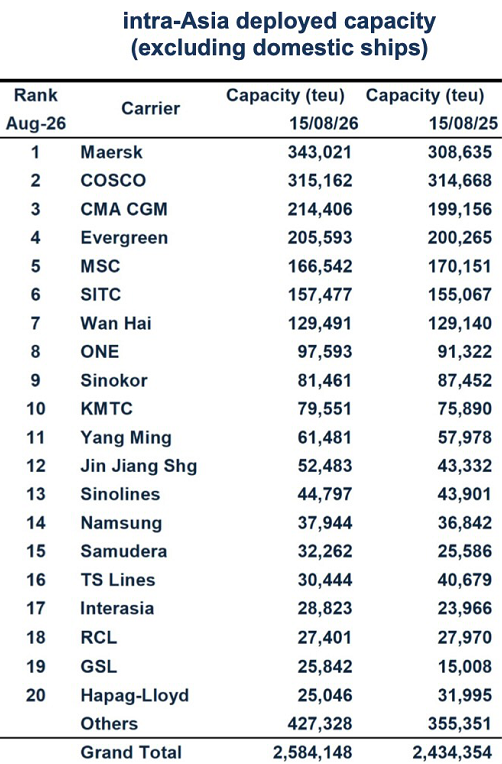
Maersk has moved to the top of the capacity rankings for international intra-Asia container services. According to Alphaliner’s latest fleet survey, Maersk had deployed more than 340,000 TEUs on intra-Asia routes as of August 15, overtaking COSCO to become the largest carrier by deployed capacity in this market. This ranking applies solely to capacity deployed on international intra-Asia container services and does not indicate any change in the global liner rankings.
Key Highlights
• Maersk deploys more than 340,000 TEUs: The carrier has overtaken COSCO to rank first in intra-Asia capacity.
• Intra-Asia capacity expands: Total capacity on international intra-Asia container services increased by 6.2% year on year to nearly 2.6 million TEUs.
• Gemini’s hub-and-spoke network expands: The network’s development has been a major factor behind Maersk’s additional intra-Asia capacity.
Why Has Maersk Overtaken COSCO?
Over the past year, Maersk has added approximately 34,000 TEUs of capacity to its international intra-Asia services, placing it among the carriers with the largest capacity increases. Maersk currently operates around 108 vessels in this market, with an average vessel size of 3,176 TEUs—one of the highest among the major carriers. Although it does not operate the largest number of vessels, its overall capacity now exceeds COSCO’s.
COSCO has taken a different course. It operates more than 120 vessels in the intra-Asia market, but its deployed capacity remains broadly unchanged from last year, while its average vessel size has fallen by around 6%. This allowed Maersk to move ahead. The change is not simply about how many vessels each carrier has added; vessel size and capacity allocation also determine the rankings. Meanwhile, the international intra-Asia container market continues to expand, with total deployed capacity approaching 2.6 million TEUs, up 6.2% year on year.
How Is the Gemini Network Reshaping Intra-Asia Capacity Deployment?
Maersk’s increase in intra-Asia capacity is partly linked to the Gemini Cooperation network operated with Hapag-Lloyd. Under its hub-and-spoke model, additional intra-Asia shuttle and feeder services consolidate cargo at hub ports for onward connection to east–west mainline services. As the network has taken shape, intra-Asia connections have assumed a larger role in collecting and distributing cargo, leading Maersk to add vessels and capacity in the region.
Maersk’s capacity growth in Asia does not necessarily mean that regional cargo volumes have suddenly surged. It also largely reflects the redeployment of capacity following changes to the carrier’s service network. For cargo transshipped through Asian hub ports, changes to feeder services, port rotations, and hub connections could all affect actual routing.
Competition Intensifies as Intra-Asia Transport Routes Change
The shift between Maersk and COSCO is not the only change in the market. According to Alphaliner, CMA CGM has added approximately 15,000 TEUs over the past year, overtaking Evergreen to move into third place. Meanwhile, SITC remains the largest regional specialist in the intra-Asia market, operating around 109 vessels with approximately 157,000 TEUs of deployed capacity. More than 80 liner operators now serve the market. Although mainline carriers operate fewer vessels, their larger average vessel sizes give them more than 63% of total deployed capacity.
More significant than the rankings themselves are the operational effects of carriers’ continued adjustments to their regional networks. Port rotations, transshipment points, feeder connections, and sailing schedules could all change as these networks are revised. For shipments requiring intra-Asia transshipment through hub ports, freight forwarders should confirm feeder connections, transshipment routes, and actual sailing schedules before booking. This can help avoid unexpected transshipment delays and transit-time changes caused by service adjustments. Maersk’s move ahead of COSCO primarily reflects the major carriers’ ongoing redeployment of capacity across Asia; the change in ranking is only the most visible result.
Sources and Disclaimer
Sources include Alphaliner, The Loadstar, Splash247, and other publicly available shipping industry information. This article is provided solely for reference by the international logistics and freight forwarding industry. Specific operational arrangements remain subject to the latest notices from the relevant authorities and carriers.
Last
24,188 TEU OOCL PORTUGAL Transits Suez as Asia-Europe Services Gradually Resume
The transit of a 24,000 TEU containership through the Suez Canal provides a clearer sign that Asia–Europe services are beginning t
Next
Oil Spill from MSC Container Ship Temporarily Disrupts Antwerp Vessel Traffic; Some Berths Remain Restricted
An oil spill occurred at Deurganckdok in the Port of Antwerp, Belgium, on September 14, local time, after a breach was discovered
