27,500-TEU Container Ships Back in Focus: Which Carrier Is Best Positioned to Deploy Them-Maersk, MSC or COSCO SHIPPING?
Logistics News
 15-Sep-2026
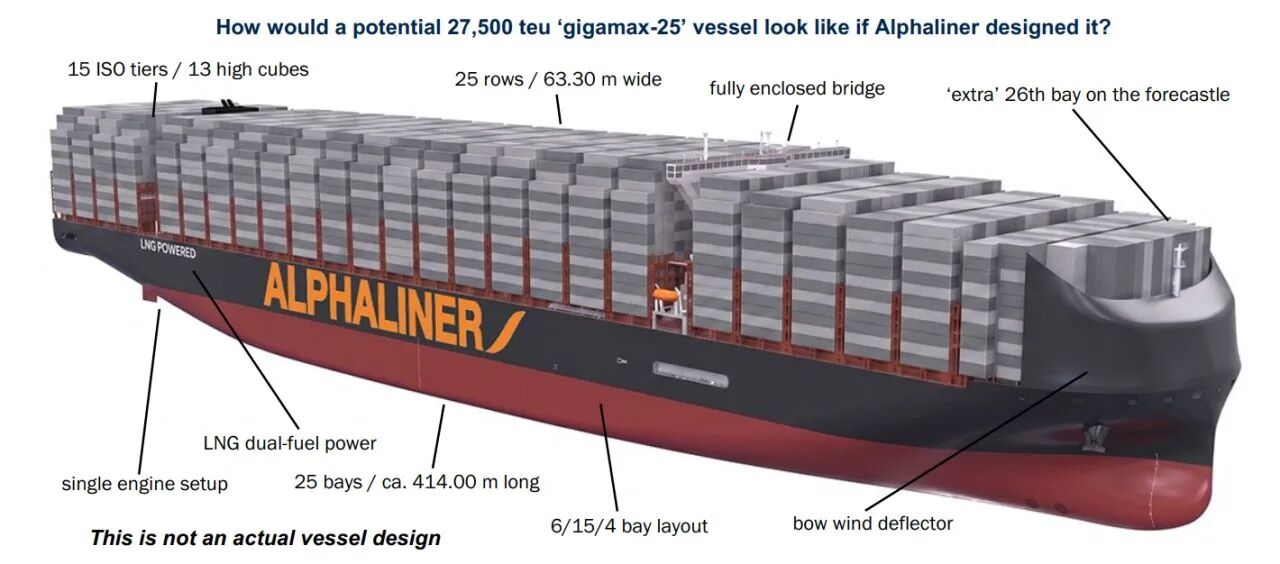
The container shipping industry may be reassessing how large its vessels can become. Shipping consultancy Alphaliner recently revisited its earlier “Gigamax” concept, suggesting that container ships with capacities of around 27,500 TEUs could become commercially viable in the 2030s as vessel designs improve and fuel prices and carbon costs evolve.
Ships of this size are not a new concept. Earlier Gigamax proposals and the 27,500-TEU LNG dual-fuel design developed by the Shanghai Merchant Ship Design and Research Institute (SDARI), part of China State Shipbuilding Corporation, have already demonstrated the technical feasibility of vessels at this scale. The industry discussion is now shifting from whether such ships can be built to whether there is a commercial case for operating them.
Key Highlights
• Renewed interest: Container ships with capacities of around 27,500 TEUs are back in focus and could become commercially viable in the 2030s.
• Potential operators: Maersk, MSC, and COSCO SHIPPING have the fleet scale and mainline networks needed to operate ultra-large container vessels.
• Commercial viability: Cargo volumes, port capabilities, and economies of scale will ultimately determine whether Gigamax vessels enter commercial service.
Why Are 27,500-TEU Container Ships Back in Focus?
“Gigamax” is not a new vessel concept. Alphaliner proposed an LNG-powered Gigamax design with a capacity of around 26,800 TEUs or more as early as 2021. In 2024, SDARI unveiled GREEN SEALION 27500, an LNG dual-fuel container ship design with a maximum capacity of 27,500 TEUs. The design received Approval in Principle (AiP) from DNV.
From a technical perspective, a capacity of 27,500 TEUs is no longer purely theoretical. Renewed interest in vessels of this size reflects continued improvements in vessel design and fuel efficiency, as well as changes in fuel prices and carbon costs. These factors are prompting carriers to reassess the long-term operating economics of larger ships.
Why Could Larger Ships Reduce Unit Costs?
For carriers, the main reason for deploying larger vessels remains economies of scale. According to Alphaliner, a highly optimized Gigamax vessel operating at 18 knots or below could add approximately 7,000 TEUs of capacity without a proportionate increase in fuel consumption.
In practical terms, if a ship can carry more containers while using relatively little additional fuel, the average cost per container could fall on high-volume deep-sea mainline trades. As fuel prices and carbon costs become increasingly important factors in fleet investment, greater capacity per vessel could also help carriers spread some operating costs across more containers.
However, economies of scale depend on sufficient cargo volumes. If a service cannot maintain high load factors, increasing vessel size may instead create underutilized capacity. The commercial value of a 27,500-TEU vessel therefore depends not simply on adding another 7,000 TEUs of capacity, but on whether those additional slots can be filled consistently over the long term.
Which Carrier Is Best Positioned to Deploy Them—Maersk, MSC or COSCO SHIPPING?
Based on their fleet scale and mainline network coverage, Maersk, MSC, and COSCO SHIPPING all have the operational foundation needed to deploy ultra-large container vessels. It is therefore unsurprising that they are viewed as potential operators.
Maersk has not yet ordered any vessels in the 24,000-TEU class. If it were to introduce a 27,500-TEU design, the capacity of its largest vessels would increase further. MSC and COSCO SHIPPING also have extensive experience operating large container ships and could deploy even larger vessels on their mainline services.
However, being identified as a potential operator does not mean that an order has been confirmed. There is currently insufficient public information to show that any of the three carriers has decided to order 27,500-TEU vessels.
Future cargo volumes, port capabilities, and investment returns will ultimately determine which carriers, if any, adopt the design. If vessel sizes continue to increase, ports will also need to expand their quay crane, yard, and landside transport capacity. A single call by a 27,500-TEU vessel would require a port to handle more containers within a concentrated period. At the same time, with global containership ordering already at a high level, carriers must consider whether adding more ultra-large capacity could create oversupply on certain trades.
The path to commercial deployment for 27,500-TEU vessels is therefore no longer defined by technical feasibility alone. Their prospects will depend more heavily on their economics and suitability for specific trades.
For the global container shipping market, the key question is not which carrier will place the first order, but whether ultra-large vessels can achieve a viable balance between cargo volumes, port capabilities, and operating costs. If these conditions gradually fall into place, 27,500-TEU vessels could represent the next stage in the development of larger container ships. If cargo volumes and port capabilities cannot support them, vessels of this size may remain limited to design proposals and a small number of suitable trades.
Sources and Disclaimer
Sources include Alphaliner, the Shanghai Merchant Ship Design and Research Institute (SDARI), DNV, and other publicly available shipping information. This article is provided solely for reference by the international logistics and freight forwarding industry. Specific arrangements remain subject to the latest notices issued by the relevant authorities and companies.
Next
MSC Shipmanagement and Hong Kong Shipowner Fined $1.75 Million Over Illegal Discharges by MSC Samira III
On August 28, local time, the U.S. Department of Justice announced that MSC Shipmanagement Limited and Hong Kong-based shipowner H
