U.S. Spot Rates Near USD 10,000 While Schedule Reliability Drops to 29.4%
Logistics News
 10-Sep-2026
Container spot rates on U.S. trades have continued to climb since the beginning of September, with the Shanghai–New York rate reaching USD 9,587 per FEU—just short of USD 10,000. At the same time, global container shipping schedule reliability has fallen to 29.4%, while on-time performance on Far East–North America trades has also deteriorated significantly. For shippers, the key concern is no longer simply rising freight rates, but whether paying more will result in more reliable service.
Key Highlights
• Shanghai–New York rates: Spot rates have risen to USD 9,587 per FEU, approaching the USD 10,000 mark.
• Schedule reliability: Global schedule reliability has fallen to 29.4%. High rates are now coinciding with poor on-time performance.
• Diverging markets: U.S. trades continue to strengthen, while Asia–Europe rates have declined sharply.
U.S. Spot Rates Approach USD 10,000 as Carriers Restrict Capacity
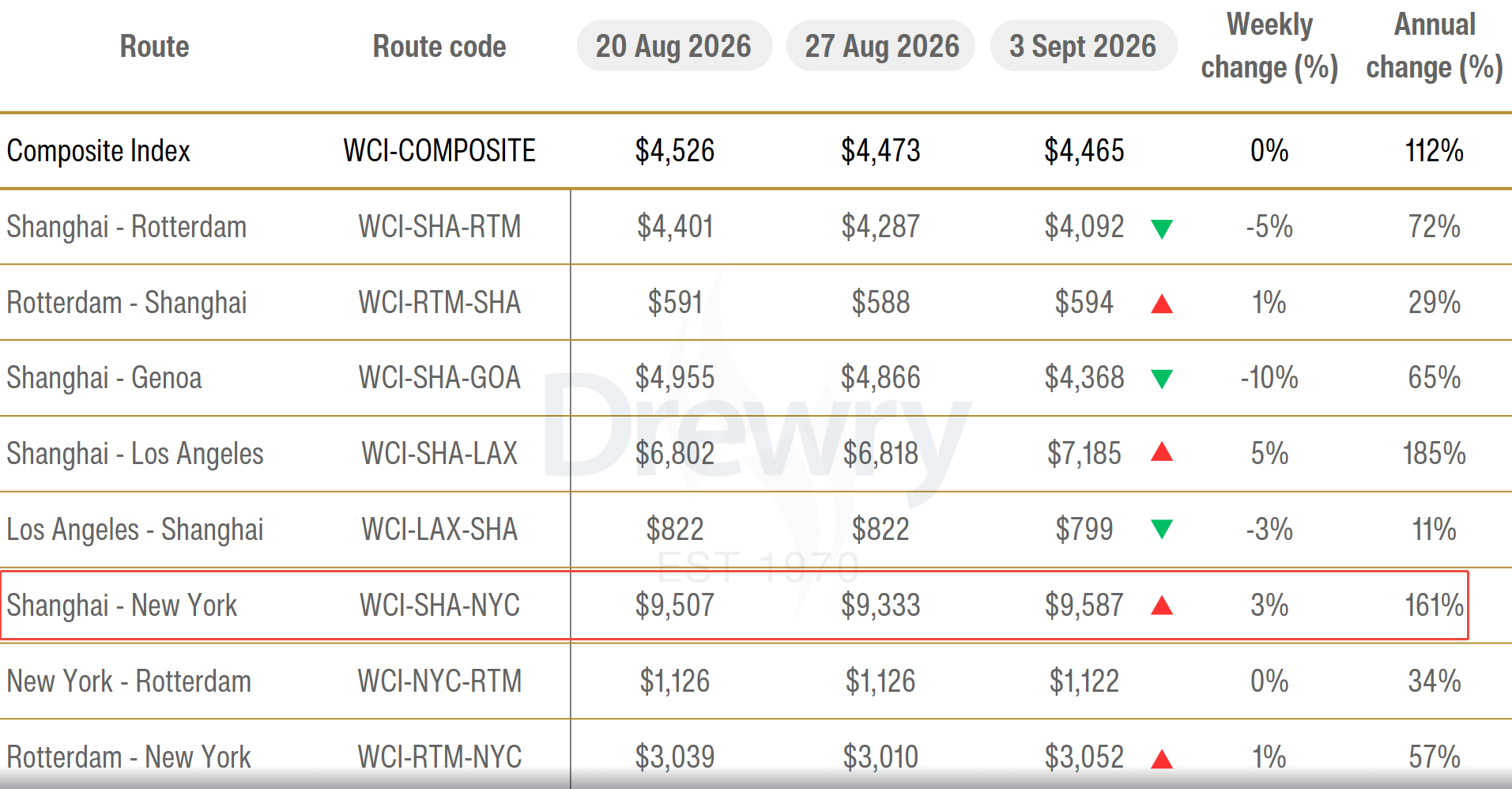
According to Drewry’s World Container Index (WCI), published on September 3, the Shanghai–New York spot rate rose 3% to USD 9,587 per FEU, while the Shanghai–Los Angeles rate increased 5% to USD 7,185 per FEU.
Rates on U.S. trades continue to rise, supported by peak-season cargo volumes and tighter supply as carriers implement blank sailings, adjust port calls, and restrict capacity on transpacific trades. Over a longer period, Xeneta data shows that as of September 3, average spot rates from the Far East to the U.S. East Coast had risen 305% since the end of February, while rates to the U.S. West Coast were up 289%.
With no significant weakening in demand, reduced effective capacity continues to support U.S. rates. Drewry’s latest capacity outlook shows that six blank sailings have already been announced on transpacific trades for next week, twice the number scheduled for this week. As a result, there is currently little indication that U.S. rates will fall sharply in the near term.
Why Is Schedule Reliability Falling as Freight Rates Rise?
While freight rates continue to climb, schedule performance is deteriorating. According to Xeneta, global container shipping schedule reliability fell to 29.4% in August 2026, marking a third consecutive monthly decline and a significant drop from the recent high of 39% recorded in May. Schedule reliability on Far East–North America trades also fell from 38% in mid-June to 19% at the end of July.
Port closures, congestion, and vessel backlogs caused by the recent typhoon season in Asia have been among the key factors affecting schedule performance. Schedule reliability measures how consistently vessels adhere to published schedules and should not be viewed simply as the percentage of vessels arriving at port on time.
Freight rates reflect market supply, demand, and effective capacity, while schedule reliability reflects actual service performance. The two indicators do not necessarily move in the same direction. This means that even when shippers pay higher ocean freight rates, they may not receive more predictable arrival times. For cargo tied to production schedules, sales deadlines, or overseas warehouse replenishment, uncertainty over transit times may be a greater concern than higher freight costs alone.
U.S. Rates Rise as European Trades Weaken
While U.S. trades continue to strengthen, rates from Asia to Europe are declining. Drewry data shows that on September 3, the Shanghai–Rotterdam rate fell 5% to USD 4,092 per FEU, while the Shanghai–Genoa rate dropped 10% to USD 4,368 per FEU.
With additional capacity entering the market and demand on European trades weakening, rates are likely to remain under downward pressure in the near term. The container shipping market is therefore not seeing a broad-based increase. Instead, a clear divergence has emerged, with U.S. trades strengthening and European trades weakening.
Customers arranging shipments on U.S. trades should look beyond freight rates and confirm the specific sailing schedule, any planned blank sailings, expected departure and arrival dates, possible transshipment arrangements, quote validity, and applicable surcharges. Additional time should also be allowed for schedule delays and onward connections, particularly for time-sensitive cargo.
Whether U.S. rates remain elevated will depend on peak-season volumes, carrier capacity management, and operating conditions across ports and trade lanes.
Sources and Disclaimer
Sources include Drewry, Xeneta, and other publicly available shipping industry sources. This article is provided solely for reference by the international logistics and freight forwarding industry. Specific operational arrangements remain subject to the latest notices from the relevant authorities and companies.

Last
Houthi Strikes Hit Saudi Energy Facilities, Renewing Red Sea Concerns
On September 8, Yemen’s Houthis launched drone and missile attacks against multiple targets in southern Saudi Arabia, including Ab
Next
Amazon Prime Air Freighter Overruns Runway as Two Miami Airport Runways Remain Closed
On September 6, a Boeing 767 operating an Amazon Prime Air cargo flight overran the runway while landing at Miami International Ai
