T.S. Lines' First-Half Profit Rises 23.3% as Middle East Revenue Surges 130% and Red Sea Services Generate USD 13 Million
Logistics News
 10-Sep-2026
T.S. Lines reported lower volumes but higher earnings for the first half of 2026. Although its container volume edged down, both revenue and profit increased. Gross profit rose 31.8% year on year, while profit attributable to shareholders increased 23.3%. Revenue from the Middle East, Red Sea, and Mexico also grew rapidly, becoming important sources of growth as the carrier adjusted its service network.
Key Highlights
• Financial performance: First-half volume fell 0.9%, while revenue increased 3% and profit attributable to shareholders rose 23.3%.
• Revenue per TEU: Average revenue per TEU increased to USD 741, while revenue from the Middle East rose 130.1% year on year.
• Red Sea services: The carrier moved 7,545 TEUs on its Red Sea services, generating approximately USD 13 million in revenue as it continued to expand its network.
Higher Revenue per TEU Lifts Profit Despite Lower Volumes
T.S. Lines’ first-half growth was not driven by higher cargo volumes. The company carried 810,842 TEUs during the period, down 0.9% year on year, while revenue still reached USD 660.4 million, an increase of 3%. Profit attributable to shareholders was approximately USD 232.6 million, up 23.3%, while gross profit rose 31.8% to approximately USD 167.5 million.
The key factor behind the combination of lower volume and higher revenue was an improvement in revenue per TEU. T.S. Lines’ average revenue per TEU increased from USD 715 in the same period last year to USD 741, a rise of approximately 3.6%. With volumes broadly stable, higher unit revenue, cost control, and adjustments to the service network allowed revenue and profit to grow significantly faster than cargo volume.
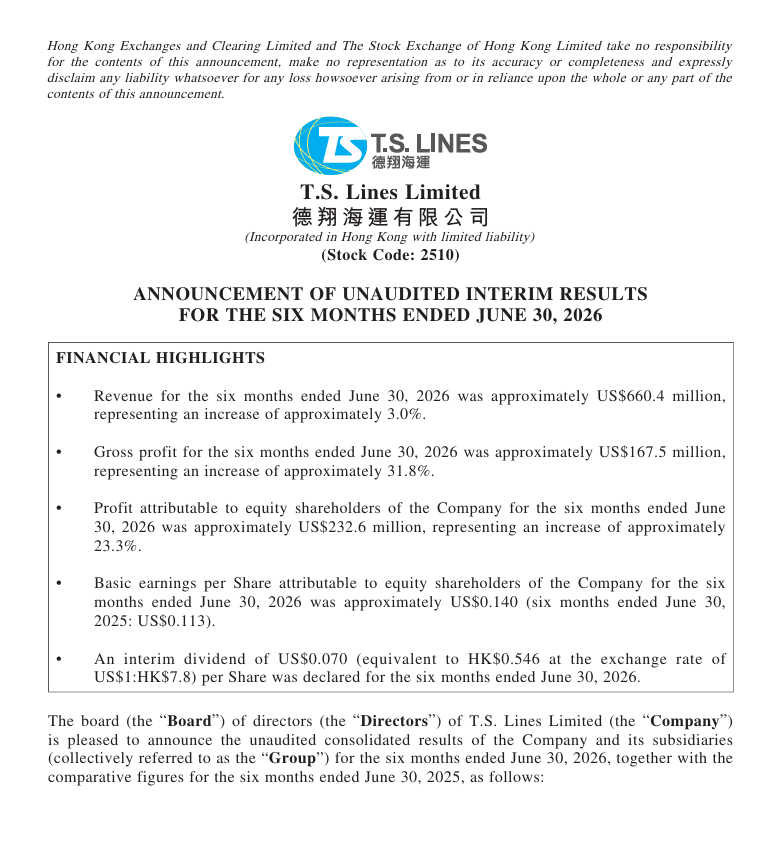
The figures show that T.S. Lines is focusing not only on increasing volumes but also on improving revenue and profitability per slot through yield management, capacity deployment, and service adjustments.
Middle East Revenue Surges 130% as Red Sea Services Create a New Revenue Stream
Revenue growth in the Middle East and other emerging markets far outpaced the company’s overall growth. In the first half of 2026, T.S. Lines generated approximately USD 77.4 million in revenue from the Middle East, up 130.1% year on year. The carrier moved 7,545 TEUs on its Red Sea services, generating approximately USD 13 million in revenue and creating a new revenue stream for the company.
Revenue from Mexico also recorded strong growth, reaching approximately USD 15.7 million in the first half, compared with around USD 5 million a year earlier. Beyond its traditional Asia-Pacific markets, the Middle East, Red Sea, and Mexico are contributing additional revenue growth.
It is important to distinguish the increase in overall Middle East revenue from revenue generated specifically by Red Sea services. The Red Sea remains a relatively new market within T.S. Lines’ broader operations, and the sharp rise in Middle East revenue cannot be attributed entirely to these services. More significantly, the carrier is expanding into longer-haul trades, reducing its reliance on traditional regional markets.
T.S. Lines Continues Capacity Adjustments With 47 Vessels Across 47 Services
Alongside changes to its market coverage, T.S. Lines is continuing to expand and adjust its fleet. As of the end of June 2026, the company operated 47 container ships with a combined capacity of 139,743 TEUs across 47 services. In April, it took delivery of the 7,000 TEU-class container ship TS KELANG. As additional newbuildings are delivered, the carrier will deploy the new capacity in line with market demand.
T.S. Lines is not simply seeking to expand its fleet. Its current strategy is focused on improving returns through service selection, unit revenue, and capacity deployment. Rapid growth in the Middle East, Red Sea, and Mexico also indicates that the carrier is reallocating capacity in response to global trade flows and market yields.
For logistics customers, the company’s first-half results send an important signal: carrier profitability does not depend solely on volume growth. Service mix and revenue per slot are also important. If T.S. Lines continues to expand its presence in longer-haul markets such as the Middle East and Red Sea, further adjustments to schedules, capacity, and service coverage may follow. Customers with upcoming shipments on these trades should monitor new services, schedule changes, and capacity deployment.
Sources and Disclaimer
Sources include T.S. Lines, the Hong Kong Stock Exchange, and other publicly available shipping information. This article is provided solely for reference by the international logistics and freight forwarding industry. Specific operational arrangements remain subject to the latest notices from the relevant authorities and companies.
Last
Amazon Prime Air Freighter Overruns Runway as Two Miami Airport Runways Remain Closed
On September 6, a Boeing 767 operating an Amazon Prime Air cargo flight overran the runway while landing at Miami International Ai
Next
Israel Gives Hapag-Lloyd and FIMI 30 Days to Revise ZIM Acquisition Plan
Israel has given Hapag-Lloyd and Israeli private equity firm FIMI around 30 days to revise their proposed acquisition of ZIM, inst
