Sudden Reversal: Houthis Deny General Red Sea Transit Fee Plan as Bab el-Mandeb Controls Tighten, Raising Route Risks and Costs for Freight Forwarders
Logistics News
 4-Aug-2026
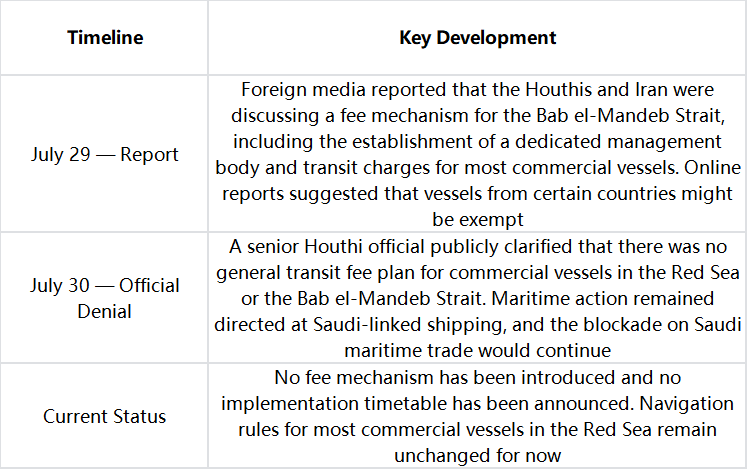
The Red Sea shipping situation has taken a sudden turn. On July 29, Reuters reported that Yemen’s Houthis were considering charging commercial vessels transit fees in the Bab el-Mandeb Strait, causing concern across the logistics market. The following day, a senior Houthi official denied the report, stating that there was currently no plan to impose a general transit fee and that the maritime blockade remained focused on Saudi-linked shipping. The report and subsequent denial indicate that risks on Red Sea routes are extending beyond security incidents to potential changes in costs and navigation rules, with important implications for freight forwarders’ quotation calculations, route risk control, and customer fulfillment.
Key Highlights
• Rapid Reversal: Houthi officials deny reports of a general Red Sea transit fee plan shortly after they emerge
• Wider Range of Risks: Red Sea shipping risks are extending from security incidents to potential cost and regulatory changes
• Scope of Controls Clarified: The blockade remains focused on Saudi-linked shipping, while no general fee currently applies to neutral commercial vessels
• Key Response for Freight Forwarders: Closely monitor policy developments and adjust Red Sea shipment plans as needed
Key Developments in the Red Sea Transit Fee Report and Official Denial
How the Report Emerged: Red Sea Shipping Faces a Possible New Form of Control
The Bab el-Mandeb Strait is a key chokepoint on the Red Sea and Suez Canal route and is critical to Asia-Europe shipping and energy transport. Since late 2023, repeated Houthi attacks have forced many vessels to reroute around the Cape of Good Hope, directly increasing freight rates, insurance costs, and transit times on Red Sea routes and leaving services unstable for an extended period.
The transit fee report raised concerns that the nature of Red Sea shipping risks could change. Previously, the market mainly had to manage the risk of attacks on vessels. Future variables may also include transit charges, compliance controls, and changes to navigation rules. Reports claimed that the Houthis were considering establishing a dedicated waterway management and fee mechanism based on arrangements used in other international straits. If introduced, such a mechanism would change the traditional free-passage arrangement in the Red Sea and affect cross-border logistics costs.
Situation Reverses: No General Transit Fee, but Targeted Blockade Remains
On July 30, senior Houthi official Hazam al-Asad publicly denied the widely discussed report, stating that there was currently no plan to charge all commercial vessels operating in the Red Sea or the Bab el-Mandeb Strait. The clarification temporarily eased concerns over an immediate increase in transit costs.
Freight forwarders should note, however, that the scope of the Houthi maritime blockade against Saudi Arabia has expanded. The restrictions are not limited to Saudi-flagged vessels. Ships calling at Saudi ports or loading or discharging Saudi-bound cargo may also fall within the restricted scope, meaning that neutral commercial vessels could still face risks.
The report also reflects growing market concern over changes in Houthi shipping controls. Maritime action is no longer limited to attacks on individual vessels but may increasingly involve more targeted restrictions based on vessel links, port calls, and cargo movements. Although no general fee plan is currently being implemented, changes to navigation rules and rising costs on Red Sea routes remain possible. With freight rates rising and sailing schedules remaining unstable, freight forwarders may use the Inquiry Board to connect with genuine cargo opportunities and suitable logistics channels, adjust shipment arrangements, and reduce fulfillment risks on Red Sea routes.
Operational Impact and Risk Control Priorities for Freight Forwarders
In the short term, immediate concerns over a general transit fee have eased, but the cost impact of the Red Sea situation is already being felt. Several liner operators have announced freight rate increases on Red Sea routes from August 1, while current market rates have reportedly risen by 40% to 50% compared with the previous month.
Regional Container Lines (RCL) has also invoked force majeure due to the Red Sea situation and cancelled sailings from several Chinese ports to the Red Sea. Related storage, rerouting, demurrage, and other additional costs are to be borne by the cargo interests, significantly increasing quotation and fulfillment risks for freight forwarders.
This means that freight forwarders can no longer limit risk control to navigation safety. They must also monitor Houthi blockade rules, carrier schedule changes, freight rate increases, force majeure clauses, and insurance policy updates. Delayed information may result in quotation losses, failure to fulfill orders, and customer disputes.
Operational Self-Check List for Freight Forwarders
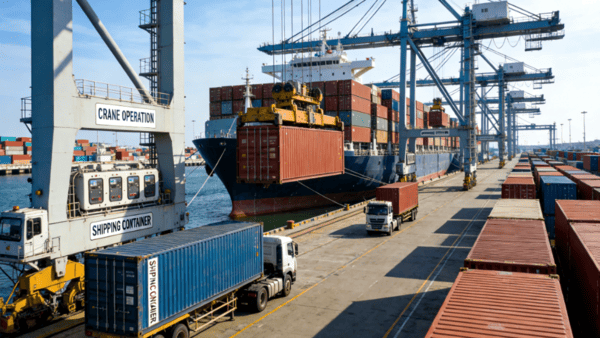
• Have you informed customers of the latest reversal in the Red Sea situation and managed shipment and quotation expectations?
• Have you reviewed current orders in detail, particularly cargo involving loading or discharge at Saudi ports, and applied appropriate risk controls in advance?
• Are you continuing to monitor official Houthi statements and carrier route adjustments?
• Are you tracking individual sailings, service suspensions, and rate increase notices from carriers to reduce exposure to force majeure risks?
Action Summary: Immediate concerns over a general Red Sea transit fee have eased, but tighter shipping controls remain a developing trend. Freight forwarders should continue monitoring policy changes, adjust quotations and shipment contingency plans flexibly, and use suitable logistics resources to offset geopolitical risks and support stable order fulfillment.
Sources: Reuters, Al-Araby, official Houthi statements, and cross-border logistics industry platforms
Disclaimer: All information is sourced from publicly available channels and is provided for industry reference only. It does not constitute commercial or logistics operational guidance.
Last
New Asia-Europe Route: South Korea Launches Its First Commercial Arctic Container Service, with an August Trial Voyage Set to Reshape Europe-Bound Logistics for Freight Forwarders
A new development is taking place in Asia-Europe cross-border logistics. South Korea’s Panstar Line has announced a commercial tri
Next
Iran Rejects Joint Management Plan: Strait of Hormuz Navigation Regime to Be Restructured as Freight Forwarders Strengthen Risk Controls for Energy Routes
A new development has emerged in Middle East cross-border shipping. On July 28, The Wall Street Journalreported that Iran had form
