Cargo in the East, Capacity in the West: Five European Carriers Control More than Half of Global Container Shipping Capacity in 2026
Logistics News
 22-Jul-2026
Introduction: The global shipping market presents a striking imbalance. Asia is home to the world’s core manufacturing capacity, leading port clusters and largest cargo volumes, making it the world’s main manufacturing and cargo origin region. However, European shipping groups control much of the global container shipping capacity, pricing power and mainline service resources. According to Alphaliner’s latest capacity data for July 2026, more than half of global container shipping capacity is concentrated among five European carriers. This highly concentrated market structure will have a significant influence on Asia–Europe freight rates, capacity allocation and industry competition in the coming years.
Global Capacity Overview: 7,592 Container Ships as Market Concentration Increases
According to Alphaliner data as of July 9, 2026, the global operating container fleet comprises 7,592 vessels, with total capacity exceeding 34.428 million TEUs.
The distribution of global container shipping capacity shows a continuing rise in market concentration. Rather than a broadly fragmented competitive market, the industry now has a tiered structure led by European carriers, followed by Asian shipping groups, with Middle Eastern and American carriers accounting for smaller shares.
The most notable feature is that five leading European carriers control 55.3% of global container fleet capacity, with combined capacity exceeding 18.9 million TEUs. This places European shipping groups in a dominant position in the global container shipping market.
Cargo volumes are concentrated in Asia, while much of the capacity and pricing power remains in the hands of European carriers. This imbalance is a key factor shaping current cross-border logistics and foreign trade shipments.
European Shipping Groups: Five Carriers Control More than Half of Global Capacity
Leading European carriers have long pursued strategies centred on larger vessels and alliance cooperation. Through vessel upsizing, fleet expansion, mergers and acquisitions, and service network optimization, they have continued to strengthen their positions in the global shipping market.
The capacity of the major European carriers in July 2026 is as follows:
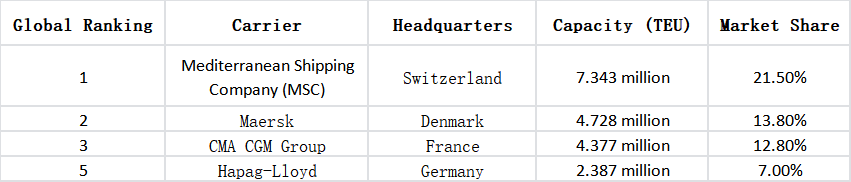
Source: Alphaliner, July 9, 2026
The figures show that MSC holds a substantial lead, with capacity reaching 7.343 million TEUs and a global market share of more than one-fifth. It is the only liner carrier with capacity exceeding seven million TEUs.
In May 2026, MSC’s operated fleet officially surpassed 1,000 vessels, making it the first container carrier to operate a fleet of this size and further raising the scale of its operations.
The capacity gap between MSC and second-ranked Maersk has widened to 2.615 million TEUs. With capacity of 4.728 million TEUs and a 13.8% market share, Maersk remains one of the principal carriers supporting global trade.
CMA CGM follows with capacity of 4.377 million TEUs and continues to narrow the gap. The group has stated that it expects to overtake Maersk and become the world’s second-largest liner carrier by the end of 2027.
Hapag-Lloyd remains fifth globally and is another major component of Europe’s leading carrier group.
Asian Carriers: More Companies and Continued Capacity Growth Supported by Cargo-Origin Advantages
Unlike Europe, where capacity is concentrated among a small number of carriers, Asia has a larger group of shipping companies expanding their fleets steadily.
Of the world’s top 30 carriers, 19 are based in Asia, more than in any other region. Together, they control 35.1% of global capacity, with combined capacity exceeding 12 million TEUs, forming a stable second tier in the market.
The capacity of the major Asian carriers in July 2026 is as follows:
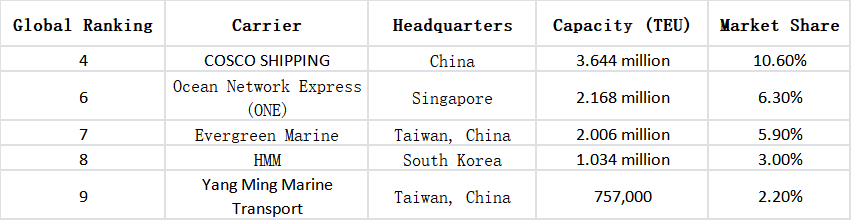
Source: Alphaliner, July 9, 2026
With capacity of 3.644 million TEUs, COSCO SHIPPING ranks fourth globally and first in Asia, making it a central carrier in the Asian shipping market.
ONE and Evergreen Marine follow. Evergreen’s capacity exceeded two million TEUs in the first half of 2026, further strengthening its position among the world’s leading liner carriers.
Supported by Asia’s position as the world’s main manufacturing base, Asian carriers benefit from high cargo density and extensive network coverage on trans-Pacific and intra-Asia routes.
This has created a market structure in which Asia controls a substantial share of cargo origins, while European carriers control a larger share of global liner capacity.
Middle Eastern and American Carriers: Focused on Niche and Regional Trades with Limited Influence on the Global Market
Compared with Europe and Asia, carriers based in the Middle East and the Americas account for relatively small shares of global capacity. They generally focus on particular regional or niche trades and have limited influence on the overall global structure, although they remain important within their respective markets.
Middle Eastern carriers account for a combined 3.6% of global market share, with total capacity exceeding 1.2 million TEUs.
The main representative is ZIM Integrated Shipping Services, which ranks tenth globally with capacity of approximately 694,000 TEUs.
A major current industry development is Hapag-Lloyd’s proposed USD 4.2 billion acquisition of ZIM. If completed, the transaction would strengthen Hapag-Lloyd’s presence on Middle East routes and reshape regional capacity distribution and freight rate structures.
The container shipping market in the Americas is largely regional. Among the world’s top 30 carriers, companies based in the Americas account for only 0.2% of global capacity.
The main representative is US carrier Matson. The company focuses on trades covered by the Jones Act, including services to Hawaii and Alaska, and specializes in regional operations. It has limited involvement in the world’s major mainline trades and therefore has little influence on Asia–Europe freight rates or the overall distribution of global capacity.
Industry Analysis: Four Key Trends Shaping Ocean Shipping over the Next Three Years
The latest capacity rankings reflect more than changes in carrier positions. They also show broader changes in the structure of global container shipping and have direct implications for freight forwarder quotations, foreign trade shipments and route planning.
1. European Carriers Retain Strong Pricing Power as Market Concentration Increases
Five European carriers control more than half of global container capacity. Freight rates, service arrangements and capacity deployment on major trades are therefore increasingly influenced by a small number of leading carrier groups rather than by a widely fragmented market.
Freight forwarders and foreign trade companies now operate within a highly concentrated carrier and alliance structure. This may limit the scope for sustained freight rate declines and increase the likelihood that rate increases will spread rapidly across the market.
Freight rate stability and predictability may continue to weaken, further increasing quotation risks.
2. European Carrier Rankings Continue to Shift as CMA CGM Targets Second Place
In the first half of 2026, CMA CGM added 237,000 TEUs of capacity, representing growth of 5.7%, the highest rate among the world’s top ten carriers.
Together with an orderbook of 158 vessels, this expansion is expected to support continued capacity growth over the next 18 months and place further pressure on Maersk’s second-place position.
The current ranking of the world’s three largest carriers may therefore change. A further reshuffling among European carriers could also lead to adjustments in global service networks, slot allocation and freight rate structures.
3. The Balance between Asian Cargo Origins and European Capacity Control Will Continue
Asia controls many of the world’s main cargo origins and port resources, while European carriers control a substantial share of mainline capacity and pricing power. This creates both interdependence and competition between the two regions.
Asian carriers benefit from their proximity to major cargo origins and have natural advantages on regional and trans-Pacific routes.
European carriers rely on their mainline capacity and global service networks to maintain influence over pricing on major international trades.
The shipping market is therefore likely to retain a long-term structure in which much of the cargo originates in Asia while a large share of global liner capacity is controlled by European carriers.
4. Geopolitical Disruption Absorbs Additional Capacity and Supports Higher Freight Rates
Key shipping corridors, including the Red Sea, the Bab el-Mandeb Strait and the Strait of Hormuz, continue to face elevated risks.
Route diversions, reduced effective capacity and longer transit times caused by geopolitical conflicts remain significant concerns. Large numbers of vessels have been forced to divert around the Cape of Good Hope, keeping capacity occupied for longer on each voyage.
This has offset part of the additional capacity delivered by new vessels and is one of the main factors supporting global freight rates at relatively high levels.
Geopolitical risks are likely to continue affecting capacity deployment and freight rate movements over the longer term.
Industry Summary: Global Container Shipping Enters an Era of High Market Concentration
The global container capacity structure in July 2026 shows that the industry has moved away from broadly dispersed competition and entered a stage characterized by high market concentration, established carrier groups and growing geopolitical influence.
Asia remains the centre of global manufacturing and cargo generation, while leading European carriers control a substantial share of global mainline capacity and pricing power.
This imbalance between cargo in the East and capacity in the West is likely to shape ocean freight rates, slot availability and service network planning over the next three to five years.
Freight forwarders and foreign trade companies need to recognize the reality of a highly concentrated carrier market, adapt to changing patterns of freight rate volatility, and adjust shipment and quotation strategies to manage risk and maintain greater control over their operations.
Sources: Alphaliner and World Ports
Disclaimer: The content and data in this article are sourced from publicly available authoritative channels and are provided for industry information only. They do not constitute commercial advice or operational guidance for logistics activities.
Last
Dual Blockade Threats Escalate: Strait of Hormuz Remains Unstable as Red Sea Risks Re-emerge, Placing Global Shipping Arteries under Severe Pressure
Introduction:The global ocean shipping supply chain is facing another major crisis. Shipping risks in the Strait of Hormuz remain
Next
Maiden Sailing on August 15: China's First Weekly China-Europe Arctic Container Service Set to Reshape Asia-Europe Ocean Transit Times
Introduction:The “Polar Silk Road” has reached a major milestone. Following last year’s successful trial voyage, a Chinese shippin
