Philippines Formally Imposes Safeguard Duty on Chinese Cement as Exemption Is Withdrawn, with Guidance for Freight Forwarders and Exporters
Logistics News
 22-Jul-2026
Introduction: The Philippines has formally begun enforcing a safeguard duty on cement imported from China. In July 2026, the Philippine Bureau of Customs (BOC) issued an implementation memorandum pursuant to Department of Trade and Industry (DTI) Administrative Order No. 26-03, formally withdrawing the safeguard duty exemption for cement imports from China and Indonesia.
Effective July 6, cement imported from China and Indonesia is subject to a safeguard duty of PHP 14 per 40-kilogram bag, equivalent to approximately PHP 349 per metric ton. China’s share of Philippine cement imports has exceeded the 3% threshold, triggering the applicable adjustment mechanism.
International freight forwarders and exporters handling China–Philippines routes, bulk cargo, construction materials and project logistics in the Philippines should immediately recalculate landed costs under CNF or CIF terms and review the related compliance risks.
I. Policy Implementation: Philippines Formally Withdraws Safeguard Duty Exemption for Chinese Cement
The implementation memorandum issued by the Philippine Bureau of Customs marks the transition of the country’s trade remedy measure on imported cement from policy announcement to mandatory enforcement.
Effective Date: July 6, 2026.
Products Covered: Cement imported from China and Indonesia.
Duty Rate: PHP 14 per 40-kilogram bag, equivalent to approximately PHP 349 per metric ton for bulk cement.
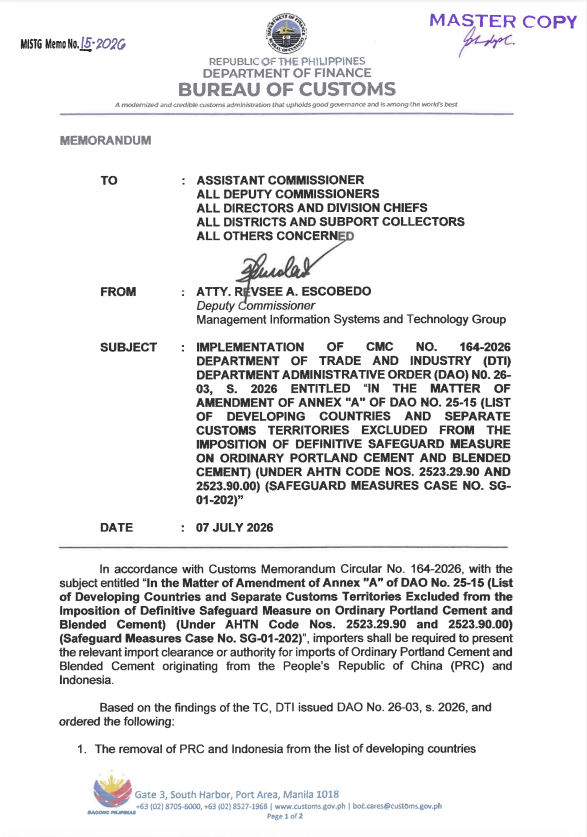
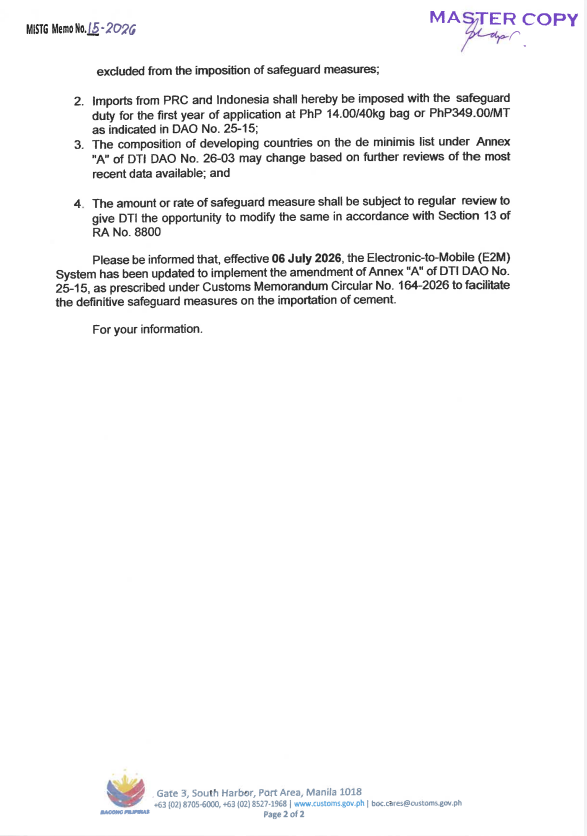
△ Original Announcement
Why Chinese Cement Lost Its Exemption
The Philippines introduced a three-year safeguard measure on imported cement in March 2026. Under the applicable rules, imports from a developing country were exempt from the safeguard duty if that country accounted for less than 3% of total imports.
However, the latest official data show that China’s share of Philippine cement imports continued to rise from 2025 through the first quarter of 2026, exceeding the 3% exemption threshold.
The withdrawal of the exemption was therefore not a temporary measure introduced without warning. It was triggered under the Philippines’ adjustment mechanism as the volume of cement imports from China increased.
II. Philippine Trade Barriers Tighten amid More Frequent Policy Adjustments
Cement is not the only product affected.
In recent years, the Philippines has increased its scrutiny of imported bulk commodities and basic construction materials, including steel, cement and agricultural products. The Department of Trade and Industry has frequently initiated trade remedy proceedings, including anti-dumping investigations, countervailing duty investigations and safeguard measures.
These measures are intended to give domestic manufacturers time to adjust through tariff protection and maintain fair competition in the local market.
Although the additional duty of PHP 349 per metric ton is expected to account for only approximately 3% to 4% of the current retail price of cement in the Philippine market and is unlikely to stop imports entirely, it sends an important regulatory signal:
Stricter scrutiny: Construction materials manufactured in China may face more stringent customs inspections and reviews of compliance with rules of origin when entering the Philippine market.
Potential domino effect: If imports of other Chinese construction materials, such as steel and aluminium, continue to increase, the Philippines may apply similar duties to additional product categories.
III. Operational Alerts and Recommended Actions for Freight Forwarders: Impact on International Logistics and Exporters
From an operational perspective, the policy adjustment will not change the standard ocean freight booking process from Chinese ports to Philippine ports such as Manila and Cebu. However, it will significantly affect supply chain flows and cost structures.
1. Importers’ Purchasing Schedules May Be Disrupted
The additional cost of approximately PHP 349 per metric ton will require Philippine construction material importers and engineering contractors to recalculate their purchasing budgets.
In the short term, importers may accelerate customs clearance while reducing shipment volumes, or shift procurement to suppliers in other developing countries that remain eligible for the exemption. Profit margins for Chinese cement exporters may therefore come under further pressure.
2. Freight Forwarders Need to Move from Transportation Services to Supply Chain Consulting
Freight forwarders operating Philippine routes and logistics providers handling bulk cargo cannot focus solely on transporting the goods.
Given the complex anti-dumping and safeguard duty policies in the destination country, freight forwarders should actively assist customers with the following:
Advance Compliance Alerts: At the booking stage, inform Chinese exporters and Philippine consignees of the implications of DTI Administrative Order No. 26-03 to avoid port storage charges and container detention caused by duty disputes after cargo arrival.
Logistics Plan Optimization: Assist bulk cargo customers in planning shipment batches and declaring Customs Value appropriately, while providing alternative destination customs clearance options to reduce customs clearance risks.
IV. Industry Summary: A New Approach to Overseas Trade amid the Normalization of Global Trade Protection
The Philippines’ formal imposition of a safeguard duty on Chinese cement reflects the continuing rise in global trade protection measures.
In addition to traditional tariff barriers, an increasing number of countries are adopting less visible non-tariff barriers, including technical standards, carbon tariffs and origin-tracing requirements.
For Chinese companies expanding into overseas markets and international logistics service providers, future competition in cross-border logistics will depend not only on ocean freight rates, but also on the ability to identify destination-country policy risks and respond quickly to supply chain changes.
Businesses need to prepare alternative transportation plans in advance and strengthen compliance risk controls to manage changes in the global trade environment.
Disclaimer: All content is based on publicly available information and is provided for industry reference only.
Last
ZIM and MSC Expand US East Coast Service: North Asia to Jacksonville in 28 Days with New Latin America and Caribbean Connections
Introduction:The US East Coast market has gained a new source of stable capacity. On July 14, the ZCP-Amberjack weekly service joi
Next
CMA CGM's Ultra-Large Container Ship Sails Out of Strait of Hormuz: Partial Recovery Seen Yet Full Normalization Remains Elusive
On June 28 local time, Reuters reported that the ultra-large container ship CMA CGM Galapagos, owned by French shipping giant CMA
