Double Disruption: Chilean Ports and Border Crossing Hit Simultaneously, Hundreds of Trucks Stranded as Logistics Delays Extend into August
Logistics News
31-Jul-2026
Cross-border logistics in South America is facing major disruption. Persistent extreme winter weather has brought heavy rain, strong winds and snowfall across Chile, restricting port operations while forcing the closure of a key land border crossing.
As of July 27, operations at Chile’s major ports had not fully returned to normal, while a key Argentina–Chile land border crossing remained closed. Both ocean and road transport are under pressure. Hundreds of cross-border trucks are stranded in queues, resulting in widespread cargo backlogs.
Industry sources expect the delays to continue into August. Even after the border crossing reopens, clearing the accumulated traffic will take time. Transit times, space planning and delivery schedules for shipments on South America West Coast routes will all be affected.
The simultaneous disruption to ocean and road transport is one of the most serious recent incidents affecting South American logistics. Unlike congestion at a single port or restrictions on one road section, the combined disruption has significantly reduced the ability to shift cargo between transport options.
The situation is directly affecting Chilean imports and exports, cross-border transportation between Argentina and Chile, and the timely delivery of refrigerated cargo. It is therefore a key risk for current shipments on South America West Coast routes.
• Simultaneous disruption: Operations are restricted at two major Chilean ports, while the main Argentina–Chile border crossing remains closed due to heavy snow.
• Severe congestion: Hundreds of cross-border trucks are stranded, while cargo, vessels and terminal yards face growing backlogs.
• Extended delays: The border crossing is expected to reopen on August 4, but clearing the accumulated traffic may take another five to six days.
• Limited alternatives: With ocean and road transport affected at the same time, normal cargo-routing alternatives are severely limited, allowing delays to spread across the logistics chain.
• Operational alert for freight forwarders: Vessel schedules, port operations and cross-border trucking arrangements should be reviewed across the full logistics chain, with additional time buffers included.
Persistent rough sea conditions and extreme weather on land have placed considerable pressure on major ports in central and northern Chile.
San Antonio and Valparaíso, two of the country’s main ports, have not yet resumed normal operations. Vessel berthing, cargo handling, and the pickup and delivery of import and export cargo remain restricted.
According to the latest port operating notices, both ports are currently allowing only limited operations. Priority is being given to the discharge of import cargo and a small volume of reefer export operations. Regular container vessel calls, full-container handling, and cargo receiving and delivery remain significantly restricted.
Valparaíso has been more severely affected. During the storm, the port was fully closed several times for entire days. This interrupted operations on vessels already in port, led to multiple port omissions and caused sailing schedules to be postponed. The resulting backlog will take time to clear.
Other regional ports have also experienced delays of varying severity.
San Vicente and Coronel remain largely operational, but cargo-handling efficiency has declined significantly and vessel schedules have been delayed.
Operations at Lirquén have been partially interrupted. Only basic berth operations remain available, and overall operating stability remains limited.
Continued restrictions at the ports are creating further schedule risks. Vessels already in port or waiting to call are facing berthing delays, changes to operating sequences and temporary port omissions.
Export cargo is being loaded later than planned, while import cargo is remaining in terminal yards for longer periods. The pace of recovery depends on weather conditions, and the existing delays are unlikely to be cleared in the short term. Schedule uncertainty on South America West Coast services therefore remains high.

Compared with the partial restrictions at the ports, road freight through the main Argentina–Chile crossing has stopped completely.
Los Libertadores, the main border crossing between Argentina and Chile, has been fully closed since July 15 due to severe snowfall. Cross-border truck movements in both directions have been suspended.
The extended closure has caused a serious buildup of trucks and cargo. Hundreds of freight trucks are currently stranded on both sides of the border, leaving the cross-border freight corridor heavily congested.
Based on current weather and operating assessments, the crossing may not be able to reopen until August 4 at the earliest.
Freight forwarders should note that reopening the crossing will not mean an immediate return to normal operations.
Even if Los Libertadores reopens as scheduled on August 4, clearing the existing queue of hundreds of trucks is expected to take five to six days. Newly arriving vehicles will add further pressure during this period.
As a result, border capacity will remain under heavy pressure, truck waiting times will stay high, and road transit times will continue to be affected. Cross-border logistics between Argentina and Chile is likely to remain congested through mid-August.
The main difficulty in the current Chilean logistics disruption is that ocean and road transport have been affected at the same time. This is also why the impact is more serious than ordinary port congestion.
Under normal circumstances, if port operations are restricted, shippers and freight forwarders can adjust vessel schedules, use alternative ports or increase the use of road transportation.
If a land border crossing closes, some cargo may be rerouted through ocean services.
In the current situation, however, restrictions at Chile’s main ports and the closure of the main land border crossing have occurred simultaneously. The usual options for adjusting transport plans are therefore severely limited.
The combined disruption is causing delays throughout the logistics chain.
At the ports, vessel schedules are disrupted and cargo handling is delayed, affecting the timely pickup and delivery of imports and exports.
On land, the suspension of cross-border trucking has interrupted cargo flows between Argentina and Chile.
As a result, cargo is remaining longer at ports, terminal yards and border facilities. Refrigerated cargo, time-sensitive exports and goods moving between Argentina and Chile face particularly high risks of cargo damage, missed delivery deadlines and contractual non-performance.
Industry sources expect the disruption to continue even after the weather improves and the border crossing reopens. The recovery period may bring another round of congestion.
Once operations at San Antonio and Valparaíso fully resume, vessels and cargo delayed during the disruption will enter the operating queue at the same time.
Berth availability, terminal yard capacity, labour and equipment may all come under pressure. The combination of accumulated and newly arriving cargo will continue to extend operating times, making it difficult to resolve vessel delays and cargo backlogs quickly.
At Los Libertadores, stranded trucks and newly arriving vehicles are expected to seek passage at the same time once the crossing reopens.
This will place further pressure on border clearance. Truck waiting times and road transport costs may rise temporarily, while the reliability of cross-border delivery will take time to recover.
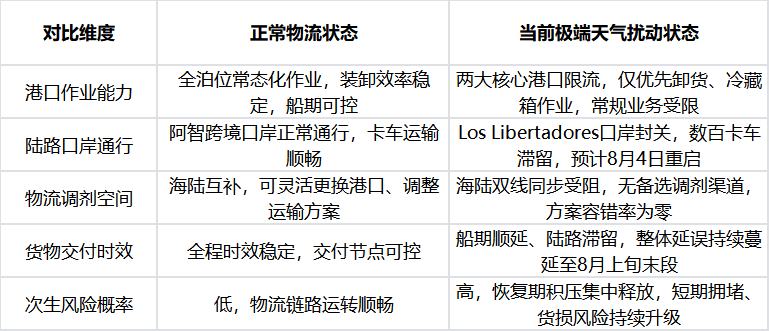
Comparison of Normal and Current Logistics Conditions in Chile

In response to the simultaneous disruption to ocean and road logistics in Chile, global freight forwarders should review current shipments, adjust transport plans in advance and reduce the risk of delays, cargo damage and customer complaints.
1. Monitor Vessel Schedules and Port Conditions
Follow operating updates from San Antonio, Valparaíso and other key ports in real time.
Review the status of each vessel calling at the affected ports and assess the risk of port omissions, late berthing and schedule delays.
Updated vessel schedules and any operational disruptions should be communicated to shippers promptly.
2. Allow Additional Time for Cross-Border Road Transport
For cargo moving between Argentina and Chile, normal transit-time estimates should no longer be used.
Additional buffer time should be included, and the reopening of Los Libertadores and the clearance of the truck backlog should be monitored closely.
Delivery schedules should not be based on normal transit times while the backlog remains unresolved.
3. Prioritize Special Cargo
For refrigerated cargo, time-sensitive orders and essential trade cargo, alternative export ports and transport routes should be assessed as a priority.
Overseas agents should be contacted in advance to prepare terminal storage and container pickup arrangements, reducing the risk of cargo damage during extended delays.
To identify available cross-border capacity and obtain current border updates, users may post requirements on the Inquiry Board and connect with qualified freight forwarders and cross-border carriers for current quotations and capacity information.
4. Establish End-to-End Alerts
Customs declaration, trucking, overseas customs clearance and last-mile delivery teams should be coordinated according to the latest logistics conditions.
Alternative arrangements should be prepared in advance for delayed shipments to reduce fulfillment risks.
Three Operational Questions for Freight Forwarders
• Have all current Chile shipments been reviewed, and have vessel-delay and port-operating risks been updated?
• Has sufficient transit-time buffer been included for Argentina–Chile cargo, and are the border reopening and truck-backlog clearance being monitored?
• Have contingency plans been updated for refrigerated and time-sensitive cargo to reduce the risk of extended storage and cargo damage?
Overall, the simultaneous disruption to ocean and road transport caused by extreme weather in Chile is a major South American logistics incident in 2026. The delays are expected to continue for an extended period, with high secondary risks and limited alternatives.
Until ports and the border crossing fully return to normal operations, cross-border logistics on the west coast of South America will remain subject to significant delays and uncertainty.
Global freight forwarders should closely monitor operational changes, manage each shipment milestone carefully, and prepare capacity and contingency arrangements to reduce logistics risks.
Sources
Official statements from the Chilean presidential representative, Cooperativa, Kuehne+Nagel notices, Chilean port authorities and publicly available information from shipping industry platforms.
Disclaimer
All information is sourced from publicly available channels and is provided for industry reference only. It does not constitute commercial or logistics operational advice.

Last
Breaking: Sulfuric Acid Chemical Tanker Explodes and Catches Fire Offshore; All 15 Crew Members Safe, No Leakage or Pollution Reported, Cause Under Investigation
On July 28 local time, a chemical tanker accident occurred in Norwegian waters. The Norwegian-flagged chemical tanker Bergstraum,

Next
One Service Cut, One Port Added: MSC Uses Blank Sailings to Support Rates While Hapag-Lloyd Expands Coverage as U.S. Trade Capacity Management Becomes More Precise
The trans-Pacific U.S. trade is undergoing a series of service adjustments in 2026, with leading carriers adopting distinctly diff