One Service Cut, One Port Added: MSC Uses Blank Sailings to Support Rates While Hapag-Lloyd Expands Coverage as U.S. Trade Capacity Management Becomes More Precise
Logistics News
31-Jul-2026
The trans-Pacific U.S. trade is undergoing a series of service adjustments in 2026, with leading carriers adopting distinctly different approaches to capacity management. MSC and Hapag-Lloyd have recently announced several mainline service changes. MSC will implement a temporary blank sailing on a key U.S. West Coast service to support peak-season freight rates through a capacity reduction. Hapag-Lloyd, by contrast, is adding a direct Oakland call to its WC5 U.S. West Coast service to strengthen its coverage of specific North American markets. It is also optimizing its South America East Coast SEC service by removing less efficient port calls.
The contrasting strategies adopted by the two leading carriers do not reflect different market assessments. Instead, they demonstrate the liner shipping industry’s shift toward more precise network management and targeted competition in individual markets. The previous model of broad capacity deployment and indiscriminate port expansion is being replaced by more selective operations. These changes are highly relevant to global freight forwarders when arranging U.S. trade bookings, assessing freight-rate trends, securing space and planning transit times.
• MSC reduces capacity: The AMERICA service will implement a temporary blank sailing in Week 34 of 2026 to support rates during the peak-season shipping window.
• Hapag-Lloyd expands coverage: The WC5 service will add a direct Oakland call to target the key Northern California cargo market.
• Two services optimized simultaneously: Hapag-Lloyd will also adjust its South America SEC service by removing Salvador and streamlining its mainline port rotation.
• Industry competition changes direction: Competition on the U.S. trades is shifting from capacity and network coverage toward precision, reliability and market segmentation.
• Operational alert for freight forwarders: As peak-season services change frequently, forwarders should continuously update space arrangements and end-to-end transit-time contingency plans.
During a key period of peak-season inventory replenishment and rising freight rates on the U.S. trades, MSC has begun implementing more targeted capacity controls. According to the carrier’s latest service announcement, MSC will blank a sailing on its mainline AMERICA U.S. West Coast service in Week 34 of 2026, using a temporary capacity reduction to adjust market supply and demand.

For this adjustment, MSC has stated that customers may continue submitting booking requests as usual. The carrier has arranged alternative services and contingency space in advance to minimize the impact of the blank sailing and maintain access to shipping capacity during the peak season.
This is not the first time MSC has used the AMERICA service to regulate market capacity. In May, the carrier implemented blank sailings on both the AMERICA and EMPIRE U.S. West Coast services in Weeks 23 and 24. This indicates that the AMERICA service has become an important capacity-adjustment tool within MSC’s U.S. West Coast network, allowing the carrier to respond to changes in cargo volumes and freight rates.
The timing of the latest blank sailing is particularly significant. At the end of May, the Shanghai–U.S. West Coast spot rate rose to USD 4,552 per FEU, up 10% from the previous period, showing a clear upward trend ahead of the peak season.
Reducing capacity during a rising-rate cycle may appear contrary to the conventional practice of adding capacity during the peak season. However, for a major independent carrier, it is a calculated capacity-management measure. A limited and temporary reduction in supply can help maintain recent rate increases, prevent rates from falling sharply and retain sufficient capacity flexibility for the subsequent cargo peak. The measure is intended to support rate stability, cargo volumes and service performance during the peak season.
MSC is not simply reducing capacity across its network. Its current U.S. West Coast operations combine selected capacity reductions with targeted service expansion.
In June, MSC officially resumed its Pearl Service between South China and the U.S. West Coast. Operated by the MSC Lyse V, the service covers the key ports of Yantian, Xiamen and Long Beach and deploys vessels ranging from 4,800 to 8,200 TEU to accommodate additional peak-season cargo volumes.
MSC has also adjusted the port rotations of its Orient, Sentosa and Chinook services:
• The Orient service has removed Oakland and changed Qingdao to the first port of call.
• The Sentosa service has added Haiphong to expand its coverage of Southeast Asian cargo.
• The Chinook service has removed Haiphong to provide additional buffer time for vessel rotation.
Through these reductions and additions, MSC has restructured capacity, port coverage and cargo allocation across its U.S. West Coast network.
In contrast to MSC’s capacity-reduction strategy, Hapag-Lloyd is continuing to expand its presence in the U.S. West Coast market. By optimizing its port rotation and adding a direct call at a key gateway, the carrier is targeting specific cargo segments and strengthening its position on the U.S. trades.
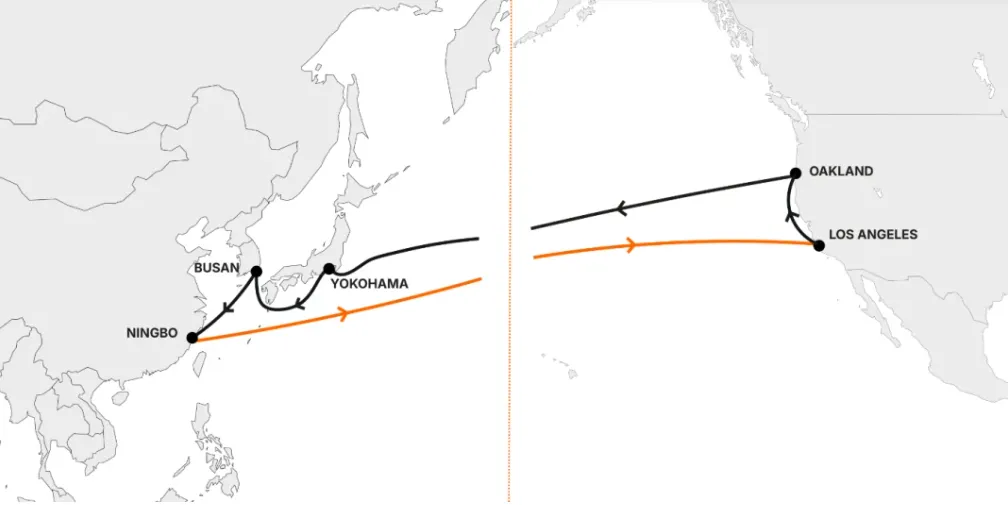
According to Hapag-Lloyd’s latest service announcement, the westbound rotation of its trans-Pacific WC5 priority service has been updated to include a direct call at the Port of Oakland. The revised port sequence further strengthens the service’s regional coverage.
Latest WC5 port rotation:
Busan → Ningbo → Los Angeles → Oakland → Yokohama → Busan

As Northern California’s largest container gateway, Oakland provides direct access to the San Francisco Bay Area, California’s Central Valley and other major commercial and industrial regions. The area generates substantial cross-border cargo volumes, with strong demand for reliable and time-sensitive logistics services.
Before this adjustment, a large proportion of Asian imports destined for Northern California had to be discharged at Los Angeles or Long Beach and then transported over long distances by rail or truck. This extended the overall logistics chain and introduced additional transfer costs, transit-time uncertainty and cargo damage risks.
The addition of a direct Oakland call to the high-priority U.S.-flag Priority 1 WC5 service means that the service receives priority in berthing, terminal handling and vessel turnaround. It will provide Northern California shippers and global freight forwarders with a direct U.S. West Coast option offering shorter transit chains, faster delivery and fewer transfers.
The adjustment also addresses a gap in direct services to Northern California. It represents another structural improvement to the WC5 service following several rounds of changes related to the China–U.S. port fee dispute, further improving service reliability and regional coverage.
While expanding its coverage of specific U.S. West Coast markets, Hapag-Lloyd has also optimized its South America East Coast SEC service. By removing less efficient port calls and adjusting the network to seasonal cargo flows, the carrier aims to improve mainline schedule reliability and operating efficiency.
According to the announcement, the SEC service will remove its call at Salvador, Brazil, to address the knock-on effects of mainline delays and improve schedule reliability. It will also end its seasonal call at Montevideo, Uruguay, following the conclusion of the Southern Hemisphere citrus export season.
By reducing the number of port calls, Hapag-Lloyd can shorten the mainline rotation and reduce operational uncertainty.
Revised SEC port rotation:
New York → Philadelphia → Charleston → Jacksonville → Port Everglades → Santos → Buenos Aires → Rio Grande → Itapoá → Santos → Rio de Janeiro → Pecém → New York
Following the adjustment, import and export cargo previously handled through the direct Salvador call will be connected via Pecém using the Brazilian coastal feeder network operated by Maersk subsidiary Aliança. This arrangement will maintain regional service coverage through feeder connections.
The model reflects a common liner shipping network-optimization approach: streamlining mainline services to improve reliability while using feeder services to maintain regional coverage. The removal of the seasonal Montevideo call also reflects more precise management of seasonal cargo flows.
MSC’s decision to reduce capacity through a blank sailing and Hapag-Lloyd’s decision to add a direct port call may appear contradictory. In practice, both strategies point to the same industry trend: competition on the trans-Pacific trades is moving away from broad capacity expansion and toward more precise, segmented and differentiated service management.
For MSC, an independent leading carrier operating within a restructured alliance environment, its share of the trans-Pacific market and its independent service network remain under continuous adjustment.
Using temporary blank sailings to regulate capacity and maintain rate discipline is a practical response to market volatility. During a peak-season period in which freight rates are rising, a limited capacity reduction can help maintain recent rate increases and reduce the risk of renewed price competition.
MSC’s decision to reduce capacity on some services while expanding others also shows that the carrier is no longer focused solely on overall capacity scale. It is paying closer attention to the performance of individual services and the balance of its wider network.
For Hapag-Lloyd, the current market is characterized by relatively ample capacity and intense competition between similar service products. Competing solely through lower rates and additional capacity is becoming increasingly difficult to sustain.
By analyzing regional cargo flows, adding a direct Oakland call to address the gap in Northern California coverage and targeting a specific market segment, Hapag-Lloyd is competing through service differentiation rather than price reductions. At the same time, removing less efficient South American port calls improves mainline stability. This approach can strengthen customer retention and increase market share in specific regions.
Overall, leading carriers are managing their networks at an increasingly detailed level. Instead of applying uniform adjustments across an entire network, they are developing specific operating strategies for individual services, regions and cargo flows.
Capacity deployment, port calls and sailing schedules are now increasingly centered on profitability, reliability and market segmentation. This is a major change in global cross-border shipping in 2026.
The trans-Pacific and South America trades have both entered a period of frequent service adjustments. Changes to port rotations, space availability and transit arrangements are placing greater demands on freight forwarders’ peak-season shipping plans, customer fulfillment and risk management.
Freight forwarders should focus on the following four areas:
1. Update U.S. Trade Booking Plans Dynamically
For MSC’s Week 34 blank-sailing window, forwarders should secure space on alternative services in advance to avoid peak-season space shortages, overbooking and cargo rollovers.
Transit-time differences between the original and alternative services should also be reviewed. Shippers should be informed of the blank sailing and alternative shipping arrangements in advance to reduce the risk of shipment delays.
2. Match Shipping Channels to Specific Regional Markets
Following the addition of Oakland to Hapag-Lloyd’s WC5 service, direct services should be considered first for time-sensitive cargo destined for Northern California and the San Francisco Bay Area. This can shorten the transfer chain and improve delivery efficiency.
For South America cargo, forwarders should adapt to the new Salvador feeder arrangement and recalculate total transit times and costs.
3. Update the End-to-End Logistics Chain
After changes to port rotations and transshipment arrangements, forwarders should reconfirm cargo cut-off dates, sailing dates and arrival dates. Trucking, customs declaration, overseas customs clearance and final delivery schedules should be adjusted accordingly.
Where overseas resources, transshipment services or destination support are required, freight forwarders may use the platform’s Company Directory to identify service providers specializing in the U.S. and South America trades, reducing the risk of disruption across the logistics chain.
4. Establish a Service-Change Tracking Mechanism
With alliance structures still evolving and service networks changing frequently, blank sailings, additional port calls, removed calls and revised transshipment arrangements have become common.
Freight forwarders should closely follow announcements from leading carriers and adjust booking strategies and customer-delivery contingency plans accordingly. Delayed information may lead to operational errors, customer complaints and fulfillment losses.
Three Operational Questions for Freight Forwarders
• Has peak-season space been secured in advance, and have alternative services been arranged for MSC’s blank sailing?
• Have regional shipping options been updated, including the new direct Oakland service for Northern California customers and the revised South America transshipment process?
• Have end-to-end transit-time calculations and delivery buffers been updated based on the latest service changes?
Industry Summary
The cross-border shipping market in 2026 has moved beyond broad capacity expansion. Carriers are optimizing global service networks through capacity reductions to support rates, targeted port additions to capture cargo from specific markets and streamlined mainline rotations to improve reliability.
For global freight forwarders, maintaining service quality and controlling operational risk in a volatile peak-season market will require close monitoring of carrier service changes, more precise matching of shipping solutions to customer requirements and flexible adjustment of logistics plans.
Sources
MSC official service announcements, Hapag-Lloyd service update notices, authoritative cross-border shipping platforms and publicly available port information.
Disclaimer
All information is sourced from publicly available channels and is provided for industry reference only. It does not constitute commercial or logistics operational advice.

Last
Double Disruption: Chilean Ports and Border Crossing Hit Simultaneously, Hundreds of Trucks Stranded as Logistics Delays Extend into August
Cross-border logistics in South America is facing major disruption. Persistent extreme winter weather has brought heavy rain, stro

Next
USD 15.7 Billion in Revenue: CMA CGM's Q2 2026 Shipping Revenue Rises 22%, While Logistics Earnings Come Under Pressure
Against a complex backdrop of continued geopolitical disruption in the Middle East and growing uncertainty over international trad