CMA CGM's Emergency Fuel Surcharge to Take Effect August 1,with Headhaul Rates Twice ONE's

Logistics News

24-Jul-2026

Introduction:


Global ocean freight surcharges will see a major adjustment in August 2026. Following ONE’s announcement of new Emergency Fuel Surcharge (EFS) rates, French carrier CMA CGM has also announced a rate adjustment.


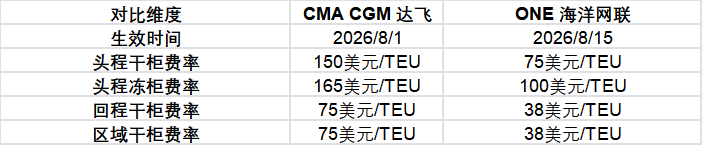
Amid escalating geopolitical tensions in the Strait of Hormuz and the Red Sea, international fuel prices have risen sharply. CMA CGM announced that a new global Emergency Fuel Surcharge will take effect on August 1, 2026. Its long-haul headhaul dry-container rate is twice ONE’s corresponding rate, and the surcharge will take effect two weeks earlier.


This article outlines CMA CGM’s EFS rates, the reasons for the increase, a comparison with ONE’s rates, and quotation risk-control recommendations for freight forwarders worldwide.


CMA CGM Announces New Global EFS Rates in Second Surcharge Adjustment


According to CMA CGM’s official Circular No. 12 and information published by authoritative shipping media, CMA CGM issued an Emergency Fuel Surcharge adjustment notice on July 21, 2026.


The revised surcharge will apply across all global trade lanes from August 1, 2026. It will remain in effect until further notice and may be adjusted according to market conditions.


This is CMA CGM’s second fuel surcharge adjustment within half a month, reversing the direction of its previous adjustment. Fuel costs had continued to fall, with related surcharges being gradually reduced. However, recent geopolitical developments in the Middle East have reversed this trend.


CMA CGM stated that escalating hostilities in the Strait of Hormuz have caused international fuel prices to rise sharply, increasing fuel-related operating costs across its global services. This is the main reason for the latest Emergency Fuel Surcharge increase.


CMA CGM EFS Rates: Three-Tier Pricing for Dry and Reefer Containers


CMA CGM’s revised Emergency Fuel Surcharge adopts a tiered global rate structure. Charges are divided into three categories: long-haul headhaul trades, long-haul backhaul trades, and intra-regional trades. Different rates apply to dry and reefer containers.


Long-haul headhaul trades: USD 150/TEU for dry containers and USD 165/TEU for reefer containers


Long-haul backhaul trades: USD 75/TEU for dry containers and USD 90/TEU for reefer containers


Intra-regional trades worldwide: USD 75/TEU for dry containers and USD 90/TEU for reefer containers


The rate structure shows that long-haul headhaul trades carry the highest additional cost, while the rates for backhaul and intra-regional trades are half the dry-container headhaul rate.


For cold-chain shipments, reefer rates are approximately 10% to 20% higher than dry-container rates. Freight forwarders handling international cold-chain logistics should calculate the reefer surcharge separately to avoid quotation errors and margin losses.


Main Drivers of the Increase: Red Sea and Strait of Hormuz Risks Push Up Fuel Prices


The latest surcharge increase follows sharp changes in maritime security conditions in the Middle East and is a major factor affecting global shipping costs in the second half of 2026.


In early July, major carriers including Maersk and Hapag-Lloyd resumed Suez Canal transit on the AE15 service. The market generally expected Red Sea shipping risks to ease and route operations to stabilize.


However, the situation changed quickly. The Houthis announced a blockade of Saudi shipping routes. Continued tensions between the United States and Iran also reduced transit efficiency through the Strait of Hormuz, while conflict risks spread toward the Bab el-Mandeb Strait. These developments reversed the earlier decline in fuel prices.


Geopolitical uncertainty has pushed up international fuel prices, prompting major carriers to reinstate or increase Emergency Fuel Surcharges. Global ocean freight costs have once again entered an upward cycle.


Industry Comparison: CMA CGM Rates Higher Than ONE’s and Effective Earlier


CMA CGM’s latest adjustment differs significantly from ONE’s previously announced EFS rates.


The two major liner carriers have introduced new surcharge policies in succession, marking the start of global surcharge adjustments for August 2026. Their policies differ significantly in both effective dates and rate levels, providing freight forwarders with a reference for quotation calculations.


Operational Impact and Quotation Risk-Control Recommendations for Freight Forwarders


The successive EFS adjustments announced by two major carriers indicate that the geopolitical risk premium on Middle East shipping routes has been repriced. The changes will directly affect freight forwarders’ bookings, quotations, and customer account management.


First, all CMA CGM trade lanes will be subject to the EFS from August 1, with long-haul headhaul trades carrying the highest additional cost.


When preparing quotations, freight forwarders should list the Emergency Fuel Surcharge separately rather than include it in a general all-in rate. Quotations should also state that the final surcharge is subject to the carrier’s official rate applicable on the on-board date, helping to avoid cost overruns and subsequent disputes.


Second, although the rates for backhaul and intra-regional trades are lower than those for headhaul trades, they still represent a fixed additional cost. Freight forwarders handling Middle East regional trade and short-haul shipments should update their quotation systems and calculate total logistics costs accordingly.


Finally, conditions in the Red Sea and the Strait of Hormuz remain unstable. Cape of Good Hope diversions and emergency transit arrangements continue to increase route operating costs. Other carriers, including Maersk and Hapag-Lloyd, may follow with similar rate adjustments, potentially leading to broader surcharge increases.


With global freight rates changing frequently and geopolitical risks remaining uncertain, freight forwarders should closely monitor carrier announcements, adjust booking arrangements, and maintain stable delivery services for overseas customers.


Industry participants may use the platform’s route services to obtain timely updates on carrier surcharge adjustments, route diversions, and capacity changes, track cost movements, and adjust their operations in response to changes in the international shipping market.


Sources:Official CMA CGM announcement

Disclaimer:The information and data contained in this article are sourced from publicly available channels and are provided solely for industry reference. They do not constitute commercial advice or logistics operating guidance.

Last

Alert:Global Containership Orderbook Reaches 11.93 Million TEU, Increasing Overcapacity Risks for 2027-2029

Introduction:The global container shipping capacity market is entering a period of major change. According to DynaLiners’ latest 2

Next

导读:全球航运附加费新规落地!2026年8月,海洋网联船务(ONE)率先更新全球航线紧急燃油附加费(EFS)计费标准,下调整体费率的同时,大幅拉开干柜与冻柜的价差。新规覆盖全球远洋、短途全航线及美加等合规监管贸易线路,是下半年全球货代运价核算、舱位成本管控的重