Container Ship Charter Rates Diverge as Maersk, CMA CGM and Hapag-Lloyd Remain Active in the Charter Market
Logistics News
 3-Sep-2026
The container ship charter market has remained active in recent weeks, with Maersk, CMA CGM, and Hapag-Lloyd all securing new charters or extending existing agreements. At the same time, New ConTex data show a clear divergence in charter rates across vessel sizes. Carriers are continuing to adjust their fleets, but rates are not rising across all vessel segments.
Key Highlights
• Carrier activity: Maersk, CMA CGM, and Hapag-Lloyd have all recently secured new charters or extended existing agreements
• Diverging rates: The container ship charter market remains active, but rate trends vary across vessel sizes
• Different market conditions: Charter rates for small and midsize vessels remain supported, while rates for larger vessels have declined year on year
Why Are Maersk, CMA CGM and Hapag-Lloyd Continuing to Charter Vessels?
Maersk, CMA CGM, and Hapag-Lloyd have recently been active in the charter market, securing vessels of different ages and sizes under varying charter periods. Although the three carriers are following different strategies, they are all using chartered tonnage to adjust their existing fleets and add or optimize capacity as market demand changes.
Compared with ordering newbuildings or purchasing secondhand vessels outright, chartering allows carriers to add readily available tonnage more quickly and adjust fleet size in response to route changes. The recent level of chartering activity therefore does not mean that the entire market is competing for vessels. More importantly, carriers are reallocating capacity according to their route and vessel requirements.
Container Ship Charter Rates Diverge Across Vessel Sizes
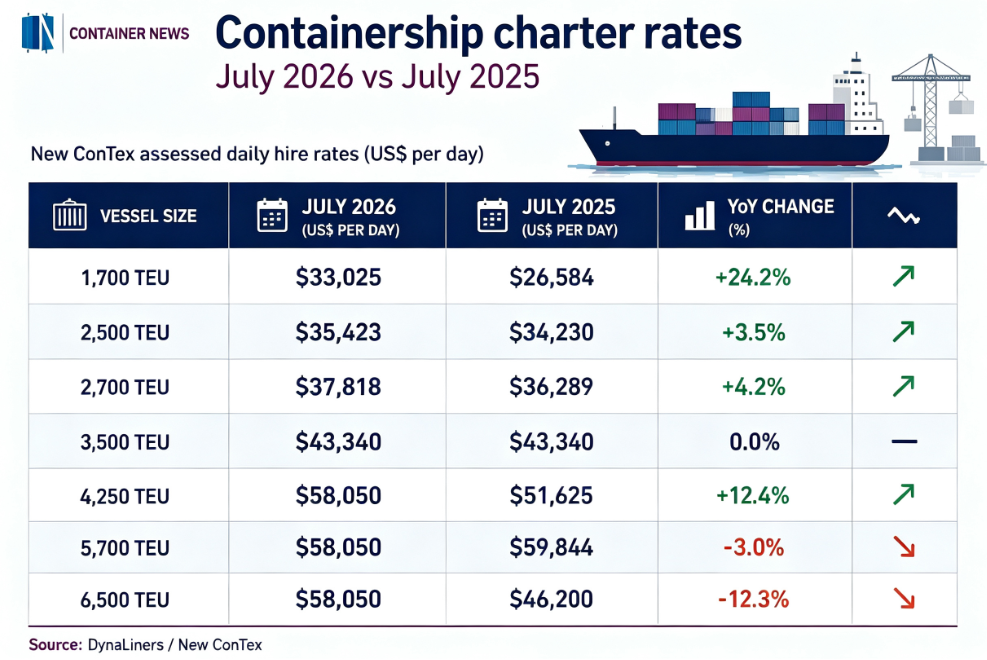
Data sources: DynaLiners and New ConTex; compiled by Container News
The latest industry data show that container ship charter rate trends varied significantly across vessel sizes in July 2026. Rates for some small and midsize vessels continued to rise, while rates for larger vessels declined year on year. This indicates that changes in supply and demand are not occurring uniformly across the charter market.
These differences reflect route requirements, available capacity, and new vessel deliveries across the various segments. Large container ships have continued to enter the market in recent years, making the supply of large-vessel capacity relatively ample. Meanwhile, demand for small and midsize vessels remains steady on certain regional routes. The overall level of chartering activity therefore does not mean that all vessel segments face the same supply and demand conditions.
Active Chartering Does Not Signal Broad-Based Growth in Tonnage Demand
For major liner operators, chartering is not simply a way to add capacity. It is also an important fleet management tool. As routes change, new vessels are delivered, and market demand shifts, carriers can use a combination of vessel sizes and charter periods to manage capacity costs while limiting the capital tied up in outright vessel purchases.
Based on current market conditions, the container ship charter market may continue to be characterized by divergence between vessel segments rather than a broad-based increase in rates. If demand for small and midsize vessels remains stable, charter rates in these segments may remain supported. For larger vessels, new capacity, route adjustments, and changes in the overall balance between fleet supply and demand will have a greater influence on rates.
For the shipping market, the key issue is not simply whether carriers are chartering vessels, but which vessels they are chartering, for how long, and on which routes. These factors provide a clearer indication of carriers’ expectations for future market demand, capacity requirements, and fleet deployment than the number of charter transactions alone.
Sources
Sources include DynaLiners, New ConTex, Container News, and other publicly available industry information. This article is intended solely as a reference for the international logistics and shipping industry.
Last
Around 5,000 Containers Affected Daily at Mundra Port as Carriers Issue Advisories
Empty container operations at India’s Mundra Port have been disrupted following the suspension of services at off-port empty conta
Next
Akkon Suspends Calls at All Russian Ports as Novorossiysk Services Face Further Disruption
Turkish container carrier Akkon Lines has further scaled back its Russian services. On August 27, local time, the company informed
