COSCO SHIPPING Holdings Reports RMB 111.92 Billion in First-Half Revenue as Volumes Rise 7.52% but Average Revenue per TEU Falls
Logistics News
 2-Sep-2026
On August 28, COSCO SHIPPING Holdings released its interim report for 2026. The report showed that the company generated operating revenue of RMB 111.922 billion in the first half of the year, up 2.59% year on year. Net profit attributable to shareholders of the listed company fell 23.48% to RMB 13.419 billion. Its container shipping business handled 14.2795 million TEUs, up 7.52%, and generated revenue of RMB 107.298 billion, up 2.38%. Volume growth significantly outpaced revenue growth, while average revenue per TEU on international services fell from $1,205.95 in the same period last year to $1,180.68. For global freight forwarders, these figures reflect not only changes in COSCO SHIPPING Holdings’ performance but also the current market trend of continued volume growth and pressure on revenue per unit.
Key Highlights
• First-half revenue: COSCO SHIPPING Holdings generated revenue of RMB 111.922 billion, up 2.59% year on year.
• Container volumes: The company handled 14.2795 million TEUs, an increase of 7.52% year on year.
• Average revenue per TEU: Average revenue per TEU on international services fell by $25.27 year on year to $1,180.68.
• Fleet capacity: By the end of July, the company operated 606 vessels, with its existing fleet and orderbook representing more than 5.3 million TEUs of combined capacity.
Volumes Rise 7.52% While Revenue Growth Slows
Container volumes increased on most of COSCO SHIPPING Holdings’ major trades during the first half of the year. Volumes on the Asia–Europe trade reached 2.1899 million TEUs, up 12.44% year on year, the highest growth rate among its major international trades. Transpacific volumes rose 9.72% to 2.6257 million TEUs, intra-Asia volumes increased 5.34% to 4.7351 million TEUs, and mainland China volumes rose 9.97% to 3.1526 million TEUs.
However, the increase in cargo volumes did not translate fully into revenue growth. Revenue from the container shipping business rose only 2.38% year on year, while average revenue per TEU on international services fell by $25.27 to $1,180.68. COSCO SHIPPING Holdings said global container shipping demand remained resilient during the first half, while market freight rates were lower early in the period before rising later. At the same time, continued growth in the global container fleet, fluctuations in bunker prices, geopolitical risks, and uncertainty surrounding trade policies placed pressure on liner operators’ cost control and operations.
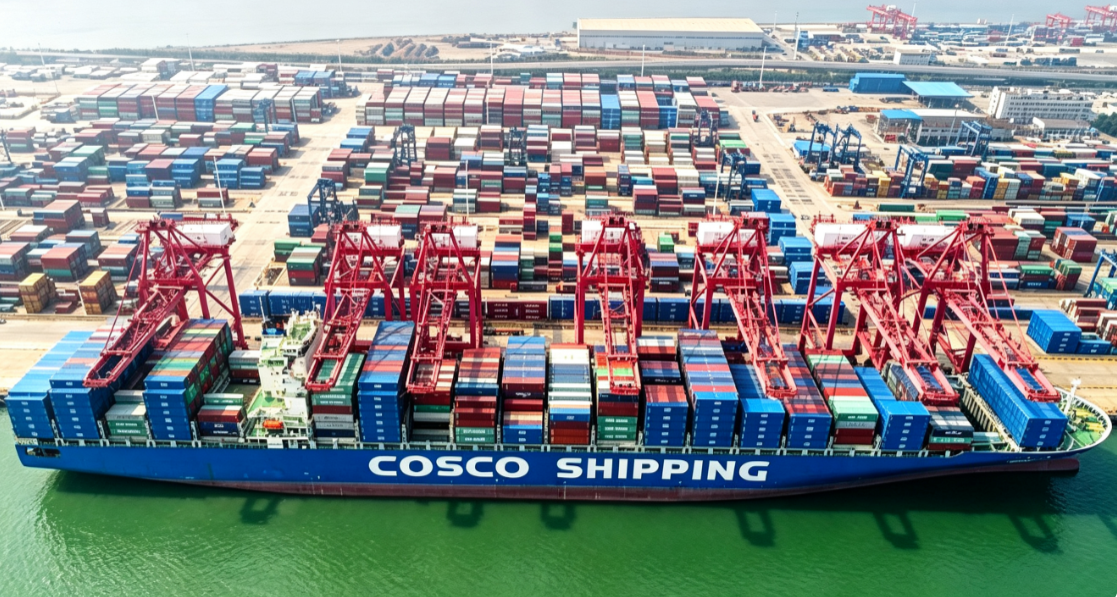
Fleet Expansion Continues as Combined Capacity Exceeds 5.3 Million TEUs
COSCO SHIPPING Holdings continued to expand its fleet while cargo volumes remained on an upward trend. At the end of July 2026, the company operated 606 container ships with a combined capacity of approximately 3.66 million TEUs. Its owned newbuilding orderbook comprised 82 vessels with approximately 1.18 million TEUs of capacity. Newbuildings to be chartered in represented an additional capacity of approximately 500,000 TEUs. Based on the company’s figures, its existing fleet and vessels on order represented more than 5.3 million TEUs of combined capacity.
The additional capacity will increase the capacity available for deployment on COSCO SHIPPING Holdings’ major international trades, while also indicating that market supply may continue to grow. For shipments scheduled in the near term, companies should continue to watch capacity deployment across individual services, schedule adjustments, and changes in space availability. At the end of June 2026, the company’s two brands operated 305 international services, including international feeder services, 64 coastal services in China, and 85 feeder services in the Pearl River Delta and along the Yangtze River. Its network covered 666 ports in approximately 146 countries and regions.
Supply Chain Business Continues to Grow Beyond Ocean Shipping
In addition to container shipping, COSCO SHIPPING Holdings continued to expand its supply chain services beyond ocean transportation. During the first half of 2026, its container shipping segment generated RMB 24.090 billion in supply chain revenue excluding ocean shipping, up 11.61% year on year. Its domestic and overseas rail, warehousing, customs clearance, and related businesses maintained relatively rapid growth.
Competition among carriers now extends beyond fleet size and service coverage. Supporting services such as rail transportation, warehousing, and customs clearance are also becoming an increasingly important part of global logistics networks. For freight forwarders, changes in carrier networks, capacity deployment, and integrated logistics capabilities may also affect routing and transport options, as well as the choice of supply chain solutions in different markets.
Overall, COSCO SHIPPING Holdings recorded higher volumes, moderate revenue growth, lower average revenue per TEU, and continued capacity expansion during the first half of the year. As new vessels continue to enter the market, space availability, freight rate trends, and competition over capacity on major trades will remain key considerations.
Sources and Disclaimer
Sources include COSCO SHIPPING Holdings’ 2026 interim report and other publicly available industry information. This article is provided solely for reference by the international logistics and freight forwarding industry. Specific operating data remain subject to the company’s official disclosures and subsequent announcements.
Last
OOCL Adds Another 24,000 TEU Methanol Dual-Fuel Vessel as Second New Ship Is Named
On August 28, Orient Overseas Container Line (OOCL) held a naming ceremony at Nantong COSCO KHI Ship Engineering Co., Ltd. (NACKS)
Next
Strike at the Port of Rotterdam Set for September 4; Vessel Operations and Trucking May Be Affected
Dutch ports are set to face industrial action in early September. On August 3, local time, FNV Havens, the port workers’ union aff
