Owned Capacity Among Major Liner Carriers Rises to 63% as MSC, Wan Hai and ZIM Take Different Fleet Strategies
Logistics News
 7-Aug-2026
Fleet ownership strategies across the global liner shipping industry are changing. According to the latest Sea-Intelligence data, owned capacity among the world’s 12 largest liner shipping companies has risen to 63%, well above the pre-pandemic average of around 50%.
Many major carriers have increased the proportion of owned vessels in their fleets following the pandemic-era shipping boom, although strategies differ sharply by company. MSC continues to expand its owned fleet, Wan Hai currently operates without chartered vessels, while ZIM remains heavily reliant on chartered tonnage. The different approaches reflect how carriers are positioning their fleets for different market cycles.
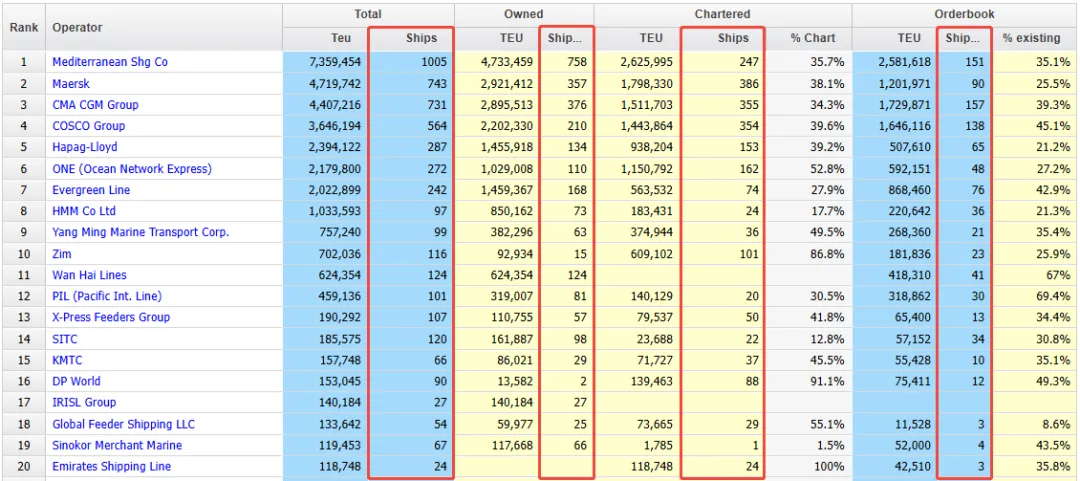
△Alphaliner TOP 100 / 04 Aug 2026
Key Highlights
• Ownership shift: Owned capacity among the 12 largest liner carriers has risen to 63%, compared with a pre-pandemic average of around 50%.
• Different approaches: Wan Hai currently operates an all-owned fleet, MSC continues to expand its owned tonnage, while ZIM remains heavily dependent on chartered vessels.
• Market impact: The extreme market conditions of 2020–2022 exposed the cost risks of heavy reliance on chartered tonnage.
• Next test: A major wave of newbuilding deliveries in 2027–2028 will test carriers’ recent investments in owned capacity.
Owned Capacity Gains Ground as Reliance on Chartering Declines
Before the pandemic, many liner carriers favored asset-light strategies based on chartered vessels. Chartering provided flexibility to adjust capacity as market conditions changed while reducing exposure to shipbuilding costs and the risk of idle owned vessels.
The extreme shipping market of 2020–2022 changed the economics of that model. As freight rates surged, charter rates also rose sharply, charter periods lengthened, and vessel owners gained greater bargaining power. For carriers heavily dependent on chartered tonnage, the cost of securing capacity increased substantially.
High charter costs also reduced the earnings benefit available to some carriers during the exceptionally strong freight market.
As a result, several major liner companies increased their focus on fleet ownership. Wan Hai currently operates 124 vessels, all of them owned. HMM, MSC and Evergreen also have shares of owned tonnage well above the industry average.
MSC Continues Large-Scale Fleet Expansion
MSC has been one of the most active buyers of vessels and newbuildings since the pandemic.
The carrier has expanded through both second-hand vessel purchases and newbuilding orders. Its operating fleet has now exceeded 1,000 vessels with total capacity of around 7.3 million TEUs, while its owned fleet is now larger than Maersk’s.
In June 2026, MSC placed another order for 20 vessels of around 20,000 TEUs each. Its total orderbook now stands at approximately 2.6 million TEUs, comparable with the total fleet capacity of a mid-sized liner carrier.
For MSC, greater fleet ownership reduces reliance on third-party vessel owners, limits exposure to charter-rate volatility and the risk of capacity loss when charters expire, and provides greater control over vessel deployment and service schedules.
CMA CGM, Evergreen and other carriers have also increased their owned tonnage.
Three Main Advantages of Vessel Ownership
A higher proportion of owned tonnage can provide several advantages.
First, it offers greater cost visibility. The acquisition or construction cost and subsequent depreciation of an owned vessel are more predictable than charter rates, particularly when the charter market rises sharply.
Second, owned vessels provide greater operational control. Carriers do not face charter expiry or redelivery requirements and have more flexibility in maintaining vessel deployment across their networks.
Third, during stronger freight markets, carriers with a higher proportion of owned vessels can retain a larger share of the earnings upside rather than seeing part of the benefit offset by rising charter costs.
ZIM Maintains a Charter-Heavy Model
While many major carriers have increased fleet ownership, Israeli carrier ZIM continues to rely heavily on chartered vessels.
According to Alphaliner data from early 2026, ZIM operates 117 vessels, including 14 owned vessels and 103 chartered vessels.
This model provided greater flexibility during the weaker freight market of 2023–2024, allowing the carrier to adjust capacity more quickly and reduce exposure to underutilized owned assets. In stronger markets, however, high charter costs can limit earnings compared with carriers that own a larger proportion of their fleets.
Neither model is optimal in every market cycle. A charter-heavy fleet can offer greater flexibility during downturns, while higher vessel ownership can provide greater earnings exposure when freight markets strengthen.
From the second half of 2027 through 2028, the liner industry is expected to see a large wave of newbuilding deliveries. A substantial number of MSC’s new vessels are scheduled to enter service during this period, adding further capacity to the market and affecting the supply-demand balance.
The delivery cycle will provide a clearer test of how the industry’s recent shift toward greater fleet ownership performs under the next phase of the container shipping market.
Disclaimer
The information in this article is sourced from publicly available channels and is provided solely for industry reference.
Last
Europe Logistics Alert: September 4 Strike to Affect the Ports of Rotterdam, Amsterdam and Zeeland
Major European shipping hubs are facing another round of disruption. Dutch port union FNV Havens has announced a nationwide port s
Next
Nadezhda Hit by Drone Attack in the Black Sea, Three Crew Seriously Injured as Shipping Risks Rise
On August 3, a serious attack on a merchant vessel occurred in the Black Sea. The Turkish-operated ro-ro cargo vessel Nadezhdawas
