Chattogram Port Suspends Storage Fee Increase: Bangladesh Route Logistics Costs Stabilize as Freight Forwarders Review the Policy Change
Logistics News
 3-Aug-2026
The latest logistics policy development at Chattogram Port has been confirmed. Bangladesh’s largest port and key logistics hub has suspended its proposed increase in container storage fees, halting a plan that would have raised charges by up to four times and stabilizing cross-border logistics costs on Bangladesh routes. As Bangladesh’s main foreign trade port, Chattogram Port’s fee standards directly affect import customs clearance, yard storage, inland transportation, and the wider logistics chain. The suspension significantly eases cost pressure on cross-border freight forwarders and foreign trade companies and is an important recent logistics development for Bangladesh routes.
Key Highlights
• Fee Increase Suspended: Chattogram Port halts the proposed fourfold increase in container storage fees and continues to apply the existing rates
• Port Management Adjustment: The proposed pricing measure was intended to accelerate cargo removal and ease yard congestion
• Supply Chain Pressure Eased: The suspension avoids a sharp rise in logistics costs and supports stable operations for freight forwarders and foreign trade companies
• Changing Industry Trend: Ports are increasingly using pricing measures to manage cargo flows, making detailed operational planning essential for freight forwarders
Policy Overview: Chattogram Port Suspends Proposed Fourfold Storage Fee Increase
Core Conclusion: Chattogram Port has suspended the proposed sharp increase in container storage fees, stabilizing Bangladesh route logistics costs in the short term and reducing the burden on cross-border freight forwarders and importing companies.
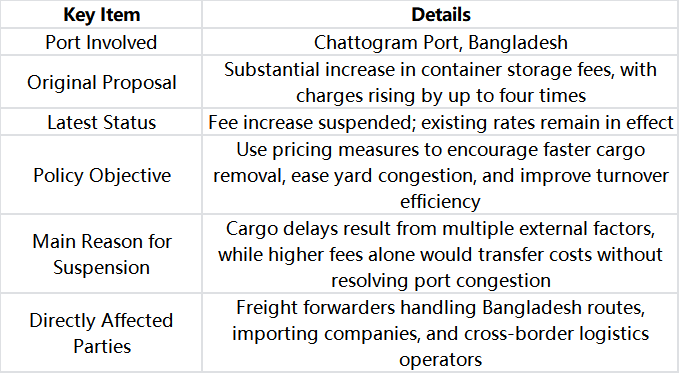
Chattogram Port is Bangladesh’s main foreign trade gateway, and its container storage fees directly affect costs across the entire cross-border logistics chain. The Chattogram Port Authority previously proposed a substantial increase in storage charges for containers remaining at the port beyond the permitted period, with the highest charges reaching four times the current rates. If implemented, the increase would have significantly raised the cost of delayed import containers and added to quotation pressure for freight forwarders and operating costs for foreign trade companies.
After the proposal was announced, it faced widespread opposition from the cross-border logistics and foreign trade sectors. Industry representatives argued that higher charges alone would not resolve congestion at Chattogram Port and would only transfer additional costs to the supply chain. In response to market concerns, the port authority formally suspended the fee increase. The existing rates remain in effect across the port, and logistics costs on Bangladesh routes have temporarily stabilized.
Key Information on Chattogram Port’s Storage Fee Policy
Rationale Behind the Proposed Increase: Using Pricing Measures to Address Container Dwell Time and Port Congestion
Core Conclusion: The proposed increase was intended to use pricing as an incentive for freight forwarders and cargo owners to accelerate customs clearance and container pickup. Its main purpose was to improve port turnover rather than simply increase revenue.
Container dwell time and yard congestion have long been major problems at Chattogram Port. Large numbers of import containers occupy yard capacity for extended periods due to customs clearance delays, incomplete documentation, insufficient inland transport capacity, and other operational constraints. This reduces terminal turnover efficiency, delays vessel loading and unloading, and disrupts cargo movement to and from the port, directly affecting overall shipment times on Bangladesh routes.
The port authority proposed higher charges for containers exceeding the permitted storage period to increase the cost of delays and encourage freight forwarders to manage documentation, customs clearance, and container pickup earlier in the process. The aim was to shorten container dwell time and release yard capacity. Similar pricing measures are used by many international ports to manage long-staying cargo.
Why the Increase Was Suspended: Avoiding Additional Cost Transfers Across the Cross-Border Supply Chain
Core Conclusion: Cargo delays are often caused by gaps in port and transport support services. Higher fees alone would not resolve the underlying problems and would only increase the logistics burden on freight forwarders and foreign trade companies.
Industry analysis indicates that cargo delays at Chattogram Port are mainly caused by operational constraints, including complex customs inspections, lengthy document review procedures, limited inland transport capacity, and restricted operations during the rainy season. These delays are not generally caused by cargo owners or freight forwarders intentionally postponing cargo pickup. Without improvements to these supporting processes, a unilateral fee increase would have little practical effect.
If the underlying customs clearance and transportation problems remain unresolved, higher charges would result in continued congestion and substantially higher costs. The suspension therefore reflects an effort to balance port efficiency with supply chain stability and reduces pressure on small and medium-sized logistics companies and foreign trade businesses handling Bangladesh routes.
Operational Impact on Freight Forwarders: Short-Term Cost Relief, but Long-Term Adjustment Still Required
Core Conclusion: The suspension reduces cost pressure on freight forwarders in the short term, but the use of pricing controls at ports is becoming more common. Detailed planning and earlier operational preparation will become important capabilities for freight forwarders.
For cross-border freight forwarders specializing in Bangladesh routes, the suspension provides direct cost relief. It reduces the risks of sharp cost increases, quotations becoming outdated, and customer disputes, while stabilizing shipment costs and quotation structures. Freight forwarders seeking to monitor rate movements and connect with compliant and stable shipping resources may use the platform’s Inquiry Board to match with suitable resources, make more accurate quotations, and improve business matching efficiency.
However, freight forwarders should recognize that ports worldwide are increasingly using higher charges to control container dwell time, and Chattogram Port may restart the proposed increase in the future. Risk control should therefore not focus only on changes in storage fees. Freight forwarders should also assess customs clearance times, inland transport capacity, and operating conditions within the port area to reduce the risk of containers remaining at the port beyond the permitted period.
Operational Self-Check List for Freight Forwarders
• Have you informed customers that the Chattogram Port storage fee increase has been suspended and adjusted quotation and shipment expectations accordingly?
• Have you optimized customs clearance and container pickup schedules for Bangladesh routes to reduce the risk of extended container dwell time?
• Are you continuing to monitor port policy developments and preparing for the possibility that the fee increase may be reintroduced?
• Have you reviewed port congestion, customs inspections, and inland transport constraints and adjusted shipment contingency plans in advance?
Overall, Chattogram Port’s suspension of the storage fee increase reflects an effort to balance port efficiency with supply chain costs and has stabilized logistics operations on Bangladesh routes in the short term. As ports increasingly use pricing measures to manage cargo flows, less structured shipment practices will become less workable. Detailed risk control and earlier operational planning will be key advantages for freight forwarders handling this route.
Action Summary: Freight forwarders can use the current period of stable costs to optimize customs clearance and container pickup procedures, continue monitoring policy developments at Chattogram Port, prepare contingency plans for possible fee adjustments, and maintain stable customer shipment arrangements and quotation structures.
Sources: Chattogram Port Authority and authoritative cross-border logistics industry platforms
Disclaimer: All information is sourced from publicly available channels and is provided for industry reference only. It does not constitute commercial or logistics operational guidance.
Last
Iran Rejects Joint Management Plan: Strait of Hormuz Navigation Regime to Be Restructured as Freight Forwarders Strengthen Risk Controls for Energy Routes
A new development has emerged in Middle East cross-border shipping. On July 28, The Wall Street Journalreported that Iran had form
Next
India Introduces New Maritime Rules: Controls on Plastic Pellet Exports Tightened Following the MSC Elsa 3 Incident
Environmental compliance requirements in global shipping continue to tighten, with marine pollution incidents prompting countries
