Maersk Takes Delivery of Its First VLAC: First Very Large Ammonia Carrier Marks a Shift in Clean-Energy Shipping
Logistics News
 3-Aug-2026
Global clean-energy shipping is developing rapidly, with the maritime transport of liquefied ammonia and other new-energy gases becoming a key area of industry growth. On July 27, South Korea’s HD Hyundai Samho delivered the Jane Maersk to Maersk. It is Maersk’s first 93,000-cubic-metre Very Large Ammonia Carrier (VLAC), marking the transition of large-scale specialized ammonia shipping from concept to implementation and a new stage of large-scale development. This article reviews the vessel’s main specifications, Maersk’s capacity expansion plans, the drivers behind market growth, and the operational response for freight forwarders.
Compared with conventional LPG carriers, Maersk’s VLAC is designed for the transport of high-risk, low-carbon liquefied ammonia and is equipped with dedicated safety systems. It can carry both LPG and liquefied ammonia, improving safety and operational flexibility in specialized shipping. The phased introduction of Maersk’s new-energy gas carrier fleet will continue to reshape global clean-energy shipping capacity and have a long-term impact on cross-border logistics for chemical products and new-energy cargoes. This is an important shipping trend for freight forwarders and foreign trade companies to monitor.
Key Highlights
• Milestone Delivery: Maersk takes delivery of its first VLAC and formally enters the large-scale ammonia shipping market
• Dual-Cargo Capacity: The vessel can carry both liquefied ammonia and LPG, serving traditional chemical trade and growing new-energy demand
• Long-Term Capacity Plan: Ten VLAC and VLGC new-energy gas carriers are scheduled for phased delivery through 2028
• Upgraded Safety Configuration: The vessel is equipped with a dedicated ammonia cargo protection system to address the corrosive and toxic properties of liquefied ammonia
• Changing Industry Structure: Major shipowners are positioning capacity in advance as clean-energy shipping moves beyond the conceptual stage
Key Information on the New Vessel
Vessel Delivery Review: Dual-Cargo Specialized Shipping Capacity Enters Service
Core Conclusion: The Jane Maersk is a major new-energy gas carrier capable of transporting both high-risk liquefied ammonia and conventional LPG, with upgraded safety systems and cargo adaptability.
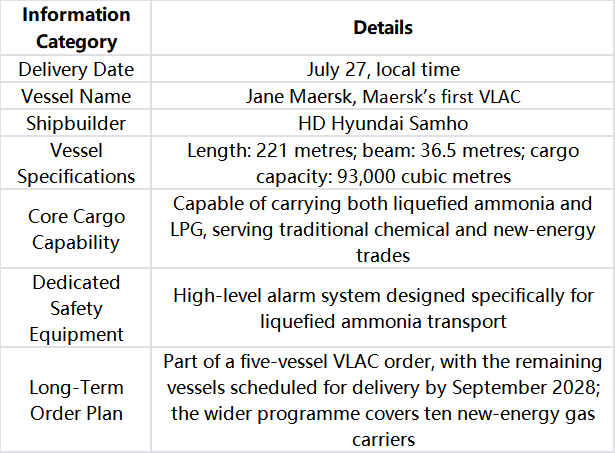
According to HD Hyundai Samho’s official delivery announcement on July 27, the Jane Maersk measures 221 metres in length, 36.5 metres in beam, and 23.6 metres in depth, with a maximum cargo capacity of 93,000 cubic metres. It is a very large specialized gas carrier designed for the new-energy shipping market. Its main advantage is its dual-cargo capability, allowing it to switch between liquefied ammonia and liquefied petroleum gas. The vessel can therefore serve both the cross-border transport of traditional chemical raw materials and the growing trade in low-carbon energy cargoes, giving it greater operational adaptability than a single-cargo gas carrier.
Liquefied ammonia is corrosive, toxic, and subject to strict transport requirements. The vessel is therefore equipped with dedicated ammonia cargo safety systems rather than relying only on standard gas carrier arrangements. These include a customized high-level alarm system that is activated independently only during liquefied ammonia loading operations. The system is intended to reduce the risks of incorrect loading, cargo leakage, and overloading, improving safety during the maritime transport of this high-risk cargo.
The delivery represents a development for both the shipbuilder and Maersk. For HD Hyundai Samho, it marks the shipyard’s formal entry into the construction of high-end VLACs and demonstrates its capacity to build large ammonia carriers in series. For Maersk, it marks an upgrade to its gas carrier fleet and its formal entry into the large-scale ammonia shipping market, reducing the growth limitations associated with relying on LPG transport alone.
VLAC Order Review: New-Energy Gas Carrier Capacity to Expand Through 2028
Core Conclusion: Although industry sources use slightly different order classifications, Maersk’s overall capacity plan is clear: ten large new-energy gas carriers will be delivered in phases as the company establishes an early position in the ammonia shipping market.
Order data reported by two major industry sources differ slightly in classification, but both confirm Maersk’s expansion in specialized new-energy shipping. According to HD Hyundai Samho, the Jane Maersk is part of a five-vessel VLAC order signed by Maersk in November 2023. The remaining four vessels of the same type are scheduled for delivery by September 2028, continuing to expand available capacity for large-scale ammonia transport.
Maersk Tankers has also stated that it is advancing a ten-vessel VLAC and VLGC newbuilding programme, with the Jane Maersk as the first vessel delivered under the programme. Based on the available information, this delivery is only the beginning. Maersk will continue to introduce specialized capacity for liquefied ammonia and LPG and develop a global gas carrier fleet serving both cargo types.
Market Growth Drivers: Dual Demand Makes VLACs a Key Area of Shipping Growth
Core Conclusion: Liquefied ammonia serves both established chemical demand and emerging low-carbon energy applications. Growth in both markets is driving demand for large ammonia carriers and prompting shipowners to position capacity in advance.
Maersk’s investment in VLACs reflects the combined opportunities created by the global energy transition and changes in chemical trade. Ammonia has two major market applications. As an established industrial raw material, it is widely used in fertilizers and fine chemicals, supporting stable cross-border trade demand. It is also being developed as a low-carbon energy carrier and fuel, with cross-regional trade in new-energy ammonia expected to increase as carbon-reduction policies advance.
The maritime transport of liquefied ammonia may therefore develop through both traditional chemical demand and additional new-energy demand. Conventional LPG carriers have more limited functions and may not meet the requirements of large-scale, long-distance ammonia transport under stricter safety and compliance standards. Dual-capability VLACs can switch between LPG and liquefied ammonia, allowing shipowners to retain access to the established gas shipping market while preparing for additional new-energy demand. This also reduces dependence on a single cargo market and improves the fleet’s ability to respond to market cycles.
Industry Development: VLAC Orders Increase as Clean-Energy Shipping Moves into the Delivery Stage
Core Conclusion: The rapid increase in global VLAC orders shows that new-energy gas shipping is moving from market expectations to the delivery of actual capacity, with competition shifting from conventional fleet capacity to new-energy fleet planning.
The global shipbuilding market is seeing a sharp increase in VLAC orders. According to the latest figures from HD Hyundai Samho, the company secured orders for nine additional VLACs in 2026 and currently holds orders for 22 vessels of this type, with a combined value of approximately USD 2.55 billion. Large-scale ammonia shipping is moving from a niche concept toward a larger and more industrialized shipping segment.
Growth in the conventional LPG shipping market is becoming more limited, while liquefied ammonia represents a new area of demand. Major shipowners are placing VLAC orders in advance to prepare capacity for future clean-energy trade and secure specialized shipping resources before the market expands further.
Long-Term Industry Impact: No Immediate Disruption to General Cargo Routes, but the Clean-Energy Shipping Structure Will Change
Core Conclusion: The delivery has no direct short-term impact on container shipping or general freight forwarding, but it will influence the long-term development of new-energy and specialized chemical shipping.
In the short term, the delivery of Maersk’s VLAC will not affect existing container services, general cargo freight rates, or conventional freight forwarding operations. Regular cross-border logistics activities will remain stable. From a longer-term industry perspective, however, this capacity expansion marks a change in how shipowners plan and invest in future fleets.
Shipowners have traditionally ordered vessels mainly to meet established trade demand, following a demand-based capacity expansion model. Maersk’s VLAC programme represents an advance investment in new-energy capacity, with specialized shipping infrastructure being established before large-scale ammonia energy trade has fully developed. As low-carbon ammonia trade expands, shipping companies that have already established VLAC fleets may play a greater role in shaping future route structures, freight rate systems, and service standards.
This also means that cross-border logistics is becoming more specialized. Competition and price transparency continue to increase in general cargo forwarding, while new energy, specialized chemicals, and liquefied ammonia require more specialized logistics capabilities. Freight forwarders seeking to enter these sectors and connect with suitable specialized shipping resources may use the Inquiry Board to identify professional service providers and develop relevant capacity resources.
Operational Recommendations for Freight Forwarders: Prepare for Opportunities in Specialized Shipping
Core Conclusion: Traditional freight forwarders do not need to make urgent changes to their general cargo operations, but they should understand the development of new-energy shipping, build resources in specialized sectors, and update their market knowledge.
Continue monitoring new-energy shipping developments. Focus on the delivery schedule for VLAC newbuildings, cross-border ammonia trade policies, and changes in clean-energy shipping rules. Establish an information base for the new-energy logistics sector and assess future growth opportunities.
Develop resources in specialized logistics sectors. For chemicals, liquefied ammonia, and other high-risk new-energy gases, gradually establish relationships with carriers and service providers that have suitable capacity, compliance qualifications, and established emergency response systems. This can help freight forwarders develop differentiated services outside the highly competitive general cargo market.
Update long-term business assessment. Freight forwarders should move beyond focusing only on general cargo freight rates and container services and include the global energy transition, new-energy fleet development, and growth in specialized cargo trade in their business planning. This will support more comprehensive and longer-term logistics planning for customers.
Operational Self-Check List for Freight Forwarders
• Are you monitoring developments in new-energy shipping and familiar with the capacity plans and industry role of VLACs and other new vessel types?
• Are you developing logistics resources for specialized chemicals and new-energy cargoes and building differentiated service capabilities?
• Are you updating your industry knowledge to reflect the shift from conventional shipping capacity toward new-energy capacity?
Overall, the delivery of Maersk’s first Very Large Ammonia Carrier is an important milestone in the development of clean-energy shipping. Although the maritime transport of new-energy ammonia has not yet achieved full-scale commercialization, major shipping companies have already begun positioning specialized capacity, moving the sector from early market expectations into the fleet delivery stage. Competition in global shipping may increasingly extend from conventional cargo capacity to specialized new-energy vessels, clean-energy shipping, and chemical logistics. Freight forwarders and foreign trade companies will need to monitor these changes, develop suitable resources, and strengthen their capabilities in specialized logistics.
Action Recommendations: Cross-border logistics providers should continue monitoring the delivery schedule for VLAC newbuildings and changes in cross-border ammonia trade policies, develop specialized chemical and new-energy shipping resources in advance, and strengthen their professional service capabilities in these sectors to prepare for future business development and differentiated competition.
Sources: Official announcement from HD Hyundai Samho, Maersk Tankers, gCaptain, and authoritative cross-border logistics industry platforms
Disclaimer: All information is sourced from publicly available channels and is provided for industry reference only. It does not constitute commercial or logistics operational guidance.
Last
India Introduces New Maritime Rules: Controls on Plastic Pellet Exports Tightened Following the MSC Elsa 3 Incident
Environmental compliance requirements in global shipping continue to tighten, with marine pollution incidents prompting countries
Next
Breaking: Houthis Claim Attack on Saudi Tanker as Bab el-Mandeb Traffic Falls by Half, Reshaping Red Sea Shipping
Security risks in the Red Sea continue to escalate. On July 28, the Houthis claimed that they had attacked the Saudi-flagged tanke
