Breaking: Sulfuric Acid Chemical Tanker Explodes and Catches Fire Offshore; All 15 Crew Members Safe, No Leakage or Pollution Reported, Cause Under Investigation
Logistics News
 31-Jul-2026
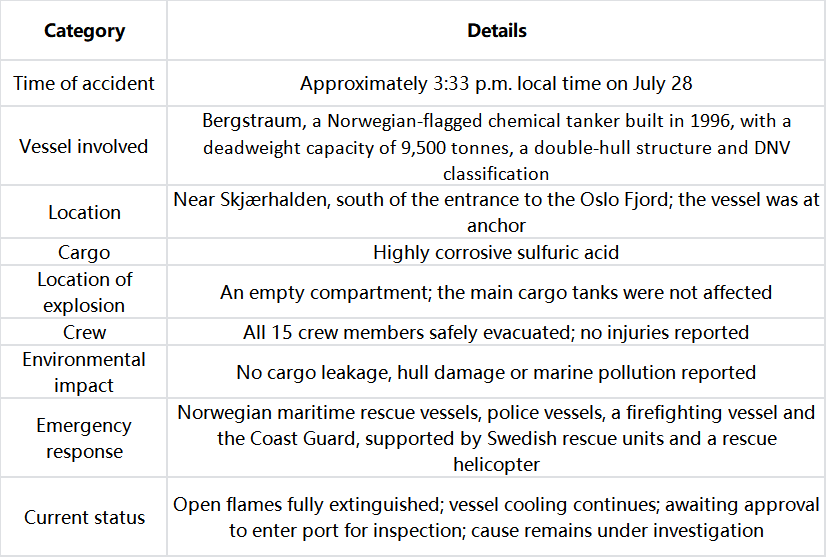
On July 28 local time, a chemical tanker accident occurred in Norwegian waters. The Norwegian-flagged chemical tanker Bergstraum, carrying sulfuric acid, suffered an explosion and caught fire near Fredrikstad in southeastern Norway, close to the entrance to the Oslo Fjord.
As the vessel was carrying highly corrosive sulfuric acid, the incident initially raised serious concerns over a possible chemical leak and marine pollution. Emergency response teams from Norway and Sweden were deployed. The fire has since been brought fully under control, all crew members are safe, and no cargo leakage or marine pollution has been reported. The cause of the accident remains under official investigation.
Although the accident did not result in serious consequences, it has again highlighted the risks involved in transporting dangerous chemicals by sea. Compared with general container and bulk shipping, the maritime transportation of sulfuric acid and other hazardous chemicals requires stricter safety controls. An explosion in an empty compartment, equipment defects or risks during offshore operations may lead to a major safety or environmental incident. The accident is relevant to cross-border chemical transportation, dangerous goods booking and vessel safety management.
Key Highlights
• Offshore emergency: A chemical tanker carrying highly corrosive sulfuric acid exploded and caught fire in Norwegian waters.
• No casualties or pollution: All 15 crew members were safely evacuated, the fire was extinguished, and no cargo leakage or marine pollution was reported.
• Location of the explosion: The explosion occurred in an empty compartment and did not affect the main sulfuric acid cargo tanks.
• Coordinated rescue response: Multiple Norwegian and Swedish maritime rescue units were involved in the emergency response.
• Industry warning: Vessel maintenance, compartment management and emergency response are key areas of risk control in chemical shipping.
Offshore Explosion Prompts Coordinated Emergency Response
The accident occurred on the afternoon of July 28 local time. At the time, Bergstraum was anchored near Skjærhalden, south of the entrance to the Oslo Fjord.
At approximately 3:33 p.m., the Norwegian Sea Rescue Society, Redningsselskapet, received an emergency report that an explosion had occurred on board and caused a fire.
As the vessel was carrying highly corrosive sulfuric acid, any spread of the fire resulting in cargo tank damage or cargo leakage could have caused serious marine pollution and maritime safety risks. Local authorities immediately launched an emergency response.
The response involved two maritime rescue vessels, two police patrol vessels, a firefighting vessel and the Norwegian Coast Guard. Swedish maritime rescue units also provided assistance, while a rescue helicopter transported firefighters to the vessel.
The crew activated the vessel’s foam firefighting system and contained the spread of the fire. Rescue authorities also placed lifeboats on standby in case an emergency evacuation became necessary.
The onboard response and external rescue operation brought the fire under control before it spread further.
By the evening of July 28, the open flames had been fully extinguished, with only a small amount of smoke remaining. Rescue teams continued cooling the vessel to prevent the fire from reigniting.
All 15 Baltic and Filipino crew members were safely evacuated, with no injuries reported. Authorities confirmed that there were no reports of sulfuric acid leakage, hull damage or marine pollution.
The vessel is currently stable and is awaiting approval from the maritime authorities to be towed into port for inspection and repairs.
Key Accident Information
Key Detail: Explosion Occurred in an Empty Compartment, Leaving the Main Hazardous Cargo Unaffected
The main reason the accident resulted in no casualties, cargo leakage or pollution was that the explosion did not affect the main cargo tanks.
The vessel’s management company, Utkilen, later confirmed that the explosion and fire occurred in an empty compartment rather than in the tanks carrying sulfuric acid. The hazardous cargo remained contained throughout the incident.
Sulfuric acid is a highly corrosive hazardous chemical. A leak in coastal waters could corrode the vessel, endanger personnel and damage the marine environment, potentially causing long-term pollution. The resulting cleanup, claims and operational losses could also be substantial.
In previous chemical tanker accidents, cargo tank explosions and chemical leakage have led to further incidents. In this case, the explosion occurred in an empty compartment while the cargo tanks remained intact, limiting the consequences of the accident.
The exact cause remains under investigation. The vessel operator will conduct an internal review and cooperate with the Norwegian maritime and safety authorities.
The investigation will focus on potential equipment failure, compartment operations, pipeline defects and maintenance issues. No preliminary conclusion has been issued.
Vessel Background: Nearly 30 Years in Service with a Previous Equipment Failure
Public vessel records show that Bergstraum was built in 1996 and has a deadweight capacity of approximately 9,500 tonnes. It has a double-hull structure, is registered with the Norwegian International Ship Register and is classed by DNV.
Norwegian shipping company Utkilen is responsible for the vessel’s operations, technical management and commercial management.
The vessel has previously experienced an equipment failure. In 2022, it suffered an engine failure while underway and lost propulsion. It was assisted back to port by tugboats for repairs.
However, maritime investigators have stated that there is currently no evidence linking the 2022 propulsion failure to the latest explosion. The two incidents involved different circumstances and types of risk. The earlier failure will be reviewed as part of the vessel’s maintenance history but is not currently considered evidence of the cause of this accident.
As a chemical tanker that has been in service for nearly 30 years, the incident has renewed attention to the maintenance risks associated with older vessels carrying dangerous goods.
Compared with newer vessels, older vessels may face issues such as aging pipelines, reduced compartment integrity and a higher risk of equipment failure. They therefore require stricter routine inspection, compliant maintenance and risk checks. Inadequate controls may increase the risk of an accident.
Industry Review: In Chemical Shipping, Risk Control Matters More Than Freight Rates
The outcome of the accident was fortunate. The vessel was anchored near the coast, emergency services arrived quickly, the explosion occurred away from the cargo tanks, and the hazardous cargo remained contained. These factors prevented a serious maritime safety or environmental incident.
However, the accident also highlights common risks in the maritime transportation of hazardous chemicals. A failure in maintenance, operations or onboard controls may lead to serious consequences.
Unlike general container and bulk shipping, the cross-border transportation of sulfuric acid, chemical raw materials and other hazardous cargo places strict requirements on vessel qualifications, vessel age, compartment management, crew operations, emergency systems and port rescue capabilities.
The consequences of an accident depend mainly on five factors: the location of the incident, the type and quantity of hazardous cargo, the vessel’s protective capability, the speed of the local emergency response and the isolation of the cargo tanks.
Global cross-border trade in chemical products continues to expand, and demand for the maritime transportation of hazardous chemicals is increasing. However, safety controls vary across the industry.
Some operators focus excessively on freight rates and sailing schedules while paying insufficient attention to vessel qualifications, maintenance records and emergency response capabilities. This creates safety risks within the cross-border supply chain.
A leakage or explosion may result in substantial cleanup costs, claims, port delays and other expenses. It may also lead to cargo delays, contract defaults and service suspensions, with losses exceeding any savings achieved through lower freight rates.
Operational Risk-Control Recommendations for Freight Forwarders and Chemical Exporters
Based on the risks highlighted by this accident, freight forwarders and international trading companies handling chemicals and other dangerous goods should strengthen their risk-control systems and avoid price-driven booking decisions.
1. Review Vessel Qualifications and Age Carefully
Give priority to chemical tankers in good condition, with complete compliance documentation, sound maintenance records and proper classification management.
Bookings involving older vessels should be reviewed carefully. Vessels with incomplete qualifications or repeated equipment failures should be avoided.
2. Strengthen Dangerous Goods Space Management
For sulfuric acid, corrosive chemicals and other hazardous cargo, verify cargo tank integrity, isolation measures and firefighting equipment.
Potential compartment risks should be identified in advance. Empty compartments and cargo tanks should be properly isolated, and cargo loading and containment procedures should be followed.
3. Establish End-to-End Shipment Tracking
Monitor vessel movements, anchorage status, weather and sea conditions throughout the transportation process.
Risks associated with coastal and offshore operations should be assessed in advance. If an abnormal situation occurs, the vessel operator should be contacted promptly to initiate the emergency response plan.
To identify compliant and reliable dangerous goods shipping resources and connect with suitable transportation channels, users may post cargo requirements on the Inquiry Board and contact qualified logistics service providers.
4. Prepare Contingency Arrangements
Dangerous goods transportation insurance, accident liability and emergency response procedures should be arranged in advance.
Procedures for handling chemical leakage, fires, port delays and other emergencies should be clearly defined to reduce financial and fulfillment losses.
Three Operational Questions for Freight Forwarders
• Are vessel access standards in place for dangerous goods shipments, including checks on older vessels and vessels with previous equipment failures?
• Before hazardous chemicals are shipped, have the vessel’s qualifications, compartment safety and emergency equipment been fully checked?
• Is there an emergency response plan for incidents occurring while the vessel is underway or at anchor?
Overall, the explosion and fire involving the Norwegian chemical tanker did not result in serious consequences, but it has again highlighted the risks facing the dangerous goods shipping industry.
For cross-border chemical transportation, low freight rates and shorter sailing schedules should not take priority over routine safety controls, standardized operating procedures and effective emergency response arrangements.
As global maritime safety regulations become stricter, detailed risk control and compliant operations will remain important to the long-term operation of chemical logistics companies.
The official investigation should continue to be monitored so that potential risks involving similar vessels or operating procedures can be identified.
Sources
Publicly available information from the Norwegian Sea Rescue Society, Redningsselskapet, vessel management company Utkilen and maritime industry sources.
Disclaimer
All information is sourced from publicly available channels and is provided for industry reference only. It does not constitute commercial or logistics operational advice.
Last
Breaking: Houthis Claim Attack on Saudi Tanker as Bab el-Mandeb Traffic Falls by Half, Reshaping Red Sea Shipping
Security risks in the Red Sea continue to escalate. On July 28, the Houthis claimed that they had attacked the Saudi-flagged tanke
Next
Double Disruption: Chilean Ports and Border Crossing Hit Simultaneously, Hundreds of Trucks Stranded as Logistics Delays Extend into August
Cross-border logistics in South America is facing major disruption. Persistent extreme winter weather has brought heavy rain, stro
