Red Sea Shipping Risks Escalate: RCL Cancels Sailing and Invokes Force Majeure; Shippers to Bear Additional Costs
Logistics News
 29-Jul-2026
Security conditions in the Red Sea have deteriorated again, with regional shipping risks escalating from delay warnings to actual sailing cancellations.
Regional Container Lines (RCL) recently issued two major customer notices in succession. After warning of risks affecting several sailings, the carrier cancelled a China–Red Sea sailing and invoked its force majeure clause, confirming the high-risk operating conditions on the route.
The latest notice states that all additional costs arising from the service disruption must be borne by shippers. This changes the cost allocation and risk-control requirements for Red Sea shipments and creates significant compliance and cost pressure for freight forwarders and importers and exporters.
The adjustment shows that Red Sea shipping risks are no longer limited to voyage delays and rerouting. They have now directly affected the operation of scheduled services. Route reliability and cost predictability have both deteriorated, bringing further disruption to the entire Red Sea cross-border logistics chain.
Key Highlights
• Sailing cancellation: RCL has cancelled a China–Red Sea sailing and formally invoked its force majeure clause.
• Clear allocation of costs and responsibilities: All additional costs arising from the service disruption must be borne by shippers, with no exemptions.
• Escalating risks: The situation has progressed from schedule warnings and port-call adjustments to the direct cancellation of a scheduled sailing.
• Costs across the logistics chain: Handling, storage, rerouting, demurrage, detention, and other charges may accumulate, significantly increasing total shipping costs.
• Changes to shipment planning: Red Sea services can no longer be regarded as stable. Sailing details must be checked regularly, and alternative arrangements should be prepared in advance.
Incident Details: RCL Issues Two Notices in Two Days as Risks Escalate
Key conclusion: Security risks in the Red Sea have reached a level at which carriers are being forced to cancel sailings, with RCL formally invoking its force majeure clause.
According to official notices issued by RCL, the latest route adjustments show a clear escalation. Within two days, the situation progressed from a risk warning to the cancellation of a sailing.
On July 23, RCL first issued an operational warning covering five Red Sea-related sailings:
TS SINGAPORE 2603W/E
SSF GALENE 2622W/E
TS DALIAN 2603W/E
LOA PEACE 001W/E
GFS PRIME 2625W/E
The carrier stated that instability in the Red Sea could result in schedule delays, longer transit times, temporary port-call changes, or cancellations affecting these sailings, potentially without advance notice.
Only one day later, on July 24, RCL issued another notice announcing the cancellation of the MV TS Chennai 2604E China–Red Sea sailing.
The carrier stated that the cancellation resulted from exceptional circumstances beyond its control and met the conditions for force majeure. RCL therefore invoked the Force Majeure clause, withdrew the original sailing plan, and would no longer guarantee performance under the original transport arrangement.
The two notices show that Red Sea shipping risks have shifted from potential disruption to actual operational disruption. Regular sailing schedules and port-call plans can no longer be implemented with certainty.
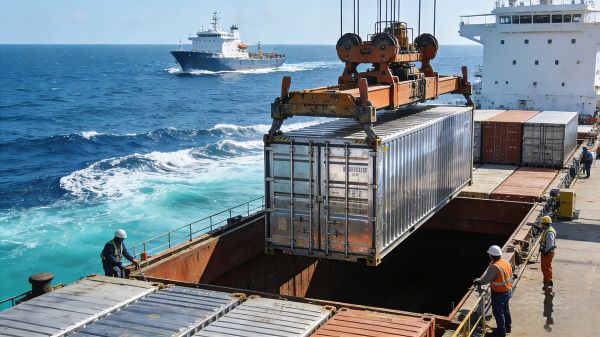
Allocation of Costs and Responsibilities: All Additional Force Majeure Costs to Be Borne by Shippers
Key conclusion: The risks and additional costs arising from force majeure have been transferred to shippers. Freight forwarders must explain the relevant risks and cost responsibilities in advance.
More significant than the sailing cancellation itself is the allocation of additional costs set out in the RCL notice.
RCL stated that, under the terms of the bill of lading, all additional costs arising from the Red Sea force majeure event must be borne by shippers. The carrier will not be responsible for the related costs or compensation.
The costs to be borne by shippers include:
• Cargo handling charges
• Storage charges
• Rerouting charges
• Transshipment and feeder connection charges
• Inland trucking charges
• Demurrage
• Detention
• Port miscellaneous charges
• All other related additional costs
This means that for all Red Sea cargo already booked, in transit, or awaiting shipment, any additional costs arising from sailing cancellations or route adjustments—including rebooking, transshipment, storage, detention, and port diversion—must be borne by shippers.
Total logistics costs may therefore rise sharply, making existing quotations no longer applicable.
Deeper Industry Shift: Risks Spread from Transit-Time Disruption to Operations and Costs
Key conclusion: Stable operations on Red Sea routes can no longer be assumed. Sailing execution, port calls, and cost control have all become uncertain.
Previously, market concerns over Red Sea services focused mainly on longer transit times caused by rerouting and unstable schedules.
RCL’s latest notices show that the risks have now extended to sailing cancellations, sharp cost increases, and failure to perform under the original transport arrangements.
The current uncertainty is no longer limited to rerouting. It now includes:
• Whether scheduled sailings can operate as planned
• Whether vessels can call at scheduled ports
• Whether cargo already in transit will be rerouted at short notice
• How transport obligations will be handled following an unexpected service suspension
Any further deterioration in regional conditions may directly result in sailing cancellations, higher costs across the logistics chain, and cargo delays.
RCL has not suspended all China–Red Sea services. It has only cancelled specific high-risk sailings and will continue to assess regional security conditions and adjust schedules accordingly.
Overall, Red Sea services have not stopped completely. However, last-minute sailing cancellations and schedule adjustments have become increasingly common, and consistent shipment reliability can no longer be assumed.
Operational Alerts and Recommended Actions for Freight Forwarders: Comparison of Traditional and Current Red Sea Shipping Models
Risk-control requirements for Red Sea routes have changed significantly. Traditional shipment planning based on low rates and stable transit times is no longer suitable under current conditions.
As the parties responsible for frontline operations and customer service, freight forwarders must update their operating standards, clearly distinguish between the traditional and current operating models, and reduce the risks of customer disputes and operating losses.
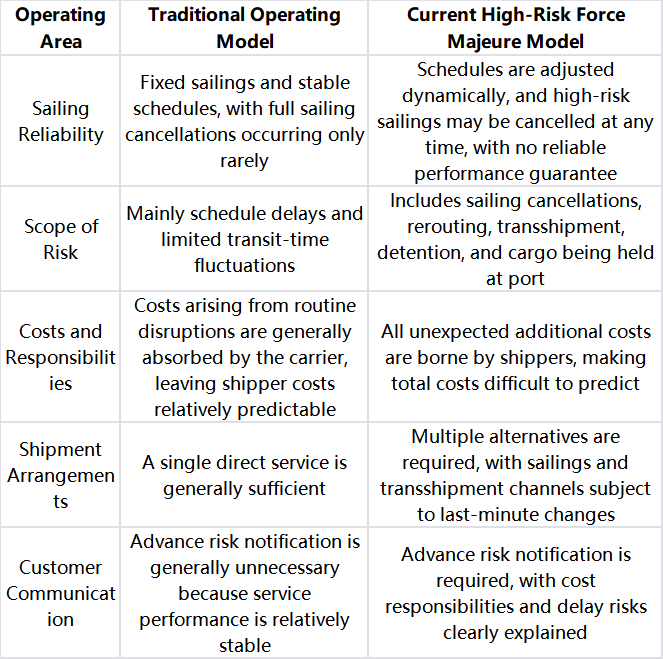
Given the current conditions in the Red Sea, freight forwarders should review all existing Red Sea shipments and check each sailing to determine whether it appears on the cancellation or high-risk warning list.
They can also use the platform’s Company Directory to identify reliable service providers with experience in handling emergency situations on Red Sea routes and established transshipment resources.
Alternative transport arrangements should be prepared in advance to reduce operating risks arising from sailing cancellations and unexpected rerouting and to maintain more stable Red Sea operations.
Three Self-Check Questions for Freight Forwarders
• Have all current shipments been reviewed? Has each sailing been checked to confirm whether it is included in the cancellation notice or high-risk warning list?
• Have cost responsibilities been explained in advance? Have shippers been informed of the rules governing additional costs under force majeure to reduce cost disputes?
• Have contingency arrangements been prepared? Are alternative sailings and transshipment options available for rapid use if a scheduled sailing is cancelled?
Industry Summary
Overall, high-risk conditions in the Red Sea are likely to continue for an extended period. Carrier declarations of force majeure, last-minute sailing cancellations, and unpredictable cost increases are becoming increasingly common.
Logistics companies should move away from the assumption that Red Sea shipments can continue to operate consistently under traditional arrangements.
Risk assessment, cost control, and contingency planning should become part of routine operations. Advance risk control, multiple alternative arrangements, and clear allocation of responsibilities can help reduce customer complaints, operating losses, contractual defaults, and other business risks.
Sources: Official RCL announcements, international maritime shipping media, World Ports
Disclaimer: This content is based on publicly available information and is provided for industry reference only. It does not constitute commercial or logistics operating advice.

Last
ONE Updates EC3 US East Coast Port Rotation with New Ningbo Call, Expanding East China Export Options
Global liner networks continue to undergo detailed optimization, with ONE introducing an important update to its US East Coast ser
Next
New Kenya Import Compliance Rule Takes Effect on August 3: ACD Filing Mandatory and Reference Code Required on Bills of Lading
Compliance requirements for cross-border logistics in Africa are tightening again as Kenya introduces a new import control system.
