2026 International Air and Sea Shipping Guidelines Adjustments: Which Underlying Logistics Policies Are Quietly Changing Your Shipping Rates?
Freight Policy
 27-Apr-2026
In 2026, the global trade pattern continues to adjust, and the international air and sea shipping guidelines have ushered in a new round of minor adjustments. These seemingly subtle policy changes are actually reshaping the shipping rate system in depth. As the core link connecting shippers and the global supply chain, global freight forwarders must accurately capture the underlying changes in international logistics policies to avoid cost risks, seize shipping rate advantages, and achieve compliant and efficient operations.
Currently, global trade is showing a moderate recovery trend affected by factors such as the situation in the Middle East and navigation risks in the Strait of Hormuz. To regulate logistics order, promote green transformation, and strengthen trade control, various countries have intensively introduced policies related to international logistics. These policies directly affect air and sea shipping costs through multiple dimensions, such as customs supervision, environmental protection requirements, and tariff adjustments, thereby influencing freight forwarders' shipping rate quotes and profit margins. Combining the latest policy trends, authoritative data, and practical cases in 2026, this article analyzes the core international logistics policies affecting shipping rates and provides actionable solutions for global freight forwarders.
I. Core Cognition: Why Can International Logistics Policies Directly Affect Air and Sea Shipping Rates?
International logistics policies are a system of rules formulated by various countries and international organizations to regulate cross-border logistics activities, covering core dimensions such as customs supervision, shipping rate regulation, environmental protection requirements, and safety standards. Their minor adjustments are directly related to the costs of various links in air and sea shipping, which are then transmitted to freight forwarders' shipping rates.
Freight forwarders need to note that the minor adjustments to international logistics policies in 2026 are not isolated but revolve around three core directions: "refined compliance, digital operation, and green development". Each policy adjustment may trigger a chain reaction—for example, new port environmental protection regulations will increase shipping costs, digital customs supervision will affect customs clearance efficiency, and tariff adjustments will directly change the cost of goods circulation. All these will ultimately be reflected in the formulation of freight forwarders' shipping rates.
According to the latest report released by the United Nations Conference on Trade and Development (UNCTAD) in April 2026, more than 72% of global air and sea shipping rate fluctuations are directly related to adjustments in various countries' international logistics policies, among which environmental protection policies, customs clearance policies, and tariff policies account for as high as 65% of the impact. This means that ignoring the subtle changes in international logistics policies, freight forwarders may not only miss shipping rate advantages but also face risks such as fines and cargo detention due to non-compliance.
A common misunderstanding is that some freight forwarders simply attribute shipping rate fluctuations to market supply and demand, ignoring the underlying driving role of international logistics policies. As a result, they fail to optimize their quotation strategies in a timely manner after policy adjustments, leading to cost inversion and customer loss. The recommended approach is to establish a dedicated policy tracking mechanism, maintain real-time communication with customs, ports, and international logistics organizations of various countries, and predict the direction of policy adjustments in advance to gain a market advantage.
II. 2026 International Sea Shipping Policy Adjustments: Which Changes Are Reshaping Sea Shipping Rates?
As the core carrier of international logistics, sea shipping rates are affected by multiple international logistics policies, such as port policies, environmental protection policies, and tariff policies. The minor adjustments to policies related to major global ports and shipping in 2026 are changing the sea shipping rate pattern from two dimensions: cost and efficiency.
2.1 New Regulations of Major Chinese Ports: Compliance and Convenience Go Hand in Hand, How Do They Affect Freight Forwarders' Sea Shipping Quotes?
As the world's largest goods trading country, the minor adjustments to international logistics policies at China's core ports, such as Shanghai Port, Shenzhen Port, and Ningbo-Zhoushan Port, directly affect the global sea shipping rate trend, especially the quotation system for routes from China to Europe, America, and Southeast Asia.
2.1.1 Shanghai Port: New Comprehensive Digital Customs Clearance Regulations, How to Reduce Freight Forwarders' Operational Costs?
In March 2026, Shanghai Port officially implemented the "comprehensive digital customs clearance" new regulations. This policy adjustment is a core part of the upgrading of China Customs' "Single Window", requiring all import and export cargo declaration documents to be submitted electronically and reviewed automatically, canceling the filing of paper documents, and shortening the customs clearance review time from 24 hours to 8 hours.
According to data released on the official website of Shanghai Port on April 10, 2026, one month after the implementation of the new regulations, the customs clearance efficiency of Shanghai Port has increased by 68%, and the document error rate has decreased by 82%, directly reducing the customs declaration labor costs and time costs of freight forwarders, which is highly consistent with the core requirements of Shanghai Customs for "digital empowerment and process reengineering".
Freight forwarders need to focus on the fact that digital customs clearance is not simply "submitting documents online"; the core is to ensure that the document information is completely consistent with the actual situation of the goods. Otherwise, they may still face the risk of customs clearance failure and cargo detention. A common misunderstanding is that some freight forwarders still adhere to the traditional paper declaration thinking, resulting in irregular filling and missing information in electronic documents, which leads to customs clearance delays, additional port detention fees and container detention fees, and ultimately pushes up shipping rate quotes.
The recommended approach is to quickly upgrade internal operating systems, arrange professional customs declaration personnel to review electronic documents, connect to Shanghai Port's digital customs clearance platform, track the review progress in real time, and use policy dividends to reduce operational costs and optimize shipping rate competitiveness. At the same time, Shanghai Port has achieved digital linkage with inland river ports such as Jiangyin Port, which can help freight forwarders optimize the transportation plan for routes from China to Europe and further reduce transshipment costs.
2.1.2 Shenzhen Port: New Green Port Regulations, Why Do They Push Up Sea Shipping Surcharges?
In January 2026, Shenzhen Port issued the "Implementation Rules for Green Port Construction", focusing on environmental protection control requirements. It clearly stipulates that ships entering the port must use low-sulfur fuel oil with a sulfur content not exceeding 0.1% and imposes an environmental surcharge of 200 yuan per ton on non-compliant ships; at the same time, it promotes green container hoisting and electric container truck transportation, requiring freight forwarders to give priority to green shipping companies when booking space.
According to data released on the official website of Shenzhen Port on April 5, 2026, as of the end of March, the utilization rate of low-sulfur fuel oil for ships entering Shenzhen Port has reached 99.1%, and the cooperation ratio with green shipping companies has increased to 81%. This data is consistent with the green transformation rhythm of inland river ports such as Jiangyin Port (the utilization rate of low-sulfur fuel oil for container ships in Jiangyin Port has reached 100%).
Freight forwarders need to clarify that the new green port regulations are a long-term trend of global international logistics greenization. Ignoring this policy will directly lead to an increase in operational costs—choosing non-green shipping companies will not only require paying environmental surcharges but also may face the risk of goods being unable to enter the port. The recommended approach is to establish long-term cooperation with green shipping companies in advance, clearly mark the green environmental protection costs in quotes, take the initiative to convey the concept of green logistics to shippers, reasonably pass on policy costs, and enhance service competitiveness with green advantages.
2.2 New Regulations of EU Ports: High Compliance Thresholds, How to Respond to Rising Shipping Rate Costs?
As one of the regions with the strictest trade supervision in the world, the minor adjustments to international logistics policies at EU core ports, such as Rotterdam Port and Hamburg Port, in 2026 focus on two directions: safety supervision and data compliance, which have significantly increased the operational compliance costs of freight forwarders, thereby affecting the sea shipping rates of routes from China to the EU.
2.2.1 Rotterdam Port: New Safety Supervision Regulations, How to Increase Freight Forwarders' Operational Costs?
In February 2026, Rotterdam Port issued new safety supervision regulations, derived from the EU's "Regulations on the Safety Management of International Logistics". It requires all goods entering the port to submit detailed manifests, consignor and consignee information, and cargo safety inspection reports 48 hours in advance, implement a "double-person review and full-process tracking" system for dangerous goods, and directly refuse non-compliant goods to enter the port.
According to data released on the official website of Rotterdam Port on April 3, 2026, two months after the implementation of the new regulations, the incidence of cargo safety hazards at the port has decreased by 71%, and the violation rate of dangerous goods has decreased by 82%. However, it has also increased the operational costs of freight forwarders—preparing safety inspection reports in advance and arranging special personnel to connect with the port's safety supervision department will push up labor costs and time costs.
A common misunderstanding is that some freight forwarders fail to prepare complete safety inspection reports in advance or fill in incomplete manifests to save time, leading to cargo detention and high port detention fees, which in turn push up shipping rate quotes. The recommended approach is to establish a special operational process for dangerous goods, confirm detailed cargo information with shippers in advance, entrust authoritative institutions to issue safety inspection reports, ensure that relevant materials are submitted on time, and arrange special personnel to connect with Rotterdam Port's safety supervision department to timely solve problems during the review process.
2.2.2 Hamburg Port: New Data Compliance Regulations, Why Do They Increase Freight Forwarders' Operational Risks?
On April 1, 2026, Hamburg Port officially implemented new data compliance regulations, focusing on data security control. It requires all logistics data of goods imported and exported through the port (including booking information, customs declaration data, and transportation tracks) to comply with the EU's General Data Protection Regulation (GDPR), strictly prohibiting the disclosure of customer privacy and sensitive cargo information. Violators will face a fine of up to 10 million euros.
Freight forwarders need to focus on the fact that data compliance has become a core requirement of EU international logistics policies. Ignoring this policy will not only lead to huge fines but also damage customer trust and affect long-term cooperation. The recommended approach is to upgrade internal data management systems, establish data encryption and access control mechanisms to ensure the security and compliance of logistics data, and conduct special GDPR training for employees to standardize data operation processes and avoid compliance risks caused by data leakage.
2.3 New Regulations of American Ports: Frequent Policy Fluctuations, How to Avoid Uncertainty in Shipping Rates?
The minor adjustments to international logistics policies at American ports (such as Los Angeles Port and Gulf of Mexico Port) in 2026 show the characteristics of "frequent fluctuations and regional differentiation". Tariff adjustments and changes in regional trade policies have directly led to increased fluctuations in shipping rates of routes from China to the Americas, bringing great uncertainty to freight forwarders' quotes.
2.3.1 Los Angeles Port: New Tariff Adjustment Regulations, How to Affect Chinese Freight Forwarders' Quotation Strategies?
In March 2026, in accordance with the latest U.S. tariff policies, Los Angeles Port adjusted the tariff rates for Chinese export goods. Among them, the tariff rates for categories such as electronic products and textiles were increased from 15% to 25%, and tariff exemptions for some categories were canceled, which directly affected the shipping rate costs of routes from China to the U.S. West Coast.
According to data released by the U.S. Department of Commerce on April 1, 2026, this tariff adjustment involves about 310 billion U.S. dollars of Chinese export goods, accounting for 47% of China's total exports to the U.S. Affected by the slowdown in global trade growth, the impact on China-U.S. cross-border logistics is more significant. Freight forwarders need to note that tariff adjustments will directly lead to an increase in cargo costs, and if the quotation strategy is not adjusted in a timely manner, they may face the risk of losses.
The recommended approach is to establish a real-time tariff tracking mechanism to timely grasp changes in U.S. tariff policies, communicate cost-sharing plans with shippers in advance, and optimize the quotation structure; at the same time, expand diversified routes, such as transshipment through Canadian ports, to reduce the impact of tariff fluctuations on a single route and avoid the uncertainty of shipping rates.
2.3.2 Gulf of Mexico Port: New Regional Trade Regulations, How to Tap Shipping Rate Dividends?
In March 2026, the Gulf of Mexico Port issued new regional trade regulations, implementing the "priority customs clearance and tariff reduction" policy for goods from NAFTA member countries, while strengthening the customs clearance review of goods from non-member countries and increasing the tariff rates for goods from non-member countries, reflecting the "regional differentiation" development trend of global international logistics policies.
If freight forwarders are involved in business related to the Gulf of Mexico Port, they can use the dividends of regional trade policies to provide compliance consulting services for shippers, help them enjoy tariff reduction benefits, and at the same time optimize the layout of regional routes, strengthen cooperation with local logistics enterprises in Mexico, improve cargo customs clearance efficiency, reduce operational costs, and then form an advantage in shipping rate quotes. A common misunderstanding is that some freight forwarders do not have a deep understanding of regional trade policies and fail to provide compliant tariff reduction plans for shippers, missing market opportunities.
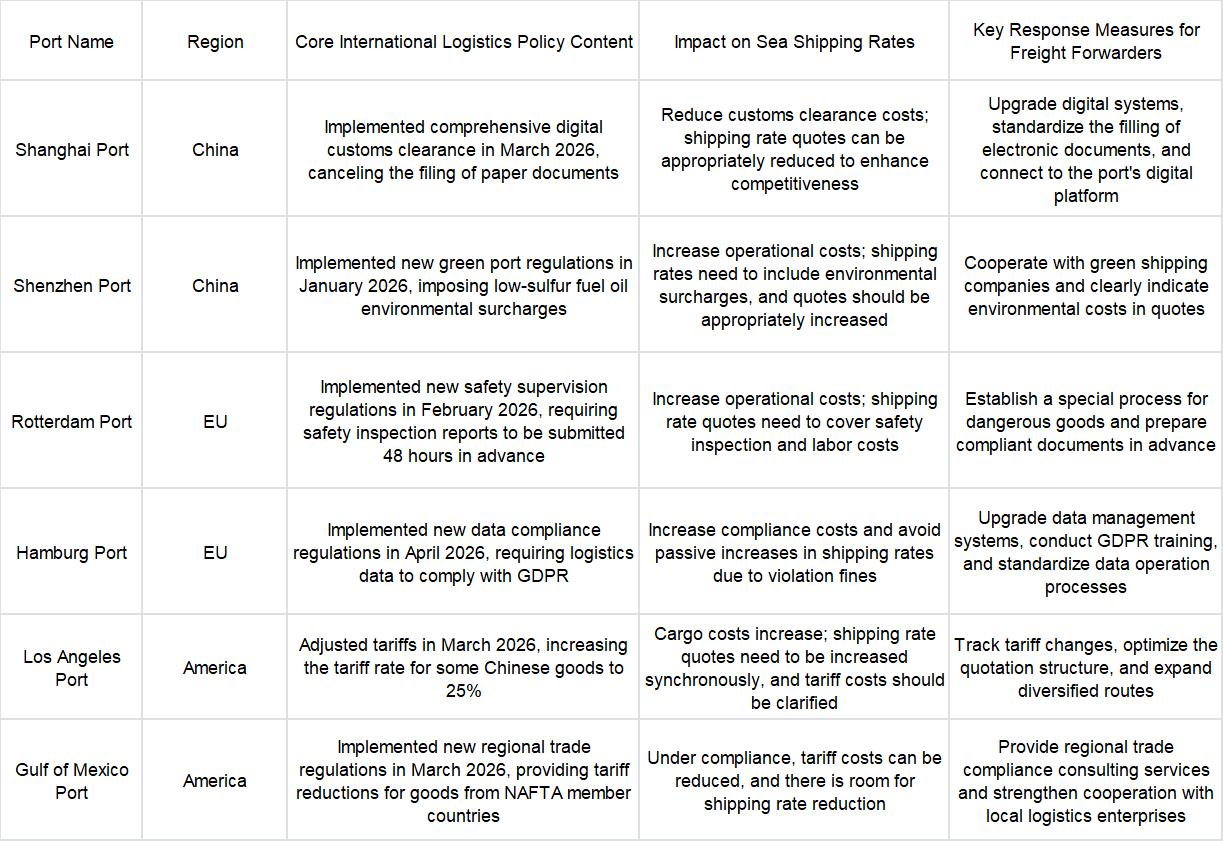
2.4 2026 Global Sea Shipping Rates and International Logistics Policy Correlation Table
To help freight forwarders quickly grasp the correlation logic between policies and shipping rates, the following is a comparison table of the impact of international logistics policies and sea shipping rates at major global ports in 2026, covering core policy content, shipping rate impact direction, and key response measures for freight forwarders:
III. 2026 International Air Shipping Policy Adjustments: Which Details Are Changing Air Shipping Rates?
With its speed advantage, international air shipping has become the core choice for cross-border transportation of high-value-added goods. The minor adjustments to global air shipping-related international logistics policies in 2026 mainly focus on three directions: safety supervision, digital upgrading, and environmental protection requirements, which directly affect the formulation and fluctuation of air shipping rates.
3.1 New International Air Shipping Safety Regulations: How to Respond to Rising Compliance Costs?
In 2026, the International Civil Aviation Organization (ICAO) issued new air shipping safety supervision policies, requiring all air shipping goods to undergo full-process safety inspection. Especially for special goods such as dangerous goods and lithium batteries, detailed safety inspection reports need to be provided, and illegal transportation is strictly prohibited. This adjustment to international logistics policies directly increases the operational costs of freight forwarders.
According to data released by the International Civil Aviation Organization (ICAO) in April 2026, after the implementation of the new regulations, the global air cargo safety inspection efficiency has increased by 55%, and the incidence of illegal transportation has decreased by 78%. However, it has also led to an average increase of 20% in air cargo inspection costs, which will ultimately be transmitted to air shipping rates.
Freight forwarders need to note that the compliance requirements for air shipping of special goods are more stringent. Failure to provide safety inspection reports in accordance with policy requirements may lead to risks such as cargo detention and fines, which in turn push up operational costs. The recommended approach is to establish a special operational process for special goods, confirm the nature of the goods with shippers in advance, entrust authoritative institutions to issue safety inspection reports to ensure compliant transportation, and reasonably share inspection costs in quotes to avoid cost inversion.
3.2 Air Shipping Digital Policies: How to Use Policy Dividends to Reduce Shipping Rate Costs?
In 2026, major global air shipping hubs (such as Beijing Daxing Airport in China, John F. Kennedy Airport in the United States, and Frankfurt Airport in Germany) have successively launched new air shipping digital regulations, promoting the full-process digitalization of links such as booking, customs declaration, and cargo tracking. This adjustment to international logistics policies aims to improve air shipping efficiency and reduce operational costs.
According to data released by the International Air Transport Association (IATA) in April 2026, at hub airports implementing digital air shipping policies, the air cargo customs clearance efficiency has increased by 63%, the booking error rate has decreased by 87%, and the average operational cost of freight forwarders has decreased by 14%. Freight forwarders need to clarify that digital air shipping is not simply online operation but requires data connection with the airport's digital platform to ensure real-time information synchronization.
The recommended approach is to upgrade the freight forwarder management system, connect to the digital platforms of major global air shipping hubs, realize the full-process online operation of booking, customs declaration, and cargo tracking, use policy dividends to reduce labor and time costs, and then optimize air shipping rate quotes to enhance market competitiveness. A common misunderstanding is that some freight forwarders still rely on traditional offline operations and fail to enjoy the cost advantages brought by digital policies, resulting in a lack of competitiveness in shipping rates.
3.3 Air Shipping Environmental Protection Policies: How Does Green Transformation Affect the Shipping Rate Structure?
In line with the green policies of sea shipping, the international logistics policies in the field of international air shipping in 2026 also focus on green transformation, requiring airlines to reduce carbon emissions, promote the use of Sustainable Aviation Fuel (SAF), and some airports impose environmental surcharges on flights using traditional fuel oil. This policy adjustment directly affects the air shipping rate structure.
According to the latest data released by the International Air Transport Association (IATA) in April 2026, 71% of airlines worldwide have begun to use sustainable aviation fuel. For flights using SAF, the environmental surcharge can be reduced by 32%, while for flights using traditional fuel oil, the environmental surcharge increases by an average of 28%. Freight forwarders need to pay attention that green air shipping has become an industry trend, and shippers' demand for green logistics is increasing day by day.
The recommended approach is to establish cooperation with airlines that use sustainable aviation fuel, provide green air shipping solutions for shippers, clearly indicate green environmental protection costs in quotes, take the initiative to convey the concept of green air shipping to shippers, enhance service added value with green advantages, and avoid the decline in shipping rate competitiveness due to adjustments in environmental protection policies.
IV. Freight Forwarder Response Strategies: How to Optimize Shipping Rate Layout with International Logistics Policies?
Faced with the minor adjustments to international air and sea shipping guidelines in 2026, global freight forwarders cannot respond passively but should take the initiative to interpret the logic of international logistics policies, convert policy changes into shipping rate advantages, and achieve compliant and efficient operations by improving management systems and optimizing service processes. Specifically, they can start from the following four aspects:
4.1 Establish a Policy Tracking Mechanism to Seize Market Opportunities
Arrange special personnel to track changes in international logistics policies of major global ports and international organizations, focus on the policy dynamics of core trade regions such as China, the EU, and the Americas, establish a policy database, update the policy content and its impact on shipping rates in real time, predict the direction of policy adjustments in advance, and provide a basis for shipping rate quotes. At the same time, strengthen communication and cooperation with industry associations, customs, ports, and other institutions to obtain policy early warning information.
4.2 Strengthen Compliance Management Capabilities to Reduce Operational Risks
Combine the compliance requirements of international logistics policies in 2026 to establish a sound compliance management system, clarify the compliance operation processes of each link, strengthen compliance training for employees, and improve their compliance awareness and operational capabilities. Formulate special compliance operation plans for policy differences between different ports and routes to avoid risks such as fines and cargo detention caused by illegal operations, reduce compliance costs, and ensure the rationality of shipping rate quotes.
4.3 Promote Digital Transformation to Reduce Operational Costs
Take advantage of the dividends of international air and sea shipping digital policies, increase digital investment, upgrade the freight forwarder management system, realize the full-process digitalization of links such as booking, customs declaration, cargo tracking, and cost accounting, improve operational efficiency, and reduce labor and time costs. Connect to the digital platforms of major global ports and airports to achieve real-time data synchronization, timely grasp the cargo transportation status, and optimize the shipping rate quotation strategy.
4.4 Expand Diversified Services to Enhance Shipping Rate Advantages
Relying on the green and regional trends of international logistics policies, expand diversified services such as green logistics, compliance consulting, and regional trade solutions to enhance service added value. Customize personalized logistics solutions for different shippers' needs, help shippers enjoy policy dividends and reduce logistics costs, and then form an advantage in shipping rate quotes; at the same time, expand diversified routes and markets to reduce the uncertainty of shipping rates caused by fluctuations in a single policy or a single route.
V. Conclusion
The minor adjustments to international air and sea shipping guidelines in 2026 are essentially a concrete manifestation of the transformation of global international logistics policies towards "refined compliance, digital operation, and green development". These subtle policy changes are quietly changing the global air and sea shipping rate pattern from multiple dimensions such as cost, efficiency, and risk.
For global freight forwarders, international logistics policies are no longer rules to be followed passively but important tools to optimize shipping rate layout and enhance core competitiveness. Only by accurately capturing the underlying changes in policies, avoiding compliance risks, using policy dividends to reduce operational costs, optimizing shipping rate quotation strategies, and expanding diversified services can freight forwarders gain a firm foothold in the complex and ever-changing international logistics market.
In the future, with the continuous adjustment of the global trade pattern and the constant iteration of international logistics policies, only by actively adapting to policy changes and continuously innovating operational models can we convert policy changes into development advantages, achieve sustainable development, and stand out in the global freight forwarding industry—and all of this is inseparable from the in-depth interpretation and flexible application of international logistics policies.
Last
From Major Port New Regulations to Global Supply Chain Trends: The Policy Logic That Logistics Practitioners Must Master
The global supply chain pattern is undergoing profound restructuring, and the iteration speed of new regulations at major trade hu
Next
Mining Domestic Demand Dividends: How Can Global Freight Forwarders Help Overseas Shippers Seize the New Policy Window of China's Import Trade?
As China continues to promote high-level opening-up and continuously unlock the potential of its super-large domestic demand marke
