Access and Compliance: Analyzing China's Latest Regulatory Policies on the Import of Food and Sensitive Goods
Freight Policy
 24-Apr-2026
For global freight forwarders, navigating China's import policies is critical to ensuring smooth customs clearance, avoiding delays, and minimizing financial risks, especially when handling food and sensitive goods. With China’s continuous optimization of import supervision systems and the implementation of new regulatory measures in 2025 and 2026, mastering the latest compliance requirements has become a core competency for freight forwarders operating in the Chinese market. This guide focuses on the latest regulatory policies for food and sensitive materials in China’s import links, providing practical insights and actionable advice tailored to the needs of global freight forwarders.
What Are the Core Principles of China's Import Policies for Food and Sensitive Goods?
China's import policies for food and sensitive goods are based on three core principles: safety priority, compliance supervision, and efficient facilitation. These principles guide all regulatory measures, aiming to protect public health, national security, and market order while promoting the smooth flow of legitimate trade. Freight forwarders must fully understand these principles to effectively coordinate all parties in the supply chain and ensure compliance at every link.
What Is the Scale of China’s Imports of Food and Sensitive Materials?
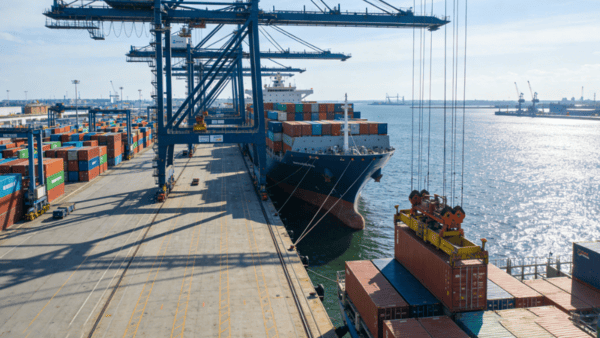
According to 2025 data from the General Administration of Customs of China (GACC), China’s total imports of agricultural products reached 207.4 billion US dollars in 2025, making it the world’s second-largest importer of agricultural products. Among these imports, food and sensitive materials such as grains, meat, dairy products, and medical supplies account for a significant proportion, which also means that the regulatory requirements for these categories are more stringent. The core goal of China's import policies is to balance trade facilitation and regulatory rigor, and freight forwarders play a key role in bridging the gap between overseas suppliers and Chinese customs.
Why Must Freight Forwarders Track Policy Changes Timely?
Freight forwarders need to note that the core principles of China's import policies are not static; they will be adjusted according to changes in domestic market demand, public health risks, and international trade trends. For example, in response to the increase in imported beef volume, China implemented a three-year safeguard measure starting from January 1, 2026, adopting the form of "country-specific quotas and additional tariffs outside the quota" to protect the domestic industry while ensuring the normal supply of imported beef. Therefore, freight forwarders must establish a real-time policy tracking mechanism to avoid risks caused by outdated policy understanding.
How Are Imported Foods Regulated Under China's Import Policies?
Imported food supervision is a key part of China's import policies, covering the entire process from overseas production enterprises to domestic circulation. The General Administration of Customs (GACC) is the main competent authority, responsible for formulating regulatory standards, conducting enterprise registration, and implementing inspection and quarantine. All imported foods must meet China's food safety standards and pass customs inspection and quarantine before entering the Chinese market.
What Are the Pre-Import Registration Requirements for Overseas Food Production Enterprises?
In March 2026, GACC revised and issued the "Regulations on the Administration of Registration of Overseas Production Enterprises of Imported Food of the People's Republic of China" and supporting implementation announcements, which will come into effect on June 1, 2026. This revision optimizes the registration management system for overseas food production enterprises, bringing important changes that freight forwarders must pay attention to.
• Classification Registration Based on Risk: The new regulations implement classified registration based on risk. According to the food safety risk level, whether major food safety incidents have occurred, and international practices, a list of imported foods requiring official recommended registration and a list of foods not eligible for automatic renewal of registration have been determined. Currently, food categories requiring official recommended registration include meat and meat products, aquatic products, etc., while 6 categories of primary edible agricultural products such as oilseeds, coarse grains, fresh-keeping vegetables, and dried beans have been removed.
• Optimization of Registration Application Methods: For newly applying enterprises, the registration application method has been optimized from the original "official recommended registration" and "enterprise self-application registration" to all applications submitted by enterprises. For foods included in the list of imported foods requiring official recommended registration, enterprises can directly submit applications to Chinese authorities after obtaining inspection reports and recommendation letters from the competent authorities of the exporting country.
• Automatic Renewal and Fast Track: Meat and meat products, bird's nest and bird's nest products are included in the list of foods not eligible for automatic renewal of registration, while other food production enterprises can automatically renew their registration upon expiration, optimizing the validity period management of enterprises. In addition, a "list registration" fast track has been added to ensure more efficient and convenient registration for legally compliant food enterprises.
Recommended practice: Freight forwarders should assist overseas suppliers in verifying their registration status before accepting food import orders. They can check the list of registered overseas food production enterprises released on the official website of GACC to confirm whether the supplier is eligible for import. For enterprises that need to apply for registration or renew their registration, freight forwarders should remind them to prepare relevant materials in advance and follow the new application procedures to avoid delays in customs clearance due to unregistered or expired registration.
What Are the Key Requirements for Imported Food Inspection and Quarantine?
Imported food must pass inspection and quarantine by customs before being allowed to enter the Chinese market. The inspection and quarantine content includes food safety indicators, labeling compliance, packaging safety, and other aspects, and the standards are strictly in line with China's national food safety standards.
• Inspection Indicators: The main inspection indicators include pesticide residues, veterinary drug residues, heavy metals, microorganisms, food additives, etc. For example, imported grains such as soybeans and wheat need to be inspected for aflatoxin, pesticide residues, and other indicators; imported meat needs to be inspected for veterinary drug residues such as clenbuterol and salmonella.
• Labeling Compliance: Imported prepackaged food must have a Chinese label that meets China's requirements, including information such as product name, net content, ingredients list, production date, shelf life, country of origin, and name and address of the importer. The Chinese label must be printed in a clear and legible manner, and the content must be consistent with the original label. Common misunderstanding: Some freight forwarders believe that the original foreign language label is sufficient, or that the Chinese label can be pasted after the goods arrive in China, which may lead to the goods being detained by customs due to non-compliant labeling.
• Packaging Safety: The packaging of imported food must be clean, intact, and meet the requirements of food safety and hygiene. Wooden packaging must comply with the ISPM15 standard and be affixed with the IPPC mark; otherwise, it may be required to be re-fumigated or even destroyed, resulting in additional costs and delays.
What Should Freight Forwarders Do for Large-Volume Imported Foods?
According to 2025 data from the General Administration of Customs, China imported more than 140 million tons of grain in 2025, including 111.833 million tons of soybeans, accounting for about 80% of the total grain imports. For these large-volume imported foods, freight forwarders need to coordinate with overseas suppliers to provide complete inspection reports and other documents, and remind suppliers to strictly control the quality of goods to avoid failure to pass inspection and quarantine.
What Are the Tariff Policies for Imported Foods Under China's Import Policies?
China's tariff policies for imported foods are constantly adjusted to meet domestic market demand and promote international trade. The "2026 Tariff Adjustment Plan" issued by the Tariff Commission of the State Council implements temporary import tax rates lower than the most-favored-nation tax rates for 935 items of goods, including some food products. The following table shows the temporary import tax rates and most-favored-nation tax rates for some common imported foods in 2026, which freight forwarders can refer to for cost calculation.
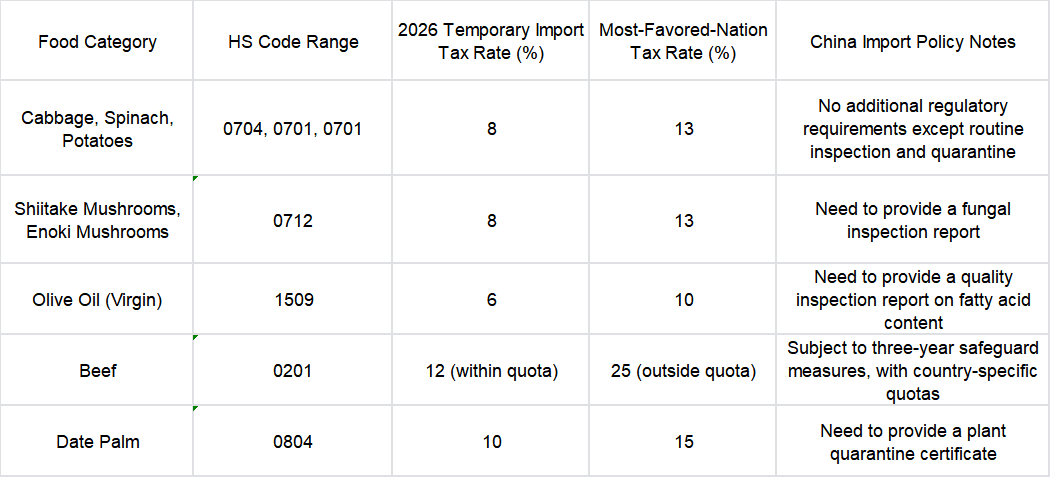
Freight forwarders need to note: When calculating the tariff cost of imported food, it is necessary to confirm whether the goods are within the quota (such as beef) and whether they are eligible for preferential tariff rates under free trade agreements. For example, China continues to implement agreement tax rates for some imported goods originating from 34 trading partners and provides zero-tariff treatment for 100% of the tariff items of 43 least developed countries with which it has diplomatic relations. Freight forwarders should remind customers to provide valid certificates of origin to enjoy preferential tax rates and reduce import costs.
What Are the Regulatory Requirements for Sensitive Materials Under China's Import Policies?
Sensitive materials refer to goods that involve national security, public health, environmental protection, and other fields and require special supervision under China's import policies. Common sensitive materials include medical supplies, dangerous goods, and some special chemicals. The regulatory requirements for these goods are more stringent than those for ordinary goods, and freight forwarders must strictly abide by relevant regulations to avoid legal risks.
How to Regulate Imported Medical Supplies Under China's Import Policies?
Imported medical supplies are an important category of sensitive materials, and their supervision involves multiple authorities such as the National Medical Products Administration (NMPA) and GACC. With the continuous improvement of China's medical and health system, the regulatory requirements for imported medical supplies have become more refined.
What Tariff Adjustments Are There for Imported Medical Supplies in 2026?
According to the "2026 Tariff Adjustment Plan", China has reduced the import tariffs on some medical products related to people's livelihood, such as artificial blood vessels and diagnostic kits for some infectious diseases, to reduce the burden on residents and promote the development of the Healthy China Initiative. For freight forwarders, the key to complying with the regulatory requirements for imported medical supplies lies in mastering the pre-import approval procedures and document requirements.
• Pre-Import Approval: Imported medical devices (such as artificial blood vessels) need to obtain a "Medical Device Registration Certificate" or "Medical Device Import Registration Certificate" issued by the NMPA; imported vaccines and other biological products need to obtain an "Import Drug Registration Certificate". Recommended practice: Freight forwarders should assist customers in completing the approval procedures in advance, as the approval cycle is usually 3-6 months, and failure to obtain approval in advance will result in the goods being detained by customs.
• Document Requirements: The required documents for imported medical supplies include a certificate of origin, commercial invoice, packing list, bill of lading, product quality certificate, and approval documents issued by the NMPA. All documents must be true, complete, and consistent, and the product name, specification, and model must be consistent with the approval documents. Common misunderstanding: Some freight forwarders confuse the approval requirements for medical devices and ordinary goods, resulting in missing approval documents and customs clearance delays.
• Inspection and Quarantine: Imported medical supplies must pass customs inspection and quarantine, and the inspection content includes product quality, safety performance, and labeling compliance. For example, imported diagnostic kits need to be inspected for accuracy and sensitivity, and imported medical devices need to be inspected for compliance with China's national standards.
What Are the Regulatory Requirements for Imported Dangerous Goods Under China's Import Policies?
Imported dangerous goods refer to goods that have flammable, explosive, corrosive, toxic, radioactive, and other dangerous properties, and their import is strictly supervised by China's General Administration of Customs and Emergency Management Department. Freight forwarders must have professional knowledge of dangerous goods and strictly follow the regulatory requirements in the process of undertaking dangerous goods import business.
• Determine Classification and UN Number: Before importing dangerous goods, freight forwarders need to confirm the dangerous category and UN number of the goods through the MSDS (Safety Data Sheet) to avoid declaration violations due to incorrect classification. For example, lithium-ion battery recycling black powder, which is included in the 2026 tariff reduction list, belongs to dangerous goods and needs to be classified according to its dangerous properties.
• Enterprise and Goods Access: The importer must have a "Dangerous Chemical Business License"; if there is no qualification, a qualified agent can be entrusted to use "dual-header declaration". Some categories (such as precursor chemicals and explosive materials) need to apply for an "Import License" in advance, and the import of dangerous goods not included in China's access list is strictly prohibited.
• Packaging and Transportation Specifications: The packaging of dangerous goods must be printed with clear dangerous goods signs, UN numbers, and warning words, and the packaging material must be suitable for the dangerous properties. Wooden packaging must comply with the ISPM15 standard and be affixed with the IPPC mark. In terms of transportation, sea freight full container dangerous goods need to apply for "dangerous goods declaration" from the maritime bureau in advance, and air freight must comply with IATA dangerous goods regulations.
• Declaration and Inspection: When declaring through the "Single Window", the dangerous category, UN number, dangerous properties, packaging method, and other declaration elements must be accurately entered, and false declaration or concealment is not allowed. The inspection rate of dangerous goods is relatively high, and freight forwarders need to prepare samples, MSDS, identification reports, etc., for customs verification in advance.
Freight forwarders need to note: The import of dangerous goods has extremely high requirements for compliance. Any link that does not meet the regulations may lead to serious consequences such as goods detention, fines, and even safety accidents. Therefore, freight forwarders should only undertake dangerous goods import business with sufficient professional capabilities and ensure that all links are compliant.
What Are the Common Compliance Mistakes of Freight Forwarders in Handling Food and Sensitive Goods Imports?
In the process of handling imports of food and sensitive goods, many freight forwarders often encounter customs clearance delays, fines, and other problems due to insufficient understanding of China's import policies or operational mistakes. The following are common compliance mistakes and corresponding improvement suggestions to help freight forwarders avoid risks.
• Mistake 1: Ignoring the Registration of Overseas Food Production Enterprises: Some freight forwarders do not verify whether the overseas food production enterprise is registered with GACC, resulting in the goods being rejected by customs because the supplier is not eligible for import. Recommended practice: Before accepting the order, check the list of registered overseas food production enterprises on the GACC official website, and remind the supplier to update the registration information in a timely manner if the registration is about to expire.
• Mistake 2: Incorrect Classification of HS Codes: Incorrect classification of HS codes for food and sensitive goods is a common mistake, which may lead to incorrect tariff calculation, missed supervision requirements, and even being identified as "false declaration". For example, classifying "high-end cosmetics" as "ordinary skin care products" to avoid high tariffs, or misclassifying second-hand equipment as new equipment. Freight forwarders need to note: It is recommended to entrust a professional customs broker familiar with the HS code rules of the corresponding category to assist in classification, and apply for "pre-classification ruling" from the customs if necessary to avoid subsequent disputes.
• Mistake 3: Inconsistent Document Information: The key information such as the product name, specification, quantity, country of origin, and goods value in the commercial invoice, packing list, bill of lading, and contract is inconsistent, which will lead to customs rejection. For example, the invoice writes "cotton T-shirts" and the bill of lading writes "clothing", or the quantity marked on the invoice is inconsistent with the packing list. Recommended practice: Make a "document check list" in advance, coordinate with overseas exporters one by one, and ensure that all document information is completely consistent.
• Mistake 4: Failing to Prepare Special Documents in Advance: For sensitive goods such as medical supplies and dangerous goods, failing to prepare approval documents, MSDS reports, and other special documents in advance will result in the goods being detained by customs. Common misunderstanding: Some freight forwarders believe that special documents can be supplemented after the goods arrive in China, but in fact, most special documents need to be prepared before the goods are shipped, otherwise, they will face long-term detention and additional costs.
How Should Freight Forwarders Adapt to the Latest Changes in China's Import Policies?
China's import policies are constantly optimized and adjusted to adapt to the changes in the domestic and international economic environment. For global freight forwarders, adapting to these changes in a timely manner is the key to maintaining competitiveness in the Chinese market. The following are specific suggestions for freight forwarders to adapt to the latest changes in China's import policies.
• Establish a Real-Time Policy Tracking Mechanism: Freight forwarders should arrange special personnel to track the latest policies issued by GACC, the Tariff Commission of the State Council, and other authorities, including policy adjustments on tariffs, inspection and quarantine, and approval procedures. They can subscribe to official announcements or cooperate with professional policy research institutions to ensure that they can obtain policy information in a timely manner.
• Strengthen Professional Training for Employees: The professionalism of employees directly affects the compliance level of import operations. Freight forwarders should regularly organize training on China's import policies, focusing on the regulatory requirements for food and sensitive goods, document preparation, HS code classification, and other key contents. At the same time, they should encourage employees to obtain professional qualifications such as customs declarers and inspection and quarantine declarers to improve their professional capabilities.
• Establish Close Cooperation with Customs Brokers and Suppliers: Professional customs brokers are familiar with the latest customs clearance processes and policy requirements, and freight forwarders can improve customs clearance efficiency and compliance level by cooperating with them. In addition, they should establish close communication with overseas suppliers, guide them to understand China's import policies, and standardize the preparation of documents and goods packaging to avoid risks from the source.
• Optimize the Risk Management System: Freight forwarders should establish a complete risk management system, conduct risk assessment for each import order, identify potential compliance risks (such as policy changes, document non-compliance, and goods quality problems), and formulate corresponding risk response plans. For high-risk orders such as dangerous goods and medical supplies, they should increase the review intensity and ensure that all links are compliant.
In the context of the continuous expansion of China's opening up, China's import policies will continue to tend towards facilitation and normalization, while the supervision of food and sensitive goods will remain strict. For global freight forwarders, mastering the latest China's import policies, adhering to the principle of compliance, and continuously improving professional capabilities are the key to seizing business opportunities in the Chinese market. By avoiding common compliance mistakes, optimizing operational processes, and strengthening cooperation with all parties, freight forwarders can help customers achieve smooth customs clearance and promote the healthy development of Sino-foreign trade. Ultimately, a deep understanding and strict compliance with China's import policies will not only help freight forwarders avoid risks but also enhance their core competitiveness in the global logistics market.
Last
From the Shanghai CIIE to Trends: Which Areas Is China Relaxing Import Restrictions to Optimize the Logistics Environment?
The 8th China International Import Expo (CIIE) held in Shanghai in November 2025 not only achieved a record-breaking intended tran
Next
2026 Customs Clearance Acceleration Guide: Paperless Declaration and Tax Incentive Strategies for Freight Forwarders in China
As global trade rebounds in 2026, China’s import policies continue to move toward liberalization and facilitation, with paperless
