What Is Tare Weight? Meaning, Calculation, and Shipping Use
Freight Knowledge
 17-Nov-2026
Tare weight is the weight of the empty packaging, container, or equipment included in a defined weighing setup. For matching measurements, gross weight minus net contents equals tare. Check what each figure includes before calculating: container tare, packaged cargo weight, payload capacity, and verified gross mass describe different things.
Shipping paperwork often shows more than one weight, and they do not all mean the same thing. The number on a container door, the weight on a packing list, and the total shipment weight may each refer to something different. Mixing them up can lead to the wrong load calculation or the wrong figure on a shipping document.
So, what is tare weight? It is the weight of the empty container, vehicle, or packaging before the goods are added. Knowing that number makes it easier to work out net and gross weight and use the right figure when planning or checking a shipment.
What Does Tare Weight Mean?
Tare weight is the weight of an empty container or packaging before goods are added. Subtracting it from the total weight gives the weight of the contents. In shipping, tare weight may refer to an empty carton, pallet, or freight container, depending on what is being weighed.
For example, if a pallet loaded with boxed goods weighs 525 kg and the empty pallet weighs 25 kg, the pallet's tare weight is 25 kg. The remaining 500 kg includes the products and their cartons. To calculate the net weight of the products alone, you would also subtract the carton weight.
Shipping containers have their own tare weight, typically marked on the container door. When preparing shipping documents, clearly identify the weight of the goods, packaging, and container to ensure accurate cargo weight calculations.
How Do Tare, Net, and Gross Weight Differ?
These terms work together only when the measurements use the same boundary. Decide whether you mean one package, a palletized shipment, or a packed container before comparing their values.
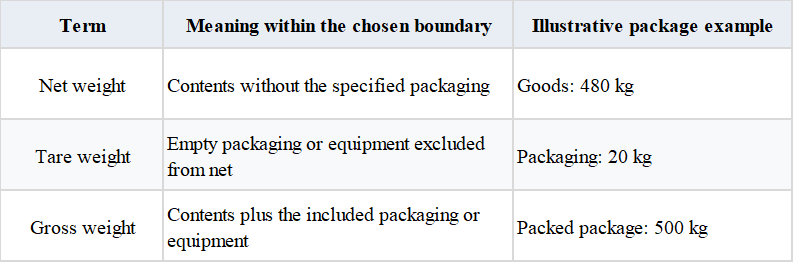
In this hypothetical example, gross equals net plus tare: 480 + 20 = 500 kg. Rearranging gives tare = gross − net, or 500 − 480 = 20 kg. The calculation is useful because both measurements refer to the same package and contents.
How Do You Determine Tare Weight?
Once the weight categories are clear, the next question is how to get the tare figure in practice. Depending on the shipment, it may come from markings, documents, or direct weighing.
Step 1. Define What Is Included in the Tare
List the empty items in the weighing setup: carton, pallet, container, or another receptacle. Specify whether removable fittings or reusable supports are included. Ask the document recipient what its net and gross fields mean. Continue when the same boundary is used for the tare figure and the corresponding contents.
Step 2. Weigh the Empty Packaging or Check Equipment Data
Weigh the empty item on suitable equipment, or use a verified specification for the actual unit where appropriate. For a freight container, identify its number and check the marked tare and operator information. Investigate a damaged, altered, or conflicting marking before relying on it for a regulated declaration. Retain the date and identification, and update the figure if the packaging or equipment changes.
Step 3. Cross-Check Gross Minus Net Using Matching Units
Subtract net contents from gross weight only after confirming identical boundaries and units. In a hypothetical package weighing 125 kg gross with 118 kg of contents, tare is 7 kg. Compare that result with the empty packaging record. Resolve any difference before transferring the figure into a packing or shipping document.
Where Can You Find a Shipping Container’s Tare Weight?
A shipping container's tare weight is usually printed on its door. You can also check shipping line records or equipment specifications when planning a shipment or verifying the weight.
l Container door markings: Look for the TARE WT marking, usually shown in kilograms (KG) and pounds (LB). Record the container number along with the tare weight, and take a photo for reference.
l Shipping line or container operator: If the marking is damaged or difficult to read, contact the shipping line or container operator. Provide the container number so they can check the equipment record for that specific unit.
l Equipment specifications: Shipping lines and container manufacturers publish specifications for common container types. These can provide estimated tare weights during shipment planning, although the actual weight may vary between containers of the same size.
If the displayed weight conflicts with the equipment records, ask the container operator to confirm the correct figure or arrange an appropriate weight check.
A freight forwarder can also help coordinate container information with the shipping line and prepare the necessary shipping documents. You can find a freight forwarder for your shipment through JCtrans when arranging container transportation.
How Does Tare Weight Affect Payload and VGM?
A container's tare weight affects how much cargo it can carry. Subtract the tare weight from the maximum gross weight to calculate the available payload. This capacity must cover the goods, packaging, pallets, and securing materials. Road and rail weight limits may further restrict how much you can load.
For example, a container with a maximum gross weight of 30,000 kg and a tare weight of 3,000 kg has a theoretical payload of 27,000 kg. If pallets, packaging, and securing materials weigh 1,000 kg, approximately 26,000 kg remains for the products themselves.
VGM (Verified Gross Mass) is the verified total weight of a packed container. Under the IMO's SOLAS guidelines, shippers can determine VGM using two methods:
l Method 1: Weigh the packed container using calibrated and certified equipment.
l Method 2: Add the verified weights of all cargo, packaging, pallets, and securing materials to the container's tare weight, following a method approved by the competent authority where the container was packed.
The shipper must provide the verified gross mass before vessel loading. For cargo that cannot be reliably weighed item by item, such as unpackaged bulk materials, Method 1 is generally the appropriate choice.
When you submit cargo details for a freight quote, specify whether the weight refers to the products alone, the packaged cargo, or an estimated loaded container. Include the cargo dimensions and packaging details to help freight forwarders assess your shipping requirements accurately.
Conclusion
A tare figure is useful only when it belongs to a clearly identified empty object and matches the boundary of the other weights. Correct arithmetic cannot fix a calculation that mixes product weight with packed cargo or equipment data.
Before issuing shipment instructions, label the object and units, confirm the allocated container’s information, and reconcile the packed load. If VGM is required, follow the applicable verification and submission process rather than treating a generic tare value as sufficient evidence.
Frequently Asked Questions
What Does the Tare Button on a Scale Do?
It offsets the weight currently on the scale so the displayed reading can show added contents without that receptacle. Confirm the scale is suitable and has enough capacity for the full physical load. Taring changes the displayed reference; it does not make the bowl, packaging, or other material physically weightless.
Do Tare Mass and Tare Wt Mean the Same Thing?
Yes. In container shipping, tare mass and tare wt refer to the same measurement: the weight of an empty container without cargo. “Tare wt” is commonly used on container door markings, while “tare mass” is the more precise technical term. Both describe the container’s empty weight, usually expressed in kilograms or pounds.
Do All Containers of the Same Size Have the Same Tare Weight?
No. Construction, equipment type, fittings, and modifications can change the empty weight even when nominal dimensions match. Use general specifications for early planning, then check the actual unit’s markings and operator record. Resolve conflicting data before preparing a loaded-mass declaration or final loading calculation.

Last
BCO Meaning in Shipping: The Cargo Owner's Role
BCO stands for beneficial cargo owner, the business with a direct commercial interest in the goods being shipped. Often an importe

Next
Training container loading warehouse managers on structural payload limitations based on a standard 40ft high load container stowage principle
What Is the 40ft High Load Container Stowage Principle for Warehouse Loading OperationsThe 40ft high load container stowage princi
