Vessels Reroute in the Strait of Hormuz as Tankers Shift North and Traffic Falls Well Below Normal Levels
Freight Knowledge
 19-Aug-2026
Shipping patterns in the Strait of Hormuz are changing. Following a series of recent attacks on commercial vessels, some shipowners have reduced their use of the southern route on the Omani side and shifted to the northern route through Iranian-controlled waters. At the same time, overall vessel traffic through the strait has fallen significantly. For the international shipping market, the routes vessels take and the number continuing to transit the strait are becoming new indicators of risk.
Key Highlights
• Northern route sees increased use: More vessels are choosing the route on the Iranian side.
• Risks rise on the southern route: Several recent attacks have occurred on the Omani side.
• Traffic falls significantly: Vessel traffic through the Strait of Hormuz is now well below normal levels.
• Engine rooms damaged in 12 attacks: Vessels face the risk of losing propulsion in the narrow waterway.
• U.S.–Iran tensions continue: Considerable uncertainty remains over future transit arrangements through the strait.
Why Are Shipowners Shifting to the Northern Route?
Vessels can use several routes through the Strait of Hormuz, including the northern route on the Iranian side, the southern route on the Omani side, and the traditional Traffic Separation Scheme (TSS).
Previously, some shipowners preferred the route on the Omani side and operated with security support coordinated by the United States. Recent attacks, however, have prompted some shipowners to reconsider that choice. According to UKMTO data, 18 attacks have been reported in and around the Strait of Hormuz since July 6, 16 of which occurred along the route on the Omani side.
Security assessments also indicate that 12 of the attacks primarily damaged engine rooms. For merchant vessels transiting the narrow strait, engine-room damage could result in a loss of propulsion, increasing the risk of losing control, grounding, or collision.
AIS Data Shows a Shift Toward the Northern Route
Actual vessel movements already reflect the change in route selection. During the seven days up to August 14, 75 outbound vessels and 76 inbound vessels were recorded in the Strait of Hormuz.
Of the outbound vessels, 19 used the northern route on the Iranian side, eight used the southern route on the Omani side, and two used the traditional Traffic Separation Scheme. Among inbound vessels, 26 used the northern route, while only five used the southern route.
The figures show that vessels have recently shown a clear preference for the northern route. However, this does not mean that the Iranian side has become a risk-free route. For shipowners, route selection remains a trade-off between different security and political risks.
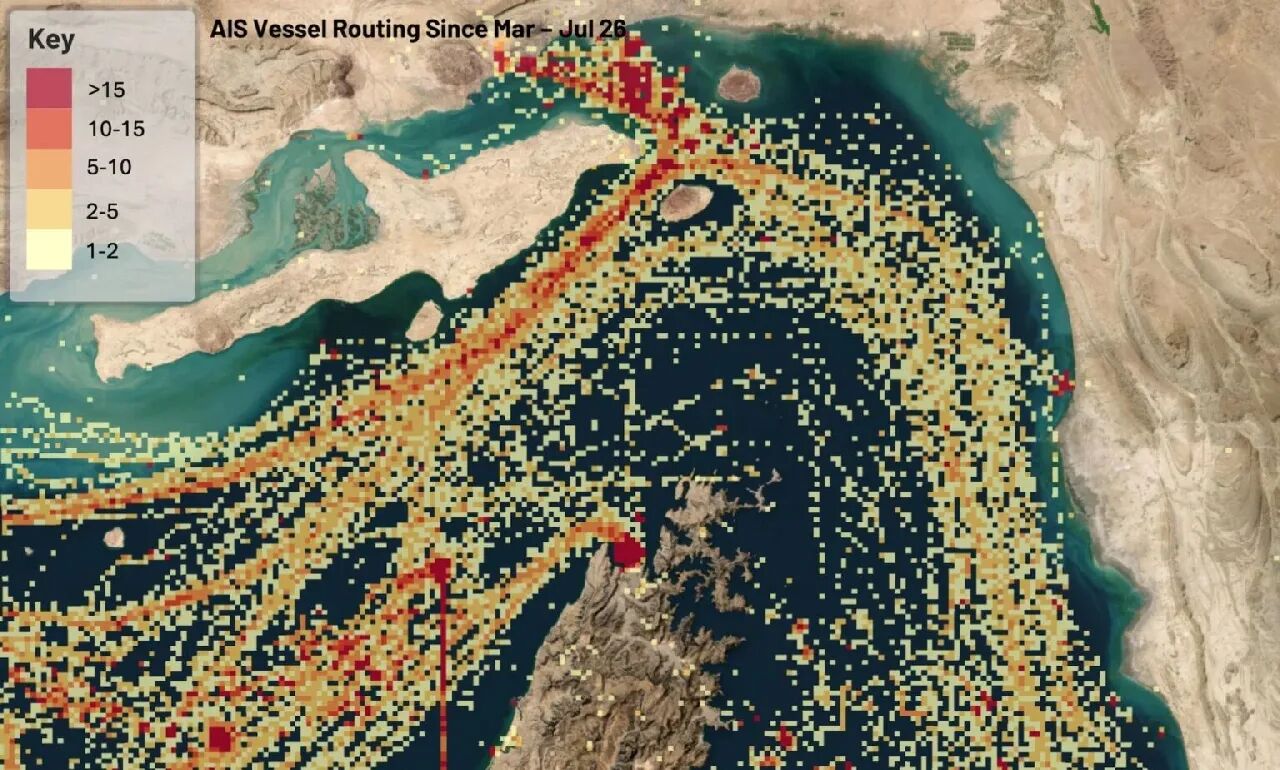 AIS data showing vessel activity through the Strait of Hormuz from March 1 to July 31, 2026. Darker colors indicate higher vessel density.
The More Significant Change Is the Decline in Overall Traffic
The decline in overall vessel traffic is more significant than the change in route selection. Under normal conditions, more than 130 vessels transit the Strait of Hormuz each day, but current shipping activity is well below normal levels.
During the seven days up to August 14, the number of vessels entering and leaving the strait remained low. Some shipowners have changed routes, while other vessels have delayed entering the strait. Tankers remain the main vessel type transiting the Strait of Hormuz, making the decline in traffic particularly important for shipments of crude oil, refined petroleum products, and other energy cargoes from the Gulf.
If this situation continues, the impact could extend beyond navigational safety to sailing schedules, capacity deployment, and energy shipping costs.
U.S. and Iranian Statements Add Uncertainty to the Resumption of Normal Transit
Changes in routes through the Strait of Hormuz are also closely linked to escalating tensions between the United States and Iran. On August 14, U.S. President Donald Trump made hard-line remarks regarding Iran and the Strait of Hormuz. Iran subsequently reiterated its control over the relevant waters.
Previous reports referred to specific remarks allegedly made on August 16 by senior Iranian military official Hatami regarding the entry of U.S. forces into the Persian Gulf, the Gulf of Oman, and the Strait of Hormuz. However, the publicly available information is currently insufficient to fully verify those remarks, and this article does not present independently unconfirmed statements as established fact.
For the shipping market, the more immediate concern is that the Strait of Hormuz remains a high-risk area. The market will need to monitor whether use of the northern route continues to increase, whether overall traffic recovers, and whether shipping companies resume routing vessels through the strait on a large scale.
If fewer vessels continue to enter the strait, the impact may extend beyond route selection to energy shipments, international shipping capacity, and related logistics costs.
Sources
UKMTO, JMIC, and publicly available industry information.
Disclaimer
This article has been compiled from publicly available information and is provided solely for industry reference. Specific navigation arrangements and security measures will be subject to the latest notices issued by shipping companies and maritime authorities.
Last
Yemen's Mocha Port Suspends Operations After More Than 25 Missile Strikes as Red Sea and Bab el-Mandeb Shipping Risks Rise
The latest developments along the Red Sea route have renewed industry concerns. According to Reuters on August 16, local time, Yem
Next
Wan Hai Lines Orders Eight Containerships for Nearly $1 Billion, with 11,000 TEU Newbuildings Scheduled for Delivery from 2029
Wan Hai Lines is expanding its containership fleet again. Lloyd’s List recently reported that the Taiwan-based liner operator has
