Tanker Grounded off Oman for Over a Month as Oil Spill Spreads Across More Than 2,000 Square Kilometers, Renewing Concerns over "Shadow Fleet" Risks
Freight Knowledge
 19-Aug-2026
A tanker carrying approximately 800,000 barrels of Russian crude oil has become the source of a serious marine pollution incident after remaining grounded off Oman for more than six weeks. The vessel, Caroline Bezengi, encountered problems near Yemen before grounding near Oman’s Al Hallaniyah Islands on June 30. The oil spill has now spread across more than 2,000 square kilometers and is threatening approximately 40 kilometers of coastline. Complicating the response further, the vessel is part of the “shadow fleet,” raising questions over insurance, sanctions, and responsibility for the salvage operation.
Key Highlights
• Pollution exceeds 2,000 square kilometers: The oil spill has spread toward Oman’s coast, threatening approximately 40 kilometers of coastline.
• Seven cargo tanks damaged: The vessel remains at risk of further structural failure, while the remaining crude oil continues to pose a major threat.
• Complex “shadow fleet” insurance: The vessel is insured by a sanctioned Russian insurance company.
• Sanctions hinder salvage operations: Salvors must obtain the relevant sanctions exemptions before intervening.
• Monsoon conditions narrow the response window: Adverse sea conditions are complicating structural assessments, pollution-control operations, and oil transfers.
Why Has the Spill Continued to Expand?
Caroline Bezengi is a Suezmax tanker approximately 25 years old and was carrying around 800,000 barrels of Russian crude oil at the time of the incident. On June 8, the vessel encountered problems near Yemen and subsequently became disabled. It drifted for several weeks before grounding near Oman’s Al Hallaniyah Islands on June 30.
Crude oil began leaking from the vessel after it grounded. Satellite imagery showed that, as of August 12, the spill had spread across more than 2,000 square kilometers and had begun moving toward Oman’s mainland coast. Approximately 40 kilometers of coastline is currently under threat, with areas near Ras Madrakah and Masirah Island also being closely monitored.
Not all the crude oil on board has leaked. According to available information, seven cargo tanks have been damaged, and the vessel remains at risk of further structural failure. If a large volume of the remaining cargo is released, the affected area could expand further and the cleanup effort could become more difficult.
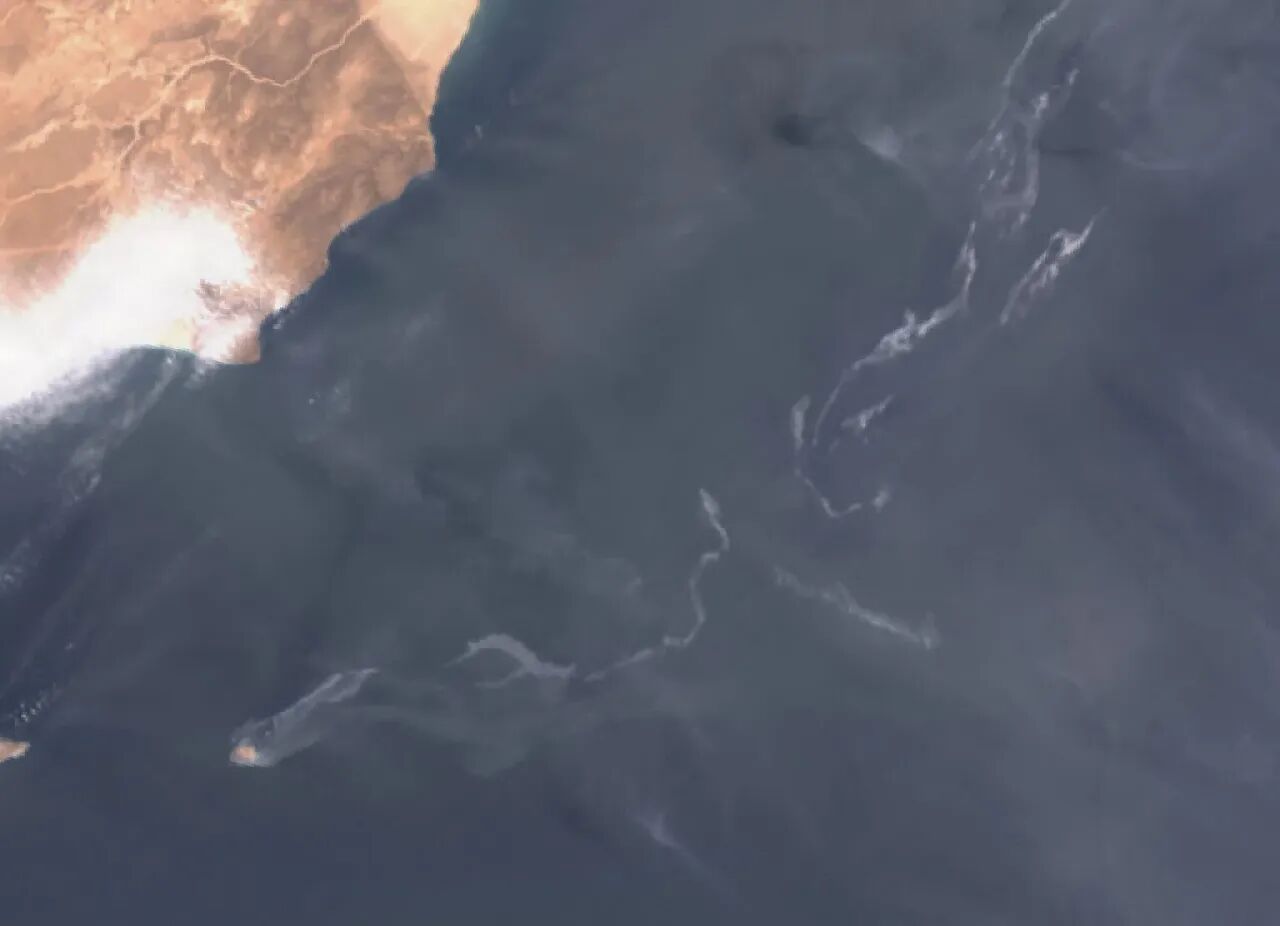 Satellite imagery taken on August 11, 2026, showed an oil spill off the coast of Oman.
Why Are “Shadow Fleet” Incidents More Difficult to Resolve?
Much of the complexity surrounding this incident stems from the tanker’s status. The “shadow fleet” is commonly used to transport sanctioned energy cargoes, and vessels in this fleet may be older, have complex ownership structures, and have non-standard insurance arrangements.
In this case, Lloyd’s List reported that Caroline Bezengi is insured by AlfaStrakhovanie, a sanctioned Russian insurance company. This means that salvors must obtain the relevant sanctions exemptions before beginning operations, making insurance issues a direct factor in the progress of the response.
The incident therefore involves more than determining who will tow the vessel. Questions also remain over who will bear the costs of salvage, pollution cleanup, and environmental damage, and whether the insurer will be able to respond to claims in practice. For sanctioned tankers, incident response and pollution compensation may face both legal and financial obstacles.
Salvage Operations Have Begun, but Time Is Running Short
On August 13, maritime risk management and emergency response company Ambrey announced its involvement in the response. Experts have boarded the vessel to assess the situation, while salvage equipment and response vessels are being mobilized. The next priorities are to stabilize the vessel, contain the pollution, and remove as much of the remaining crude oil as possible.
Southern Oman is currently in the Khareef monsoon season. Strong winds, high waves, and difficult sea conditions are complicating personnel access, equipment deployment, and oil-transfer operations. The International Maritime Organization previously stated that monsoon conditions had restricted responders’ ability to approach the vessel and had delayed operations.
Considerable uncertainty therefore remains. If the vessel stays structurally stable, the response team may still be able to contain the pollution. However, further structural damage could result in a larger release of the remaining cargo.
“Shadow Fleet” Risks Extend from Shipping to Environmental Damage
The Caroline Bezengi incident is more than an isolated tanker grounding. As sanctioned energy trade continues, the safety and environmental risks associated with the “shadow fleet” are receiving increasing attention.
These risks may not be immediately apparent during normal operations. However, once a collision, explosion, grounding, or crude oil spill occurs, responsibility among shipowners, cargo owners, insurers, salvors, and coastal states can quickly become more complex.
How the salvage operation will ultimately be completed, how the remaining crude oil will be handled, and who will be responsible for pollution compensation involving the sanctioned tanker remain subject to further investigation and confirmation by the relevant authorities.
Sources
Lloyd’s List, Reuters, the International Maritime Organization, and publicly available industry information.
Disclaimer
This article has been compiled from publicly available information and is provided solely for industry reference. Responsibility for the incident, insurance coverage, and compensation will be subject to the final findings of the relevant authorities.
Last
Wan Hai Lines Orders Eight Containerships for Nearly $1 Billion, with 11,000 TEU Newbuildings Scheduled for Delivery from 2029
Wan Hai Lines is expanding its containership fleet again. Lloyd’s List recently reported that the Taiwan-based liner operator has
Next
U.S. East Coast Ocean Freight Rates Near $9,000 as Iran and Oman Announce a New Transit Plan for the Strait of Hormuz-Where Are Rates Headed in the Second Half of the Year?
Changes to vessel traffic through the Strait of Hormuz continue to affect the global container shipping market. Iran recently reit
