Strait of Hormuz Shipping Alert! Successive Security Incidents Raise Risks to LNG and Energy Shipping
Logistics News
4-Aug-2026
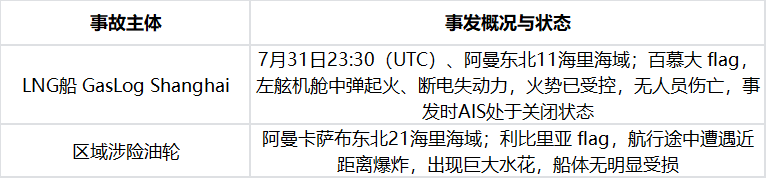
Security concerns have again emerged along a key global energy shipping route. On July 31 local time, two vessel security incidents occurred in succession near the Strait of Hormuz. An LNG carrier was struck by an unidentified projectile, caught fire and lost propulsion, while a nearby tanker encountered an explosion at close range.
As a key passage for global oil and gas transportation, the Strait of Hormuz is facing rising security risks. The incidents may increase war risk insurance costs for energy shipping and prompt carriers to tighten risk control standards for Middle East services.
• Main incident: An LNG carrier was struck and caught fire, resulting in a blackout and loss of propulsion; all crew members were safe
• Successive incidents: A tanker in the same area encountered an explosion at close range, further increasing regional tensions
• Carrier concerns: Two LNG carriers operated by the same company have experienced security incidents within a short period
• Industry impact: Rising risks to energy shipping may lead to adjustments in insurance premiums, services and transport costs

Introduction: A major energy carrier experienced a serious incident along a main shipping route, significantly reducing navigational safety in the Strait of Hormuz.
According to reports from UKMTO, Vanguard and other maritime organizations, the LNG carrier GasLog Shanghai was fully laden with Qatari LNG. After calling at ports in Qatar and Kuwait, the vessel was sailing eastbound after transiting the Strait of Hormuz when it was struck by an unidentified projectile.
The projectile struck the port-side engine room and caused a fire, followed by a blackout and loss of propulsion. Following emergency response measures, the fire was extinguished. All crew members were safe, the vessel was reported to be stable, and no fuel or gas leakage or pollution was reported.
The vessel’s AIS signal was switched off at the time of the incident, making it more difficult to trace the incident and handle the situation at the scene.
Freight forwarders may use the Inquiry Board to identify stable capacity and reduce the impact of unexpected shipping-route risks on service fulfillment.
Introduction: Two security incidents involving vessels operated by the same company within a short period highlight risks at both energy ports and major shipping routes.
The incident in the Strait of Hormuz was not an isolated case. Another LNG carrier operated by GasLog, GasLog Salem, had previously caught fire while calling at the Port of Damietta in Egypt. The incident also affected a floating storage and regasification unit in the port area.
Industry organizations assessed that the incident may have involved a drone attack. Although Egyptian authorities did not officially determine the source of the incident, the two successive events have highlighted the security risks facing vessels carrying energy cargo.
From port calls to open-water navigation, risks across the energy shipping process are increasing, while the stability of energy logistics routes in the Middle East and North Africa is declining.

Introduction: The Strait of Hormuz carries a significant volume of global oil and gas transportation, and local incidents can quickly affect global supply chains.
The Strait of Hormuz connects the Persian Gulf with the Gulf of Oman and is a key passage for global crude oil and LNG exports, directly affecting energy supplies to countries across Asia and Europe.
The latest security incidents may lead to higher war risk surcharges, tighter carrier navigation policies for high-risk waterways, longer energy transport turnaround times and higher overall operating costs.
The strait has not experienced a large-scale closure or a complete interruption of transportation. However, regional uncertainty continues to increase, and market participants remain cautious.
Operational Checklist for Freight Forwarders
• Continue monitoring navigation conditions in the Strait of Hormuz and maritime security warnings
• Closely follow carrier service adjustments in the Middle East and notices concerning changes to war risk surcharges
• Review transport arrangements for energy cargo and prepare alternative routing options in advance
• Inform customers promptly of shipping-route risks and assess potential schedule delays and cost increases
Action Summary
The successive incidents in the Strait of Hormuz indicate a renewed increase in risks to energy shipping in the Middle East. Disruption along the passage may continue to increase energy logistics costs and cause greater schedule volatility.
Freight forwarders should regularly monitor regional developments and changes in carrier policies, adjust shipment arrangements for Middle East services where necessary, and use suitable capacity resources to mitigate unexpected risks and maintain stable transportation of energy cargo.
Sources: Seatrade Maritime, Vanguard, UKMTO and official carrier announcements
Disclaimer: All information is obtained from publicly available sources and is provided for industry reference only. It does not constitute commercial or logistics operational advice.

Last
Black Sea Services Significantly Reduced! Hapag-Lloyd Suspends Ukraine Feeder Services as Major Carriers Scale Back Operations
Security risks in the Black Sea continue to worsen, prompting major liner companies to scale back their shipping operations in Ukr

Next
Black Sea Shipping Risks Escalate! FESCO Container Ship Attacked and Sunk as Regional Route Risk Controls Tighten
On August 1, the container ship Yanina, operated by Russia’s FESCO Group, was attacked by drones and sank in international waters