August Container Shipping Market Shifts: Spot Rates Decline for a Third Consecutive Week as MSC and Maersk Adjust Charges Across Major Trade Lanes
Logistics News
4-Aug-2026
The container shipping market is entering a key period of structural change in August. Global spot freight rates have declined for a third consecutive week, while growth in traditional peak-season demand has slowed noticeably. At the same time, MSC and Maersk are increasing Peak Season Surcharges (PSS) across several major trade lanes. This divergence between falling base freight rates and rising surcharges marks a departure from a one-directional market and signals a more differentiated stage of competition. It also provides an important reference for freight forwarders planning August space bookings, route quotations, and shipments.
• Market Trend: Container spot rates decline for a third consecutive week as peak-season restocking demand weakens and market conditions begin to normalize
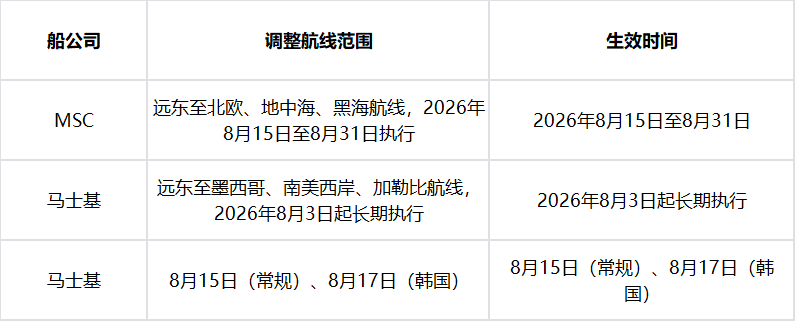
• Carrier Actions: MSC and Maersk adjust PSS across key trade lanes covering Europe, the Mediterranean, the Black Sea, the Middle East, and Latin America
• Pricing Rationale: The adjustments are not simply general rate increases, but part of a revised pricing structure intended to offset persistently high operating costs
• Industry Trend: Differences between trade lanes will become more pronounced in August as costs, demand, and capacity continue to interact

Introduction: The effect of peak-season restocking is weakening, capacity is gradually returning to the market, and spot rates remain under pressure, with clear differences between trade lanes.
According to gCaptain, global container spot freight rates have declined for a third consecutive week. The Red Sea diversion premium and concentrated peak-season restocking demand that previously supported higher rates have gradually weakened. At the same time, new capacity continues to enter the market, while cargo volumes on major trade lanes have fallen short of expectations, keeping the overall supply-demand balance relatively loose.
The current rate decline varies significantly between trade lanes and is not a market-wide fall. Established European and North American trade lanes have sufficient capacity and face greater pricing pressure, while cargo demand on Middle East, Black Sea, and Latin America routes remains relatively stable and resilient. The widening differences in supply and demand are prompting major carriers to move away from uniform rate adjustments and adopt route-specific pricing strategies. Freight forwarders may use the Company Directory to identify suitable freight forwarding companies and reduce exposure to market fluctuations.
Introduction: The surcharge increases do not indicate a reversal in the market. Carriers are using surcharges to offset fixed costs and balance overall revenue as base freight rates decline.
Against the backdrop of falling spot rates, major carriers are making frequent adjustments to Peak Season Surcharges. Although these changes appear to run against the wider market, they reflect carriers’ efforts to manage operating risks. Container shipping costs remain high due to geopolitical disruption in the Red Sea, route diversions, fuel price volatility, port congestion, and lower vessel turnaround efficiency. Base freight rates alone may no longer cover overall operating expenses.
Carriers are therefore increasingly allowing base freight rates to follow market conditions while using surcharges as a more stable revenue component. This approach responds to weaker spot-market conditions and helps maintain reasonable shipping costs for cargo owners while allowing carriers to cover basic route costs and reduce the risk of wider losses. It also protects earnings on routes with more stable demand and offsets stronger rate competition on established trade lanes, helping balance revenue across the fleet.

Introduction: The market is moving away from a one-directional rate pattern and entering a period shaped by demand, costs, and capacity.
The container shipping market is no longer following a simple upward or downward rate pattern. Slower demand continues to limit the potential for spot rates to rise, while high operating costs and geopolitical uncertainty continue to support carrier surcharge structures. A broad market-wide increase or decline is therefore unlikely in the short term. Differences in rates and earnings between trade lanes will be a key feature of the August market.
For freight forwarders, focusing only on base ocean freight is no longer sufficient. They also need to monitor carrier PSS adjustments, the pace at which capacity is released after the peak season, schedule reliability, and changes in space availability. Quotation strategies and shipment plans should be adjusted according to conditions on each trade lane.
Operational Self-Check List for Freight Forwarders
• Are you distinguishing between market conditions on different trade lanes and adjusting customer quotations accordingly?
• Are you monitoring PSS changes from major carriers in real time to avoid omitting additional costs from quotations?
• Have you secured stable space in advance to manage repeated market fluctuations in August?
• Have you explained the differences between trade lanes to customers and provided appropriate shipment timing recommendations?
Action Summary: The main features of the August container shipping market are greater differences between trade lanes and frequent rate adjustments. Freight forwarders should move away from a simple rising-or-falling market view and closely monitor carrier surcharges, route-level supply and demand, and operating cost trends. They should adjust quotations and shipment plans flexibly and use suitable carrier resources to offset market fluctuations and improve the stability of order intake and fulfillment.
Sources: Official announcements from MSC and Maersk, gCaptain, and authoritative cross-border shipping industry platforms
Disclaimer: All information is sourced from publicly available channels and is provided for industry reference only. It does not constitute commercial or logistics operational guidance.

Last
Drought Halts Navigation on Dutch Canal! Hapag-Lloyd Imposes Temporary Inland Surcharge as European Inland Transport Costs Rise
European inland logistics are being disrupted by drought. The Eefde lock on the Twente Canal in the Netherlands has been closed du

Next
Dardanelles Traffic Suspended After Bulk Carrier Grounds, Raising Schedule Risks for Freight Forwarders on Black Sea Routes
A key shipping passage serving the Black Sea was temporarily disrupted. On July 29 local time, a San Marino-flagged bulk carrier s