Breaking: Houthis Claim Attack on Saudi Tanker as Bab el-Mandeb Traffic Falls by Half, Reshaping Red Sea Shipping
Logistics News
31-Jul-2026
Security risks in the Red Sea continue to escalate. On July 28, the Houthis claimed that they had attacked the Saudi-flagged tanker NCC GHAZAL. According to the group, this was the fourth Saudi-linked tanker targeted since it announced a maritime blockade of Saudi ports on July 20. The series of reported attacks has continued to affect market confidence. Meanwhile, the latest shipping data shows a significant decline in vessel traffic through the Bab el-Mandeb Strait. Red Sea shipping risks are no longer limited to individual security incidents but are affecting actual transit volumes, energy transportation and tanker freight rates.
At the same time, traffic through the Strait of Hormuz remains at a low level, placing pressure on two key Middle Eastern maritime routes. Diversions are extending voyage distances and slowing vessel turnaround, while tanker charter rates are rising. The impact of geopolitical conflict is gradually shifting from a security concern to a recurring operational challenge that freight forwarders and shippers must manage over the longer term.
• Escalating situation: The Houthis claim a fourth attack, targeting the Saudi-flagged tanker NCC GHAZAL.
• Sharp decline in traffic: Vessel tonnage through the Bab el-Mandeb Strait has fallen by a further 50% from the second-quarter average, while VLCC transits have declined significantly.
• Pressure on two routes: Traffic through the Strait of Hormuz remains extremely low, restricting two major global energy transportation corridors.
• Freight-rate impact: Longer diversions are increasing vessel demand, while VLCC and VLGC charter rates continue to rise.
• Changing risk profile: Red Sea risks are shifting from a short-term security threat to a long-term operational risk requiring continuous planning.
On July 20, the Houthis announced a maritime blockade of Saudi shipping and threatened to target vessels calling at Saudi ports. A series of reported incidents followed the announcement. According to Seatrade Maritime on July 27, a tanker was attacked after completing loading at the Saudi port of Yanbu. The vessel’s name was not disclosed.
On July 28, the Houthis issued another statement claiming that they had attacked the Saudi-flagged tanker NCC GHAZAL. Martin Kelly, an analyst at EOS Risk Group, said that the vessel was reportedly targeted by an anti-ship missile while sailing in the southern Red Sea and subsequently reversed course.
The Houthis claimed that the vessel was targeted for violating their maritime restrictions on Saudi shipping. According to the group, it was the fourth Saudi-linked tanker attacked since the blockade was announced.
However, the unilateral claim should be treated with caution. The Maritime Executive reported on July 28 that the United Kingdom Maritime Trade Operations office, or UKMTO, had issued an alert concerning an unidentified tanker near Jizan, Saudi Arabia. Crew members reportedly heard an explosion, but neither the vessel nor its crew was harmed, and no marine pollution was reported.
UKMTO did not confirm that the vessel involved was NCC GHAZAL and did not identify the party responsible.
As of publication, neither the Saudi authorities nor relevant companies, including Bahri, had publicly confirmed the reported attack.
Based on the available information, the Houthis have claimed a fourth attack on a Saudi-linked tanker. Maritime security information indicates that NCC GHAZAL may have been targeted by a missile and subsequently turned back, but the full details have not been independently confirmed by all parties involved.
Compared with reports of individual attacks, changes in vessel traffic provide a clearer indication of market risk avoidance.
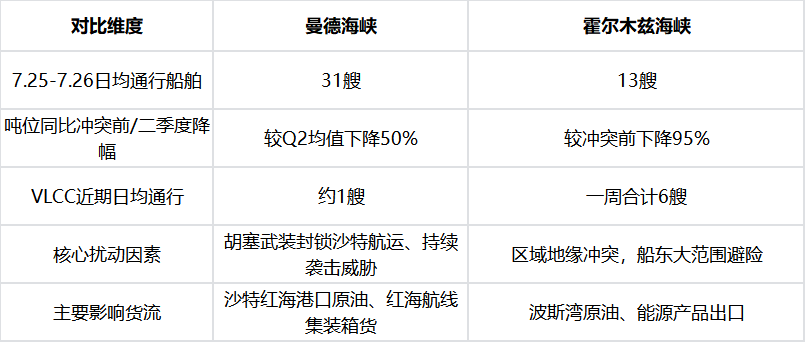
According to Clarksons Research, an average of approximately 31 vessels per day entered or exited the Bab el-Mandeb Strait between July 25 and 26. By vessel tonnage, this represented a further decline of approximately 50% from the already reduced average recorded in the second quarter of 2026.
The decline in very large crude carrier traffic was even more pronounced. Steve Gordon, Global Head of Research at Clarksons Research, said that only about one VLCC per day passed through the Bab el-Mandeb Strait during the previous week, compared with approximately three per day in the second quarter.
Following the Houthis’ announcement of restrictions on Saudi shipping, risk-avoidance measures have continued to increase. The security situation is now directly affecting vessel-routing decisions.
While traffic through the Bab el-Mandeb Strait is declining, traffic through the Strait of Hormuz also remains extremely low.
Clarksons Research data shows that an average of approximately 13 vessels per day passed through the Strait of Hormuz during the July 25–26 weekend. Vessel numbers were down 90% from pre-conflict levels, while vessel tonnage had fallen by more than 95%.
Only six VLCCs passed through the Strait of Hormuz during the previous week, representing a decline of approximately 95% from normal levels.
Crude oil export volumes have also contracted. Approximately one million barrels of crude oil per day have recently departed the Persian Gulf, well below the approximately 10 million barrels per day recorded in early July and the pre-conflict level of 15 million barrels per day.
The simultaneous decline in traffic through both maritime chokepoints means that current pressure on Middle Eastern shipping is no longer limited to isolated incidents. The Bab el-Mandeb Strait connects the Red Sea with surrounding shipping routes, while the Strait of Hormuz is a key route for crude oil exports from the Persian Gulf. Restrictions affecting both energy corridors are increasing uncertainty for global seaborne crude oil transportation.

If large volumes of Saudi crude oil cannot be transported to Asian markets through the Red Sea, vessels may have to divert around the Cape of Good Hope, significantly extending voyage distances.
According to Clarksons data, crude oil exports from the Saudi port of Yanbu have recently reached approximately 3.8 million barrels per day. If a substantial volume of this cargo is diverted around the Cape of Good Hope, some voyage distances could approach twice the length of the original route.
Longer voyages directly extend vessel turnaround times. Transporting the same cargo volume therefore requires more vessels, reducing effective market capacity. The tanker charter market has already responded.
According to Clarksons Research, during the previous week:
• VLCC daily charter rates rose by 13% to approximately USD 145,000 per day.
• VLGC spot charter rates rose by 24% to approximately USD 172,000 per day.
Market reports also indicated that two DHT-operated VLCCs had been chartered at USD 226,000 and USD 241,000 per day respectively. However, Tankers International later stated that neither transaction was ultimately confirmed.
Overall, geopolitical risks in the Red Sea and the wider Middle East are affecting tanker prices by extending voyage distances, slowing vessel turnaround and reducing effective capacity.
Current Traffic Conditions at Two Key Middle Eastern Chokepoints

Over the past two years, the Red Sea crisis has mainly affected container shipping, with many carriers diverting vessels around the Cape of Good Hope.
As reported attacks on Saudi shipping continue, the challenges facing the market are becoming more complex. Shipowners and freight forwarders must now consider more than vessel safety. They must also assess whether vessels should continue transiting the Red Sea, whether long-term diversion plans are required, how much additional time diversions may involve, and how additional fuel costs, war-risk insurance premiums and other operating expenses should be allocated.
Red Sea shipping risks are shifting from a direct security threat to an ongoing operational issue that carriers, international trading companies and freight forwarders must continue to manage.
For container shipping, if low traffic levels through the Bab el-Mandeb Strait continue, it will become increasingly difficult for major carriers to restore direct Red Sea services. For energy transportation, continued diversions will absorb vessel capacity and may further increase overall shipping costs.
Logistics operators should continue monitoring three key developments:
• Whether vessel traffic through the Bab el-Mandeb Strait continues to decline.
• Whether carriers expand the scope or extend the duration of their diversions.
• Whether geopolitical security risks continue to affect freight rates, surcharges and war-risk insurance premiums.
The latest Houthi attack claim, combined with the sharp decline in Bab el-Mandeb traffic, has increased uncertainty on Middle Eastern shipping routes. Relevant companies should adjust their shipping plans and prepare contingency arrangements.
1. Monitor Vessel-Routing Decisions
Closely monitor the routes used by vessels serving the Red Sea and Persian Gulf. Confirm in advance whether shipowners plan to divert around the Cape of Good Hope and assess the risk of extended sailing schedules.
2. Recalculate Total Logistics Costs
Diversions increase fuel consumption, voyage duration and war-risk insurance premiums. Companies should not assess shipments based only on base freight rates.
Total end-to-end logistics costs should be recalculated, and overseas customers should be informed promptly of expected cost changes.
3. Prepare Alternative Transportation Plans
For Middle Eastern energy cargo and general international trade cargo, companies should prepare multiple alternative routes in advance to reduce fulfillment risks caused by disruption to a single shipping corridor.
To obtain cargo information for different routes and connect with transportation solutions, users may post their requirements on the Inquiry Board and engage with multiple service providers.
4. Follow Authoritative Maritime Updates Closely
Companies should distinguish between unilateral statements issued by armed groups and information verified by UKMTO, port authorities or other official sources.
Shipping plans should not be adjusted solely on the basis of unconfirmed reports.
Three Operational Questions for Freight Forwarders
• Have customers with current Middle East shipments been informed of Red Sea transit risks and possible sailing delays?
• Has the additional transit time and total cost of diverting around the Cape of Good Hope been assessed?
• Are alternative route plans available if traffic through both key chokepoints remains at a low level?
Overall, the Houthis’ claim that they attacked a Saudi tanker has introduced further uncertainty into the Red Sea situation. The significant decline in vessel traffic through the Bab el-Mandeb Strait shows that risk-avoidance measures are becoming routine.
If traffic through both the Bab el-Mandeb Strait and the Strait of Hormuz remains low, the market will no longer be dealing only with short-term disruption. Geopolitical risks affecting Middle Eastern shipping routes will increasingly be reflected in the long-term pricing of global shipping.
For freight forwarders and exporters, route selection alone is no longer sufficient. Transit times, schedule reliability, insurance costs and surcharge fluctuations must also be assessed continuously. This is the main impact of the latest developments on the international logistics industry.
Sources
Publicly available information from Clarksons Research, UKMTO, EOS Risk Group, Seatrade Maritime and The Maritime Executive.
Disclaimer
All information is sourced from publicly available channels and is provided for industry reference only. It does not constitute commercial or logistics operational advice.

Last
Maersk Takes Delivery of Its First VLAC: First Very Large Ammonia Carrier Marks a Shift in Clean-Energy Shipping
Global clean-energy shipping is developing rapidly, with the maritime transport of liquefied ammonia and other new-energy gases be

Next
Breaking: Sulfuric Acid Chemical Tanker Explodes and Catches Fire Offshore; All 15 Crew Members Safe, No Leakage or Pollution Reported, Cause Under Investigation
On July 28 local time, a chemical tanker accident occurred in Norwegian waters. The Norwegian-flagged chemical tanker Bergstraum,