ONE Updates EC3 US East Coast Port Rotation with New Ningbo Call, Expanding East China Export Options
Logistics News
29-Jul-2026
Global liner networks continue to undergo detailed optimization, with ONE introducing an important update to its US East Coast service.
Ocean Network Express (ONE) recently issued a service update announcing a revised rotation for its core EC3 US East Coast service. The adjustment focuses on the Asian port rotation, adding a call at Ningbo and changing the order of the Asian origin ports to address the previous lack of a direct US East Coast connection from East China.
This is neither a new service launch nor a service suspension. It is an optimization of ONE’s existing network. However, the change will affect booking procedures, cut-off times, sailing schedules, and overseas delivery arrangements. Freight forwarders and other cross-border logistics companies must therefore update their operating procedures and shipment plans.
The EC3 update reflects ONE’s continued efforts to improve the reliability and regional coverage of its US East Coast service. By strengthening its East China port coverage, the carrier can better balance cargo volumes and vessel turnaround across the transpacific network while providing customers with more flexible and potentially lower-cost shipping options between East Asia and the US East Coast.
• Network optimization: ONE has announced an updated rotation for its EC3 US East Coast service, adding Ningbo as a new port of call.
• Revised port rotation: The Asian port sequence has been adjusted to create two main export gateways in North and East China.
• Confirmed implementation sailing: The revised rotation will take effect on a designated sailing, with clear schedule milestones.
• Improved delivery reliability: The adjustment is intended to improve vessel turnaround and reduce the risk of delays spreading across multiple ports.
• Operational updates required: Booking, cut-off times, ETD/ETA data, and final-mile delivery arrangements must all be updated.
Key conclusion: This is an update to an existing service rather than a new route launch. Ningbo has been added to ONE’s main US East Coast service, expanding direct shipping options for cargo from East China.
According to ONE’s official update issued on July 23, the EC3 US East Coast service has introduced a revised service rotation.
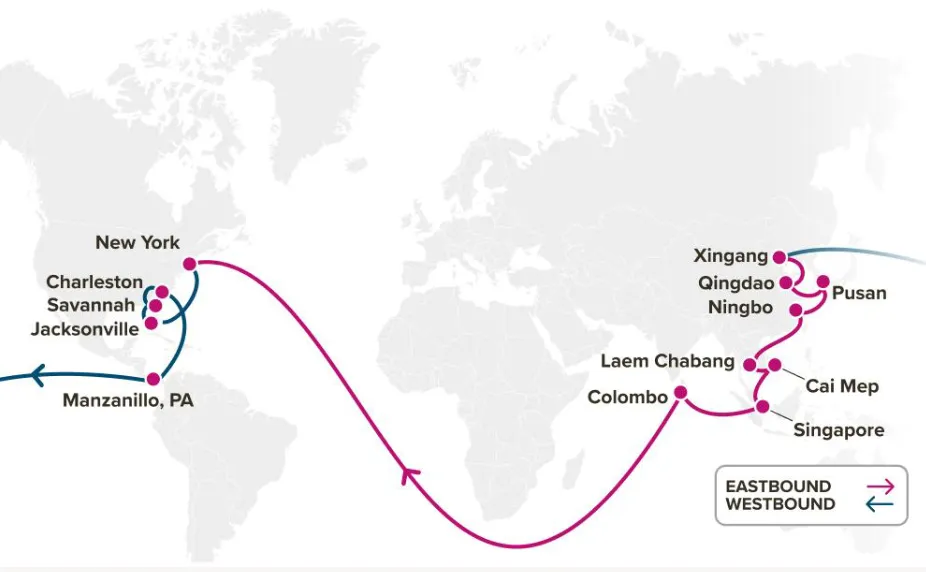
The service retains its established Asia–Indian Ocean–US East Coast route. Only the Asian origin ports and their sequence have been adjusted, while the existing US East Coast port coverage remains unchanged.


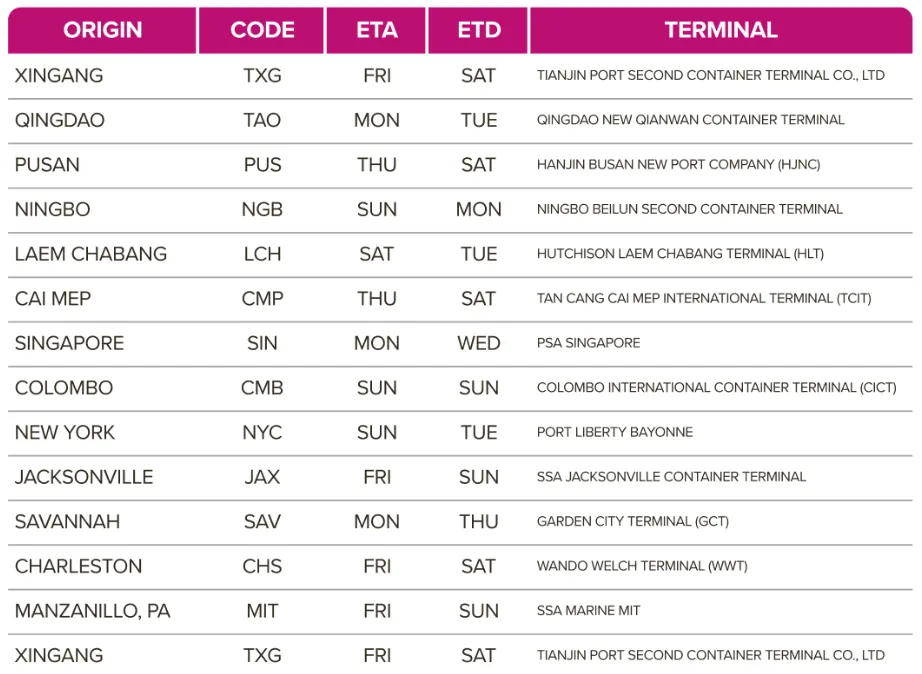
The latest EC3 port rotation is:
Xingang – Qingdao – Busan – Ningbo – Laem Chabang – Cai Mep – Singapore – Colombo – New York – Jacksonville – Savannah – Charleston – Panama – Manzanillo – Xingang

The revised rotation will take effect with the HMM PERIDOT 0010W/0011E sailing.
Key schedule milestones have also been published. The vessel arrived in New York on July 24 and is expected to return to Xingang on September 11 after completing the full rotation.
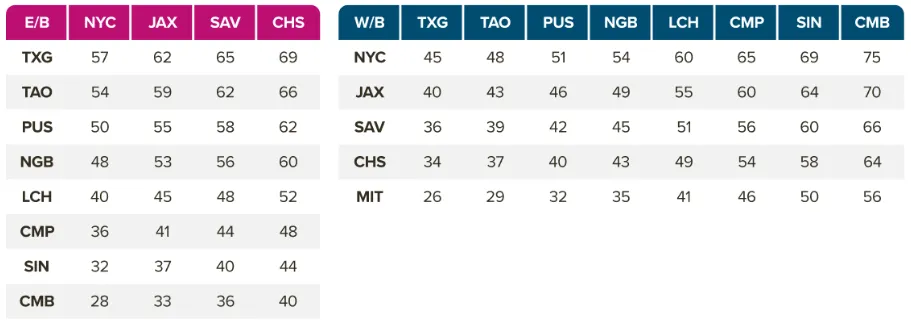
The overall service cycle remains stable and predictable, making it easier for freight forwarders to plan long-haul cross-border deliveries.
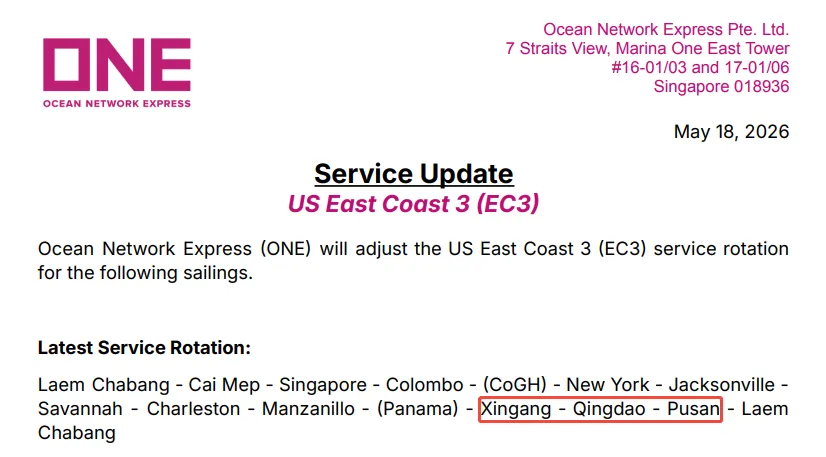
Compared with the previous rotation introduced on May 18, the latest adjustment addresses the lack of an East China port call.
Under the previous EC3 rotation, the service called at Xingang, Qingdao, and Busan in Northeast Asia before proceeding through Southeast Asia. Cargo from East China had no direct loading point and had to rely on transshipment or alternative services.
By adding Ningbo to the main rotation, the revised service creates coordinated export coverage across North and East China and better matches the distribution of major cargo origins in East Asia.
ONE has described the adjustment as an “updated service rotation.” The main service structure, US East Coast port coverage, and trunk-route arrangement remain unchanged.
Key Changes: Expanded Port Coverage and Revised Rotation Strengthen East China–US East Coast Shipping
Key conclusion: The addition of Ningbo fills a gap in regional port coverage and improves vessel turnaround and cargo allocation, benefiting both carrier operations and cross-border shipments.
The reliability of long-haul liner services depends heavily on balanced cargo volumes, well-planned port rotations, and efficient vessel turnaround.
Although the EC3 adjustment adds only one port call, it reflects ONE’s continued optimization of its US East Coast service.
For the carrier, distributing cargo across multiple origin ports can reduce cargo concentration, terminal congestion, and pressure around cut-off times at individual ports.
The revised rotation can also improve sailing and berthing schedules, reduce unnecessary turnaround time, support schedule reliability, and lower the risk of delays spreading across multiple ports.
The update also brings practical benefits for freight forwarders and cross-border companies.
Previously, US East Coast cargo from East China relied heavily on transshipment. This meant a longer logistics chain, more operating stages, greater schedule volatility, higher indirect costs, and less control over cargo movements.
With Ningbo added to the main service rotation, cargo from East China can move directly to key US East Coast ports, including New York, Jacksonville, Savannah, and Charleston.
This simplifies the logistics chain, shortens overall transit times, and reduces the risks of cargo damage and delays during transshipment.
Key conclusion: Changes to the mainline port rotation affect more than the ocean leg. They also change delivery schedules throughout the cross-border logistics chain, requiring corresponding updates to destination operations.
The revised EC3 service continues to cover four major commercial ports on the US East Coast, reflecting the importance of this trade in transpacific commerce.
Compared with shorter US West Coast services, US East Coast routes involve longer voyages, more intermediate points, and greater exposure to external disruption.
They therefore place greater demands on schedule reliability, terminal efficiency, intermodal connections, and integrated warehousing and distribution at destination.
Even minor changes to vessel schedules or port rotations can affect container pickup, rail transfers, trucking, warehouse appointments, and final delivery.
For time-sensitive cargo involving e-commerce, retail, and manufacturing orders, overseas buyers often work with fixed inventory and delivery schedules.
If freight forwarders continue using the previous sailing schedule or outdated ETA data when arranging destination services, they may face schedule mismatches, failed connections, cargo delays, and late deliveries.
The global liner industry has entered a period of optimizing existing networks. Carriers are no longer focusing only on expanding capacity or launching new services.
Instead, they are improving network reliability through revised port rotations, port coverage adjustments, and schedule changes.
These adjustments may not cause significant short-term freight rate movements, but they can change regional shipping patterns and delivery requirements.
Over time, they may support more standardized transit times, more detailed service planning, and a wider range of shipping options for US East Coast cargo.
Key conclusion: Freight forwarders must stop relying on the previous EC3 operating arrangements and update booking, schedule verification, and destination services to match the revised rotation.
Following ONE’s latest US East Coast service adjustment, cross-border logistics companies should update operating procedures throughout the process, from booking to final delivery.
This will help reduce operating errors, customer complaints, and fulfillment losses caused by outdated information.
Update Sailing and Transit-Time Databases
Remove the previous EC3 port rotation, ETD/ETA data, and cut-off schedules.
For cargo departing from Xingang, Qingdao, and Ningbo, verify the latest departure time, transit time, and documentation and customs cut-off requirements for each sailing and shipment.
All booking information, transit-time information provided to customers, and carrier schedule data should remain consistent.
Match Delivery Plans to US East Coast Destination Ports
New York, Savannah, Jacksonville, and Charleston serve different inland markets.
Freight forwarders should select destination ports based on the final delivery location, customer requirements, and current port congestion.
If a port experiences congestion, slow terminal operations, or berthing delays, an alternative port arrangement should be available to maintain delivery continuity.
Freight forwarders can also use the platform’s Company Directory to identify local service providers with established US East Coast customs clearance, trucking, and overseas warehousing resources.
This can improve their ability to respond to disruptions.
Update Overseas Logistics Arrangements Across the Full Transport Chain
Domestic trucking, customs declaration, terminal operations, destination container pickup, rail transfers, warehouse management, and final-mile delivery should all be adjusted according to the revised schedule.
Sufficient buffer time should be allowed for long-haul ocean services.
For orders with fixed delivery windows, several schedule options should be prepared in advance to prevent minor sailing adjustments from disrupting the entire logistics chain.
Key Differences Between the Previous and Revised EC3 Service Models
From the perspective of freight forwarders managing cross-border operations, the EC3 update improves the coverage and operating structure of ONE’s US East Coast service.
The previous rotation had limited origin-port coverage, and cargo from East China depended heavily on transshipment.
This reduced flexibility and created greater uncertainty in costs, transit times, and exception handling, making it more difficult for freight forwarders to coordinate deliveries for customers in different markets.
The revised port structure allows cargo from North and East China to be distributed more effectively.
It also supports more balanced vessel turnaround and more stable schedule performance, improving predictability for cross-border deliveries.
For freight forwarders, the main benefit is greater flexibility in shipment planning.
Origin and destination ports can now be selected according to cargo volume, cargo location, customer transit-time requirements, and cost considerations.
This reduces dependence on a single shipping option and improves the ability to match services to customer requirements.
At the same time, the service update raises operating requirements.
The previous port rotation and transit-time data are no longer applicable. Freight forwarders must maintain updated route databases and closely follow network changes announced by major carriers.
Detailed operational management is required to meet cross-border delivery requirements.
Three Self-Check Questions for Freight Forwarders
• Have all data been updated? Have the previous EC3 port rotation, cut-off requirements, and transit-time standards been fully replaced to prevent operations based on outdated information?
• Have current orders been reviewed? Have booking and shipment plans for customers in East China been adjusted following the addition of Ningbo as a direct port of call?
• Have all supporting arrangements been updated? Have domestic and overseas trucking, warehousing, customs clearance, and final-mile delivery arrangements been adjusted accordingly?
Industry Summary
Overall, the global liner market has entered a period of detailed and dynamic network optimization.
Carrier service adjustments are no longer limited to capacity and freight rates. They increasingly focus on port coverage, vessel turnaround, and delivery reliability.
Freight forwarders must monitor mainline service changes, adapt quickly to revised operating requirements, and adjust cross-border delivery plans.
These measures can help reduce operating risks, improve service quality, and maintain competitiveness in long-haul US East Coast logistics.
Sources: Official ONE announcement, authoritative cross-border logistics industry platforms, World Ports
Disclaimer: This content is based on publicly available information and is provided for industry reference only. It does not constitute commercial or logistics operating advice.

Last
Maersk and Hapag-Lloyd Revise Tango Service: Direct Salvador Call Removed and Pecem Added to Mainline Rotation
Global liner networks continue to be adjusted, with an important change announced for the US East Coast–East Coast South America t

Next
Red Sea Shipping Risks Escalate: RCL Cancels Sailing and Invokes Force Majeure; Shippers to Bear Additional Costs
Security conditions in the Red Sea have deteriorated again, with regional shipping risks escalating from delay warnings to actual