Global Container Freight Rates Continue Decline Amid Trade Uncertainty
Logistics News
 24-Aug-2025
As of August 21, the Drewry World Container Index fell 4% to $2,250 per 40-foot container, marking the tenth consecutive week of decline and signaling continued market stabilization after a period of high volatility.
Following the U.S. announcement of additional tariffs in April, the market experienced turbulence, driving freight rates to a peak in May through early June. Rates then sharply declined, and by mid-July, the downward trend began to lose momentum.
This week, transpacific rates dropped noticeably, with Shanghai–Los Angeles falling 3% to $2,412/FEU and Shanghai–New York down 5% to $3,463/FEU. Drewry noted that U.S. retailers’ accelerated buying for the peak season has ended, and they are now scaling back purchases in response to the slowing U.S. economy and higher tariff costs.
Asia-Europe trade lanes also declined, with Shanghai–Rotterdam down 6% to $2,973/FEU and Shanghai–Genoa down 3% to $2,978/FEU. Despite healthy demand and port delays in Europe, growing vessel overcapacity continues to pressure rates.
Drewry expects supply-demand balance to weaken in the second half of 2025, potentially causing further spot rate contractions. Future rate movements will largely depend on any new tariffs from Trump and capacity adjustments related to U.S. sanctions on Chinese vessels.
The broader impact of tariff policies is evident in cargo volumes. According to the National Retail Federation’s (NRF) Global Port Tracker, imports at major U.S. container ports are projected to decline 5.6% in 2025 compared with 2024.
NRF Vice President Jonathan Gold warned: “Tariffs are driving up consumer prices, and reduced imports will ultimately mean fewer goods on store shelves. Small businesses, in particular, are struggling to stay afloat. We need binding trade agreements that open markets by lowering tariffs rather than raising them.”
This uncertain trade environment is disrupting global shipping networks. Ben Hackett, founder of Hackett Associates under NRF’s Global Port Tracker, described the situation as “intermittent tariff policies,” creating confusion for importers, exporters, and consumers.
Recent port activity reflects these effects. U.S. ports handled 1.96 million TEUs in June, down 8.4% YoY, but accelerated imports ahead of August tariffs pushed July throughput to an estimated 2.3 million TEUs. A sharp decline is expected for the remainder of 2025, with November projected at 1.71 million TEUs, the lowest level since April 2023.
Last
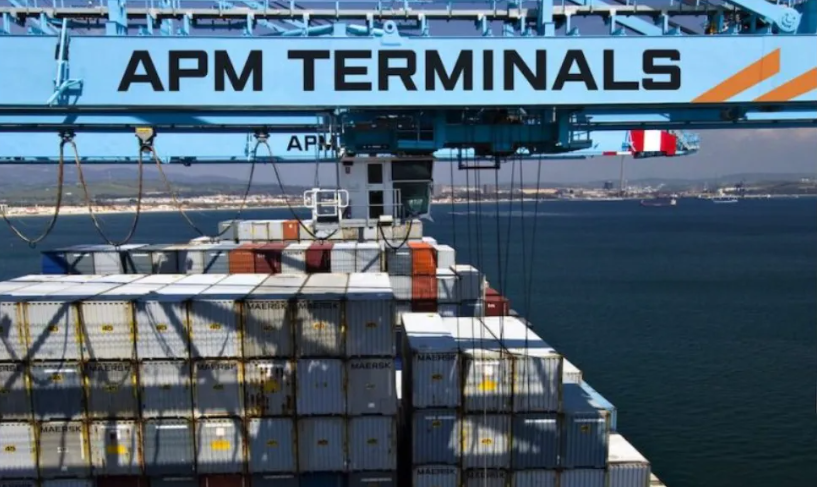
Maersk s APM Terminals to Invest $1 Billion in Three Key Ports in Andhra Pradesh
APM Terminals, a Maersk company, has signed a Memorandum of Understanding (MoU) with the Andhra Pradesh Maritime Board to invest I
Next
日前,外部消防队已经登上了“MARIE MAERSK”号集装箱船,并正在与船上船员一起扑救已经燃烧了一周的火灾。根据马士基最新更新,这艘巨型集装箱船目前在利比里亚南部海岸锚地。马士基确认火灾已被控制,但尚未完全扑灭。这艘船的避难港仍未确定。事件发生在8月13日
